Best Types of Commercial Roofing Materials by Climate Zone
Discover which types of commercial roofing materials perform best in specific climate zones, from hot deserts to snowy regions and coastal areas.
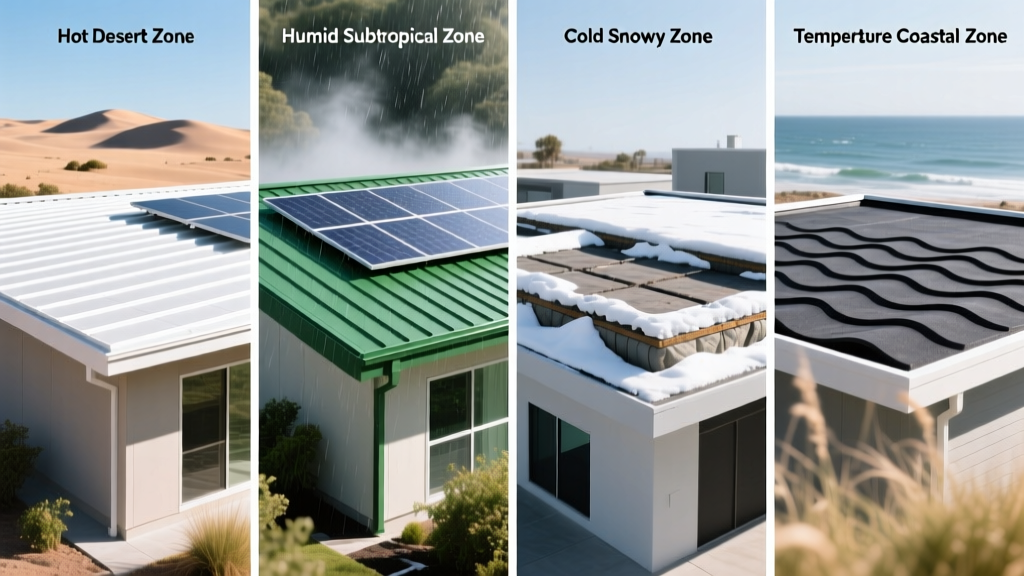
The Climate-Material Matching Matrix
Commercial roof failures rarely stem from inherently defective materials; they occur when a system is mismatched to local environmental stress vectors. A membrane that excels in the Pacific Northwest will degrade rapidly in the Sonoran Desert. Selecting the right types of commercial roofing materials requires analyzing solar absorptance, thermal cycling limits, wind uplift ratings, and hydrostatic resistance. The matrix below maps primary climate zones to their optimal commercial roofing systems and the materials that must be avoided.
| Climate Zone | Primary Stressors | Optimal Material Systems | Materials to Avoid |
|---|---|---|---|
| Hot & Arid (Southwest US) | UV degradation, thermal shock, sustained 160°F+ surface temps | PVC, Premium TPO (80-mil+), Reflective Metal | Standard 60-mil TPO, Uncoated Black EPDM |
| Cold & Snow-Heavy (Northeast US, Canada) | Freeze-thaw cycling, ice damming, heavy snow loads | Black EPDM, SBS Modified Bitumen | Mechanically fastened single-ply (without vapor barriers) |
| Coastal & Hurricane (Gulf, Southeast) | Wind uplift, salt spray corrosion, driving rain | Standing Seam Metal, Fully Adhered PVC | Ballasted systems, standard carbon-steel fasteners |
| Temperate & High-Rain (Pacific Northwest) | Ponding water, algae/moss, low-slope drainage issues | Heat-Welded PVC, Fluid-Applied Polyurethane | TPO with taped seams, gravel-surfaced BUR |
Hot & Arid Climates: Combating UV and Thermal Shock
In regions like Arizona, Nevada, and West Texas, commercial roofs face extreme ultraviolet radiation and severe thermal shock. Surface temperatures on uncoated roofs can exceed 170°F during summer afternoons, then drop rapidly at night. This expansion and contraction causes seam fatigue and membrane splitting.
Recommended Systems: PVC and Premium TPO
Polyvinyl Chloride (PVC) membranes, such as Sika Sarnafil S3015 or Carlisle Sure-Weld PVC, are the gold standard for extreme heat. PVC features a high melting point and utilizes hot-air welded seams that create a monolithic, chemically bonded joint stronger than the membrane itself. This prevents seam peeling under intense UV exposure.
If budget constraints necessitate Thermoplastic Polyolefin (TPO), standard 60-mil TPO will likely fail within 7-10 years in these zones due to top-ply delamination. Instead, specify premium formulations like GAF EverGuard Extreme (80-mil), which includes specialized UV stabilizers and a thicker weathering surface to withstand sustained high-heat environments.
Cold & Snow-Heavy Climates: Freeze-Thaw and Ice Dams
Facilities in Minnesota, New York, and southern Canada must prioritize freeze-thaw resilience and snow-load management. The primary goal is to prevent snowpack from melting and refreezing at the eaves, which creates ice dams that force water backward under the membrane.
Recommended Systems: Black EPDM and SBS Modified Bitumen
While cool roofs dominate southern markets, black Ethylene Propylene Diene Monomer (EPDM) is highly effective in cold climates. A 60-mil black EPDM system, such as Carlisle SynTec, boasts a solar absorptance of up to 85%. This intentional heat absorption helps melt the snowpack uniformly, reducing the structural load and minimizing ice dam formation. Furthermore, EPDM remains highly flexible at temperatures as low as -40°F, preventing the brittle cracking seen in some plastics.
For buildings with high foot traffic or complex penetrations, SBS (Styrene-Butadiene-Styrene) Modified Bitumen is superior. The rubberized asphalt modifiers allow the material to stretch and recover during freeze-thaw cycles without losing its granular surfacing.
Cold Climate Decision Framework
- Choose Black EPDM if: The roof is a simple, large, unobstructed box (e.g., a warehouse) with minimal penetrations, and you want to offset winter heating costs via passive solar gain.
- Choose SBS Mod-Bit if: The roof has heavy HVAC traffic, numerous pipe penetrations, or requires a multi-layer redundant waterproofing barrier (e.g., a 2-ply torch-applied system over Polyiso insulation).
Coastal & High-Wind Zones: Uplift and Salt Corrosion
Facilities along the Gulf Coast and Atlantic seaboard face dual threats: catastrophic wind uplift from tropical systems and accelerated corrosion from salt aerosols. The types of commercial roofing materials deployed here must meet stringent FM Global or UL wind uplift ratings while utilizing non-corrosive components.
Recommended Systems: Standing Seam Metal and Fully Adhered PVC
A 24-gauge Galvalume standing seam metal roof, such as the McElroy Metal Ultra-Dek system, is engineered for hurricane zones. The concealed clip design allows the metal panels to expand and contract while transferring wind uplift forces directly to the structural deck. For coastal applications, it is critical to specify stainless steel or heavily polymer-coated fasteners; standard zinc-plated screws will corrode within five years in a salt-spray environment, leading to panel detachment.
Temperate & High-Rainfall Zones: Ponding and Biological Growth
In the Pacific Northwest and parts of the Midwest, roofs endure prolonged drizzle, high humidity, and low-slope ponding water. The primary failure modes here are capillary action drawing water through seams, and biological growth (algae and moss) degrading the roof surface.
Recommended Systems: Heat-Welded PVC and Fluid-Applied
Ponding water is the enemy of taped seams and liquid adhesives. PVC membranes utilize hot-air welding (typically at 900°F to 1,100°F depending on ambient humidity), creating a watertight bond that is entirely impervious to standing water. According to the National Roofing Contractors Association (NRCA), while most single-ply manufacturers void warranties if water ponds for more than 48 hours, properly welded PVC systems routinely outlast their warranties even in poor drainage scenarios.
For domed roofs, complex curbs, or structures where sheet goods are difficult to flash, Fluid-Applied Polyurethane systems provide a seamless, monolithic membrane that cures into a durable rubber-like shell, eliminating seams entirely and resisting moss adhesion.
2026 Commercial Roofing Cost & Lifespan Breakdown
The following pricing reflects Q1 2026 national averages for fully installed commercial systems, including tear-off of one existing layer, installation of 2-inch Polyiso insulation (R-26 to meet modern IECC energy codes), and the membrane. Regional labor variances and supply chain fluctuations may affect final bids by ±15%.
| Material System | Installed Cost (Per Sq. Ft.) | Expected Lifespan | Best Climate Match | Maintenance Requirement |
|---|---|---|---|---|
| TPO (60-mil to 80-mil) | $8.50 - $12.50 | 15 - 25 Years | Temperate, Mild | Annual seam inspections |
| PVC (50-mil to 60-mil) | $11.00 - $15.50 | 20 - 30+ Years | Hot, Humid, High-Rain | Low (wash to remove debris) |
| EPDM (60-mil) | $8.00 - $11.50 | 20 - 30 Years | Cold, Snow-Heavy | Bi-annual tape/adhesive checks |
| SBS Modified Bitumen (2-Ply) | $9.50 - $13.50 | 20 - 25 Years | Cold, High-Traffic | Coating reapplication at yr 10 |
| Standing Seam Metal (24-ga) | $15.00 - $24.00 | 40 - 60 Years | Coastal, High-Wind, Snow | Fastener/clip checks post-storm |
Code Compliance and Sourcing Standards
When specifying commercial roofing materials, facility managers and architects must align material choices with local building codes and energy standards. The U.S. Department of Energy's Cool Roof guidelines mandate high solar reflectance index (SRI) values for flat roofs in southern climate zones to mitigate the urban heat island effect and reduce cooling loads. Conversely, the EPA's Heat Island Effect guidelines note that cool roofs in northern climates can cause a "winter heating penalty," validating the use of dark EPDM in zones 5 and above.
Always verify that the specified membrane carries an active FM Approvals or UL listing for the specific wind and fire ratings required by your local jurisdiction. Requesting a custom warranty that covers ponding water, high-wind blow-offs, and specific chemical exposures (such as grease from restaurant exhaust fans) is critical for long-term asset protection.
Written by
Sarah WhitfieldSarah Whitfield is a chartered quantity surveyor (MRICS) and construction cost analyst with 15 years of experience in material pricing, procurement strategy, and project budgeting. She earned her degree in Construction Management from the University of Reading (UK) and has worked on projects ranging from $2M custom homes to $180M mixed-use developments across North America and Europe. Sarah currently leads cost estimating for BuildMat Insight, maintaining a proprietary database of 4,000+ material price points updated quarterly. She is a frequent contributor to RSMeans cost data panels and has presented at the International Cost Engineering Council (ICEC) congress. Based in Denver, CO, Sarah is an avid trail runner and volunteer mentor for Women in Construction.
More from Sarah Whitfield
View all
Wood & Lumber
What Are the Different Types of Wood? A Builder's Guide
Compare structural softwoods, finish hardwoods, and engineered lumber. Analyze Janka ratings, MOE values, and 2026 pricing for construction.
Aug 4, 2026

Walls & Panels
Steel Framing vs Wood Framing: Corrosion and Moisture Defense
Compare steel framing vs wood framing for moisture resistance. Learn about galvanized coatings, condensation risks, and corrosion protection strategies.
Jul 21, 2026

Stone & Masonry
How to Cut Stone Veneer: Wet Saw vs Grinder Comparison
Compare the best tools for cutting stone veneer. We review wet saws, angle grinders, and chop saws to help you achieve clean, chip-free cuts.
Jul 21, 2026