How to Evaluate LeafGuard Roof Drainage Solutions for Installation
Learn how to evaluate LeafGuard roof drainage solutions. This installation guide covers fascia requirements, roof pitch limits, and costs.

The Mechanics of LeafGuard’s Reverse-Curve System
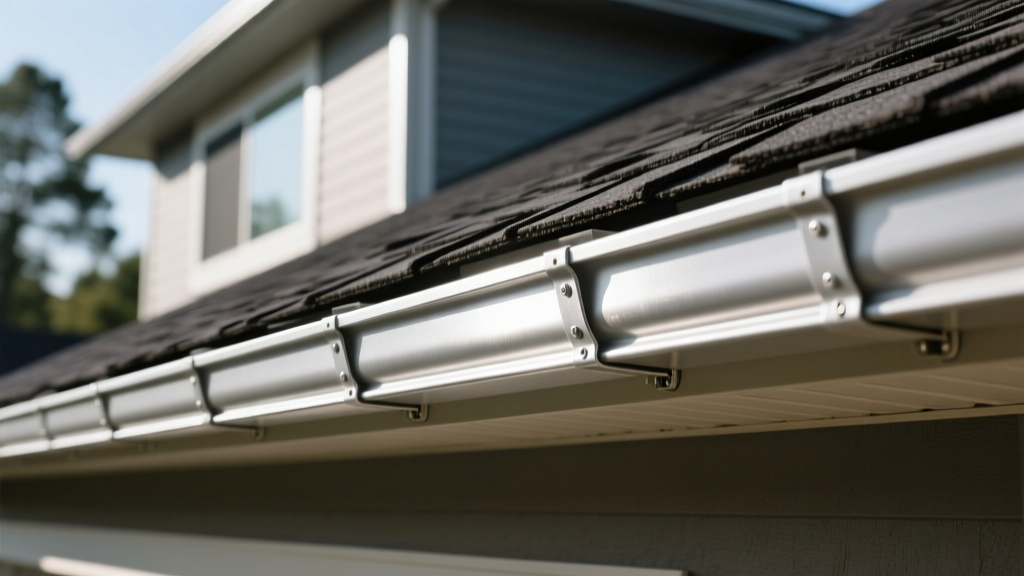
When you evaluate the construction materials company LeafGuard on roof drainage solutions, you must look beyond their consumer marketing and examine the engineering from an installation perspective. LeafGuard utilizes a reverse-curve (or surface tension) design, which relies on the molecular adhesion of water. As rainwater hits the curved hood, it clings to the surface and wraps around the lip into the gutter trough, while debris falls to the ground.
Unlike retrofit micro-mesh screens that sit on top of existing gutters, LeafGuard is a complete tear-off and replacement system. The hood and trough are manufactured as a single, continuous piece of .032-gauge aluminum. This thickness is substantially heavier than the .019-gauge or .024-gauge aluminum used in standard builder-grade gutters, providing superior structural rigidity but demanding a more robust mounting infrastructure.
Pre-Installation Roof and Fascia Evaluation
The most common point of failure in reverse-curve gutter installations is improper substrate preparation. LeafGuard’s proprietary internal hanging brackets do not mount to the roof deck; they screw directly into the vertical fascia board. Therefore, the condition and geometry of your fascia dictate the viability of this system.
Roof Pitch Compatibility Matrix
Surface tension systems require adequate water velocity to carry debris over the hood's lip. Roof pitch directly influences this velocity. According to guidelines referenced by the Insurance Institute for Business & Home Safety (IBHS), proper drainage sizing and pitch alignment are critical to preventing overflow.
| Roof Pitch | LeafGuard Performance | Installation Adjustment Required |
|---|---|---|
| Steep (8/12 or greater) | Excellent. High water velocity sheds debris efficiently. | Install drip edge extensions to prevent water from overshooting the hood. |
| Standard (4/12 to 7/12) | Optimal. Matches the engineered design parameters. | Standard installation protocol; tuck hood 1/4 inch under the first course of shingles. |
| Low (2/12 to 3/12) | Moderate. Debris shedding decreases; pine needles may cling to the hood. | Increase downspout frequency to maximize draw; consider micro-mesh alternatives. |
| Flat (< 2/12) | Poor. Insufficient velocity for surface tension adhesion. | Do not install. Use internal scuppers or parapet drainage systems instead. |
Step-by-Step Installation Process Evaluation
LeafGuard is exclusively sold and installed through a network of certified dealers, meaning DIY installation is not an option. However, general contractors and project managers evaluating bids must understand the installation sequence to ensure quality control.
- Tear-Off and Disposal: Existing gutters and spikes are completely removed. The contractor must inspect the exposed fascia for hidden rot caused by previous ice damming or overflow.
- Fascia Preparation: The wood is scraped clean, dried, and treated with a wood preservative if necessary. A custom-bent aluminum fascia wrap (coil stock) is often applied at this stage to protect the wood and provide a clean aesthetic backer for the gutter.
- Bracket Mounting: Internal hanger brackets are screwed into the fascia every 24 inches on-center. This is a critical differentiator; standard gutters often use hangers spaced 36 to 48 inches apart. The 24-inch spacing prevents the heavy aluminum from sagging under snow loads.
- On-Site Seamless Extrusion: The dealer brings a specialized truck-mounted extrusion machine. Coils of .032-gauge aluminum are fed through the machine, forming the continuous hood-and-trough profile to the exact measured length of each roof run. This eliminates mid-run seams, which are the primary failure points for leaks in traditional systems.
- Downspout Integration: The system requires 3x4-inch downspouts (standard systems use 2x3-inch). The larger cross-sectional area is mandatory to handle the high-volume capture rate of the wide hood without creating a hydraulic bottleneck at the drop outlet.
Hydraulic Capacity and Debris Shedding Performance
LeafGuard advertises the ability to handle up to 32 inches of rain per hour. Independent testing by organizations like This Old House confirms that reverse-curve systems excel in heavy, wind-driven downpours where micro-mesh screens often suffer from surface-blinding (where water sheets over the top of wet debris rather than passing through it).
By utilizing 3x4-inch downspouts and 3x4-inch drop outlets (compared to the industry-standard 2x3-inch), a LeafGuard system increases the drainage exit volume by approximately 85%. This prevents trough overflow during microburst weather events common in the Southeastern and Midwestern United States.
The Pine Needle and Oak Catkin Edge Cases
While the system handles broad-leaf debris (maple, oak leaves) exceptionally well, it faces challenges with specific botanical profiles. In regions heavily populated by Eastern White Pine or Loblolly Pine, the long, fibrous pine needles can mat together on the hood's curve. Instead of falling to the ground, the needles interlock, forming a porous dam that allows water to flow through but traps subsequent debris. Similarly, oak catkins (the stringy spring blossoms) can adhere to the wet aluminum hood. For homes situated directly under dense pine canopies, a heated gutter cable system installed beneath the hood may be required to facilitate winter debris shedding.
Cost Analysis: LeafGuard vs. Competitor Systems
Evaluating the financial investment requires comparing LeafGuard against other premium drainage solutions. Pricing fluctuates based on regional labor rates, roof complexity, and linear footage, but the following 2026 market averages provide a reliable baseline for budgeting.
| System Type | Avg. Installed Cost (Per Linear Ft.) | Material Gauge | Warranty Structure |
|---|---|---|---|
| LeafGuard (Reverse Curve) | $22 - $32 | .032 Aluminum | Lifetime Transferable (Clog-Free) |
| Gutter Helmet (Reverse Curve) | $18 - $26 | .024 Aluminum | Lifetime (Non-Transferable) |
| Premium Micro-Mesh (Retrofit) | $12 - $18 | Surgical Steel Mesh | 25-Year Material |
| Standard Seamless K-Style | $8 - $14 | .027 Aluminum | 10 to 20-Year Leak |
The premium pricing of LeafGuard is justified by the on-site seamless manufacturing process, the heavier gauge aluminum, and the structural integrity of the 24-inch on-center hidden bracket system. However, for homeowners on a strict budget with standard tree cover, high-quality stainless steel micro-mesh retrofits offer a more cost-effective return on investment.
Long-Term Maintenance and Warranty Realities
LeafGuard backs its system with a "No-Clog" guarantee, promising to clean the gutters for free if they ever clog. From a facility management perspective, this transfers the liability of ladder work and maintenance back to the dealer. However, the warranty has specific caveats that must be evaluated during the contract review phase.
The warranty typically excludes clogs caused by structural alterations to the roof (such as adding a new dormer without updating the gutter sizing), damage from extreme weather events (like hurricanes or ice dams that physically crush the hood), and failure to maintain the downspout exit points. If the underground drainage pipes or splash blocks become blocked, causing water to back up into the 3x4 downspout, the resulting gutter overflow will void the clog warranty. Project managers must ensure that the site's overall stormwater management plan, including French drains and dry wells, is functioning correctly to support the high-volume output of the LeafGuard system.
Final Verdict for Construction Professionals
Evaluating LeafGuard requires recognizing it as a premium, heavy-duty architectural drainage system rather than a simple gutter accessory. Its .032-gauge seamless construction and robust internal bracket system make it an excellent choice for new construction, high-end renovations, and properties with steep roof pitches and heavy broad-leaf tree cover. It is less suited for low-pitch roofs, tight budget constraints, or properties overwhelmed by fibrous pine needles. By ensuring the fascia is structurally sound and the downspout routing is adequately sized, contractors can confidently specify LeafGuard as a permanent, maintenance-free roof drainage solution.
Written by
Elena RodriguezElena Rodriguez is a civil engineer and technical writer specializing in concrete technology, masonry systems, and ASTM/ACI compliance. She earned her B.S. in Civil Engineering from Texas A&M University and spent a decade at a materials testing laboratory, performing over 2,000 concrete compressive strength tests and masonry prism evaluations. Elena is an ACI-certified Field Testing Technician (Grade I) and a member of ASTM Committee C12 on Natural Building Stone. She currently consults on forensic engineering cases involving concrete failures and moisture intrusion. Based in San Antonio, TX, Elena is a proud member of the Society of Women Engineers (SWE) and coaches her daughter's FIRST Robotics team.
More from Elena Rodriguez
View all
Walls & Panels
Cost Analysis: Light Gauge Steel Framing Advantages and Disadvantages
Evaluate light gauge steel framing advantages and disadvantages through a strict cost analysis lens, comparing material, labor, and lifecycle expenses.
Aug 4, 2026

Walls & Panels
Gypsum Board Types: Exact Specifications, Thickness & Dimensions
Compare standard, Type X, and moisture-resistant gypsum board types. Get exact specifications, thicknesses, dimensions, and ASTM standards for your project.
Aug 4, 2026

Fire Resistance
Best Fire-Resistant Outdoor Decking Materials: 2026 Buyer Guide
Discover the best fire-resistant outdoor decking materials for 2026. Compare Class A PVC, aluminum, and hardwood options for WUI compliance and safety.
Aug 4, 2026