How to Choose the Right Type Roof Material for Your Climate
Discover which type roof material withstands your local weather. Compare costs, durability, and climate-specific roofing systems for 2026.

The Climate-Roofing Connection: Why Geography Dictates Material
Selecting the correct type roof material is not merely an aesthetic choice; it is a structural defense mechanism against your specific regional environment. A material that performs flawlessly in the arid Southwest will suffer catastrophic failure in the freeze-thaw cycles of the Northeast. In 2026, with material costs averaging between $4.50 and $35.00 per square foot installed, making a climate-aligned decision prevents premature degradation, voided warranties, and exorbitant energy bills.
This guide breaks down the exact material specifications, industry standards, and product categories required for the four primary North American climate zones.
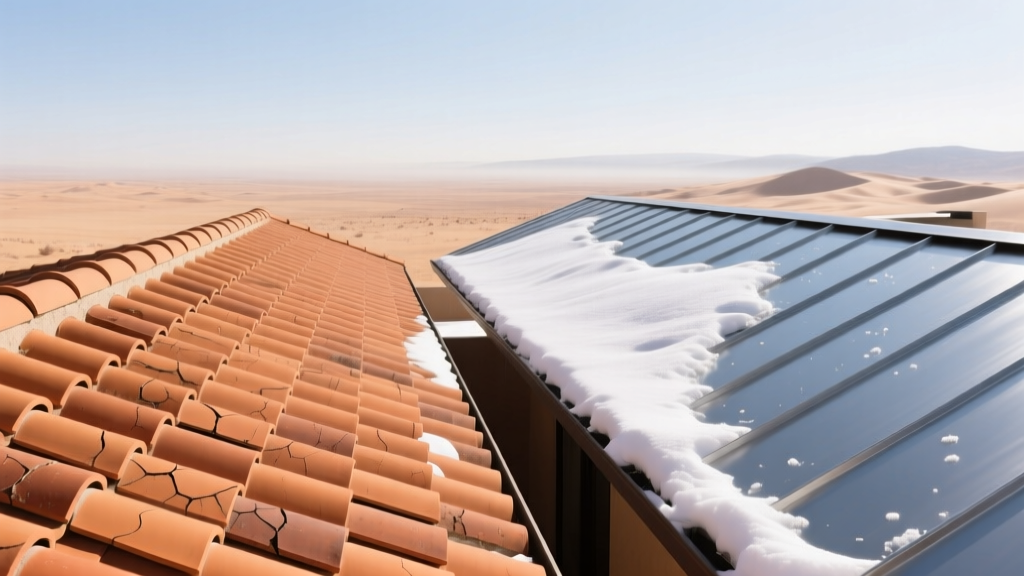
Hot and Arid Zones: Beating UV Degradation and Heat Gain
In regions like the American Southwest, the Middle East, and parts of Australia, roofs face relentless ultraviolet (UV) radiation and extreme thermal shock (temperature swings of 40°F or more between day and night). The primary enemies here are asphalt binder desiccation and thermal expansion.
Recommended Materials and Specifications
- Clay and Concrete Tile: Brands like Ludowici or Boral offer exceptional thermal mass. Ensure tiles are rated for high UV exposure. Concrete tiles should have a minimum compressive strength of 4,000 psi.
- TPO/PVC Membranes (Flat Roofs): For commercial or low-slope residential, use a minimum 60-mil thick Thermoplastic Polyolefin (TPO) membrane. Look for a Solar Reflectance Index (SRI) of 82 or higher.
- Cool-Coated Standing Seam Metal: Specify PVDF (Kynar 500) paint systems with high infrared-reflective pigments to keep attic temperatures down.
Cold and Snow-Load Regions: Managing Ice Dams and Thermal Shock
Northern climates present a dual threat: massive static loads from snow accumulation and the destructive freeze-thaw cycle that causes ice damming. The wrong type roof material here will lead to water infiltration, sheathing rot, and interior damage.
Recommended Materials and Specifications
- 24-Gauge Standing Seam Metal: The smooth, interlocking profile allows snow to shed uniformly. Ensure the system uses concealed clips that allow for thermal expansion and contraction without backing out fasteners.
- Architectural Asphalt Shingles: Must be rated ASTM D3462 for high tear strength. Standard 3-tab shingles are strictly prohibited in these zones due to wind uplift and ice vulnerability.
- Synthetic Slate: Products like DaVinci Roofscapes resist impact from falling ice and do not absorb water, eliminating the spalling and cracking seen in natural slate during freeze-thaw cycles.
The Underlayment Imperative
In snow-heavy regions, the roof covering is only half the system. You must install a self-adhering polymer-modified bitumen membrane (commonly known as ice and water shield, such as Grace Ice & Water Shield) extending at least 36 inches past the interior warm wall line in all eaves, valleys, and penetrations.
High-Wind and Hurricane Corridors: Uplift Resistance
Coastal zones and hurricane alleys (like the US Southeast and Gulf Coast) require materials engineered to resist catastrophic wind uplift. The standard metric for this is ASTM D3161 (for shingles) and UL 580 (for metal and tile).
Recommended Materials and Specifications
- Impact-Resistant Architectural Shingles: Must carry an ASTM D3161 Class F wind rating (150 mph) and an UL 2218 Class 4 impact rating for wind-borne debris. Examples include GAF Timberline UHDZ or Owens Corning Duration Storm.
- Concealed-Fastener Metal Panels: Mechanical lock standing seam systems (not snap-lock) tested to UL 580 Class 90 or higher.
- Concrete Tile with Hurricane Clips: If using tile in Florida or similar zones, every single tile must be secured with a stainless steel hurricane clip and structural adhesive, per the FORTIFIED Home standard.
"In high-velocity hurricane zones (HVHZ), relying solely on adhesive strips for asphalt shingles is a critical failure point. Always specify hand-sealed tabs with roofing cement at all eaves and rakes." — Insurance Institute for Business & Home Safety (IBHS) Guidelines
For comprehensive wind-resistance standards, contractors should consult the FORTIFIED Home program, which provides rigorous, climate-specific installation checklists that exceed baseline building codes.
Wet, Humid, and Temperate Rainforests: Moisture and Algae
The Pacific Northwest, the US Southeast, and tropical regions battle constant moisture, high humidity, and dense shade. The primary threats are gloeocapsa magma (black algae), moss accumulation, and wood rot.
Recommended Materials and Specifications
- Algae-Resistant Asphalt Shingles: Specify shingles infused with copper or zinc granules (e.g., Owens Corning Duration with StreakGuard). These metals create a toxic environment for algae spores when washed by rain.
- Copper or Zinc Roofing: Naturally biocidal, these metals prevent any organic growth. While the upfront cost is high ($30-$45 per sq. ft.), the zero-maintenance lifespan in wet climates justifies the investment.
- Cedar Shakes (With Caveats): Only use pressure-treated, fire-retardant cedar (like Certi-Last) and ensure a minimum 4:12 pitch with heavy synthetic underlayment to prevent moisture trapping.
2026 Climate-Specific Roofing Matrix
Use this decision matrix to align your budget with the correct type roof material for your specific environmental stressors.
| Climate Zone | Primary Threat | Best Material Choice | Material to Avoid | 2026 Avg. Installed Cost (per sq. ft.) |
|---|---|---|---|---|
| Hot / Arid | UV Degradation, Heat | Clay Tile, TPO Membrane | Standard Asphalt, Dark Metal | $18.00 - $32.00 |
| Cold / Snow | Ice Dams, Freeze-Thaw | Standing Seam Metal, Synthetic Slate | 3-Tab Shingles, Natural Slate | $14.00 - $28.00 |
| High Wind / Coastal | Uplift, Debris Impact | Class F Shingles, Mech-Lock Metal | Snap-Lock Metal, Unclipped Tile | $12.00 - $24.00 |
| Wet / Humid | Algae, Moss, Rot | Copper, Algae-Resistant Shingles | Untreated Wood, Standard Asphalt | $8.00 - $40.00 |
The 4-Step Material Selection Framework
Before signing a contract, run your project through this verification sequence to ensure the selected type roof material matches your local microclimate.
- Verify the Wind Load Rating: Check your local building department for the required design wind speed (e.g., 110 mph vs. 150 mph). Ensure the product spec sheet explicitly lists the corresponding ASTM or UL test passing grade.
- Calculate the Snow Load Capacity: In northern zones, structural engineers must verify that the roof trusses can support the dead load of heavy materials (like slate or concrete tile at 900-1,100 lbs per square) plus the live load of regional snow accumulation.
- Audit the Underlayment Specification: The roof covering is only as good as what lies beneath it. In wet or cold climates, reject synthetic felt alone; demand self-adhering bituminous membranes in all critical transition areas.
- Review the Warranty Exclusions: Read the fine print. Many manufacturers void warranties if their asphalt shingles are installed in high-altitude, high-UV zones without specific ridge-vent requirements, or if metal panels are installed within 1,500 feet of saltwater without a specialized marine-grade coating.
Choosing the correct roofing system requires looking past curb appeal and focusing on the environmental physics of your specific zip code. By matching the material's physical properties to your regional climate stressors, you secure a roof that performs structurally and financially for decades.
Written by
Elena RodriguezElena Rodriguez is a civil engineer and technical writer specializing in concrete technology, masonry systems, and ASTM/ACI compliance. She earned her B.S. in Civil Engineering from Texas A&M University and spent a decade at a materials testing laboratory, performing over 2,000 concrete compressive strength tests and masonry prism evaluations. Elena is an ACI-certified Field Testing Technician (Grade I) and a member of ASTM Committee C12 on Natural Building Stone. She currently consults on forensic engineering cases involving concrete failures and moisture intrusion. Based in San Antonio, TX, Elena is a proud member of the Society of Women Engineers (SWE) and coaches her daughter's FIRST Robotics team.
More from Elena Rodriguez
View all
Walls & Panels
Cost Analysis: Light Gauge Steel Framing Advantages and Disadvantages
Evaluate light gauge steel framing advantages and disadvantages through a strict cost analysis lens, comparing material, labor, and lifecycle expenses.
Aug 4, 2026

Walls & Panels
Gypsum Board Types: Exact Specifications, Thickness & Dimensions
Compare standard, Type X, and moisture-resistant gypsum board types. Get exact specifications, thicknesses, dimensions, and ASTM standards for your project.
Aug 4, 2026

Fire Resistance
Best Fire-Resistant Outdoor Decking Materials: 2026 Buyer Guide
Discover the best fire-resistant outdoor decking materials for 2026. Compare Class A PVC, aluminum, and hardwood options for WUI compliance and safety.
Aug 4, 2026