Repair and Maintenance Guide for Different Kinds of Roof Materials
Discover specific repair costs, failure modes, and maintenance schedules for different kinds of roof materials, from asphalt shingles to metal and EPDM.

The Degradation Matrix: How Different Kinds of Roof Materials Fail
A deferred maintenance schedule on a 30-year architectural shingle roof routinely reduces its functional lifespan to 18 years. Understanding the specific failure modes inherent to different kinds of roof materials is the only way to transition from reactive emergency patching to proactive asset management. Every roofing substrate interacts differently with thermal cycling, UV radiation, and hydrostatic pressure.
| Material Type | Primary Failure Mode | Secondary Failure Mode | Avg. Repair Cost (per 100 sq. ft.) |
|---|---|---|---|
| Architectural Asphalt | Granule loss and UV embrittlement | Wind uplift and thermal blistering | $400 - $650 |
| Exposed Fastener Metal | Neoprene washer degradation | Fastener back-out and panel oil-canning | $150 - $300 (re-screwing) |
| Standing Seam Metal | Clip fatigue and thermal binding | Galvanic corrosion at dissimilar metal flashings | $800 - $1,200 |
| EPDM / TPO Membrane | Seam delamination | Puncture from HVAC traffic and ponding water | $350 - $550 |
| Clay / Concrete Tile | Underlayment rot (not the tile itself) | Efflorescence and freeze-thaw spalling | $1,500+ (lift and relay) |
Asphalt Shingles: Granule Loss, Thermal Blistering, and Wind Uplift
Asphalt shingles, governed by ASTM D3462 standards, rely on ceramic-coated granules to shield the underlying asphalt binder from UV degradation. When granules detach, the asphalt bakes, loses its volatiles, and becomes brittle. This is particularly prevalent on south- and west-facing slopes where afternoon solar gain is highest.
Actionable Repair Protocols
Do not attempt to re-adhere loose granules with roofing cement; this creates a localized thermal trap that accelerates blistering. Instead, utilize the following repair framework:
- Isolated Damage (Under 5% of roof area): Perform individual shingle replacement. Break the factory sealant strip on the damaged shingle and the three surrounding shingles using a flat pry bar. Extract the nails, slide out the damaged piece, and install a matching replacement (e.g., GAF Timberline HDZ or Owens Corning Duration). Hand-seal the tabs with four 1-inch dabs of ASTM D4586 compliant asphalt roof cement.
- Widespread Granule Loss: If your gutters are consistently filled with granules and the shingles feel like sandpaper, spot repairs are financially inefficient. Plan for a full tear-off. Current 2026 material and labor costs for architectural shingles range from $4.50 to $7.50 per square foot, heavily dependent on roof pitch and tear-off complexity.
Never power-wash asphalt shingles to remove Gloeocapsa magma (black algae) or moss. The 2,000+ PSI water pressure will instantly strip the protective granules and force water under the shingle mat. Use a low-pressure garden sprayer to apply a 50/50 mix of sodium hypochlorite (pool chlorine) and water, let it dwell for 20 minutes, and gently rinse.
Metal Roofing: Fastener Back-Out and Galvanic Corrosion
Metal roofing systems are frequently marketed as "maintenance-free," a claim that the Metal Construction Association (MCA) actively disputes. The maintenance profile depends entirely on whether the system is exposed fastener or standing seam.
Exposed Fastener Systems (Corrugated / R-Panel)
Exposed fastener roofs experience severe thermal expansion and contraction. A 40-foot steel panel can expand up to 1.5 inches during a 100-degree temperature swing. This constant movement causes the screws to back out, compressing and eventually destroying the neoprene EPDM washers that seal the penetrations. Leaks typically begin at the 12-to-15-year mark.
- The Fix: Do not simply tighten the existing screws, as the neoprene washer is already compromised. You must "re-screw" the roof. Remove the old fastener and replace it with a new #12 or #14 stainless-steel screw with a fresh EPDM washer, upsizing the diameter if the hole has wallowed out. Budget $1.50 to $3.00 per linear foot for this maintenance procedure.
Standing Seam and Galvanic Action
Standing seam roofs (such as Petersen PAC-CLAD) hide the fasteners inside the panel clips, eliminating the washer degradation issue. However, they are highly susceptible to galvanic corrosion when dissimilar metals interact. If a contractor installs copper valley flashing or uses untreated carbon-steel screws to mount solar racking to a galvalume steel roof, the resulting electrolytic reaction will eat through the roof panels in under 36 months. Always isolate dissimilar metals using 30-mil butyl tape or specialized dielectric separators.
EPDM and TPO Membranes: Seam Delamination and Puncture Vulnerability
Low-slope commercial and residential flat roofs rely on single-ply membranes. The National Roofing Contractors Association (NRCA) notes that 90% of flat roof leaks occur at the seams and penetrations, not in the field of the membrane.
EPDM (Ethylene Propylene Diene Monomer)
EPDM (commonly manufactured by Carlisle SynTec or Firestone) utilizes primer and double-sided butyl tape to join seams. Over 15 to 20 years, UV exposure and ponding water cause this adhesive bond to fail, leading to seam peeling. Repairing EPDM requires cleaning the failed seam with a specialized EPDM splice wash, applying fresh primer, and overlaying a 3-inch or 6-inch strip of uncured EPDM flashing tape, rolling it out with a silicone seam roller to ensure microscopic adhesion.
TPO (Thermoplastic Polyolefin)
TPO seams are hot-air welded, creating a monolithic, chemical bond that is vastly superior to EPDM tape. However, TPO is highly vulnerable to punctures. A standard 45-mil TPO membrane can be punctured by a dropped screwdriver or sharp gravel from HVAC ballast. For high-traffic roof areas (around RTUs and skylights), always upgrade to a 60-mil or 80-mil reinforced TPO membrane, which incorporates a polyester scrim layer that increases puncture resistance by over 40%.
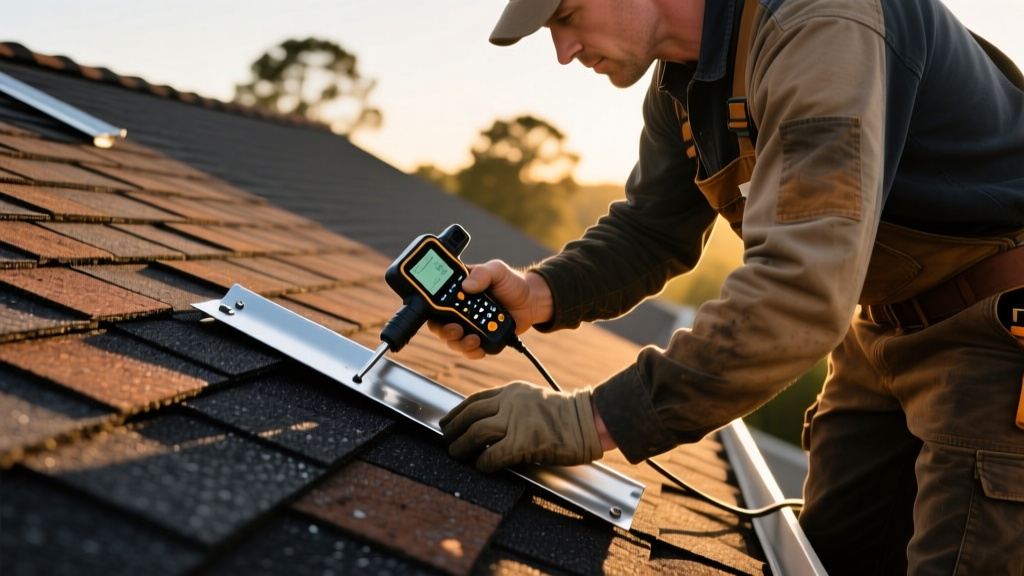
Before repairing a flat roof, conduct an evening infrared thermography scan. Wet insulation beneath the membrane retains heat longer than dry insulation after sunset. Using a FLIR thermal camera allows you to map the exact footprint of trapped hydrostatic moisture, ensuring you only cut out and replace the saturated polyiso board rather than guessing at the leak's origin.
Clay and Concrete Tile: The Underlayment Paradox
Homeowners often assume that because clay and concrete tiles (from manufacturers like Boral or Eagle Roofing) carry 50-year or lifetime warranties, the entire roof system is indestructible. This is a critical misunderstanding of how tile roofs function.
Tile is merely a water-shedding surface; it is not waterproof. Wind-driven rain easily blows up and under the tiles. The actual waterproofing barrier is the underlayment (typically 30-pound asphalt felt or a synthetic membrane like Tyvek Protec) installed directly on the roof decking. While the tiles will easily last 75 years, the underlayment beneath them degrades in 20 to 25 years due to the intense heat trapped between the tile and the deck.
The Lift-and-Relay Procedure
When the underlayment fails, the roof leaks, even if every single tile is perfectly intact. The required repair is a "lift and relay." Contractors must carefully remove every tile, strip the rotted underlayment, install a modern high-temp self-adhering ice and water shield (required because tile roofs easily exceed 160°F at the deck level), and reinstall the original tiles. Because tile breakage during removal is inevitable, you must source 10% to 15% replacement tiles. Due to the extreme labor intensity, lift-and-relay costs frequently exceed $1,500 per square (100 sq. ft.), making it one of the most expensive maintenance procedures in the industry.
Bi-Annual Inspection Framework
To maximize the lifespan of any of these kinds of roof materials, implement a strict bi-annual inspection protocol. The Asphalt Roofing Manufacturers Association (ARMA) recommends inspections in early spring and late autumn.
The 12-Point Diagnostic Checklist
- Flashings: Inspect step flashings at wall intersections and pipe boots. Look for cracked neoprene collars or separated solder joints on copper pipe jacks.
- Valleys: Ensure open metal valleys are free of debris dams. Debris traps water, causing capillary action that draws moisture up under the adjacent shingles.
- Ridge Vents: Check the mesh baffles on ridge vents for bird nesting or insect infestations, which block attic exhaust and cause ice dams in winter.
- Gutter Pitch: Verify that gutters are draining completely within 4 hours of a rain event. Standing water in gutters accelerates fascia rot and causes winter ice damming at the eaves.
- Attic Decking: From inside the attic, use a Tramex moisture meter on the OSB or plywood roof decking around all penetrations. Readings above 15% indicate an active, hidden leak requiring immediate intervention.
Written by
Priya KapoorPriya Kapoor is a real estate market analyst and construction economics researcher with expertise in housing affordability, development feasibility, and infrastructure investment. She holds a Master of Regional Planning from Cornell University and previously worked as a senior analyst at CBRE's Investment Properties group, where she modeled returns for $4B in mixed-use development pipelines. Priya now runs an independent research practice advising developers, municipalities, and REITs on construction cost forecasting and market timing. She publishes the quarterly "BuildMat Market Pulse" report tracking material price indices across 12 commodity categories. Based in Austin, TX, Priya serves on the board of Habitat for Humanity Austin and is a marathon runner.
More from Priya Kapoor
View all
Construction Cost
Cost to Build a 1600 Sq Ft Home in 2026: Full Breakdown
Accurate 2026 cost to build a 1600 sq ft home—material, labor, and regional pricing breakdowns included. Plan your budget with real-time estimates.
Aug 11, 2026

Wood & Lumber
Name the Types of Wood for Pressure Treatment and Preservation
Learn how to name the types of wood best suited for pressure treatment. Compare species treatability, chemical retention levels, and 2026 preservation costs.
Aug 4, 2026

Stone & Masonry
Stone Veneer Suppliers Lindenhurst: 2026 Cost Analysis
Analyze 2026 stone veneer costs in Lindenhurst, NY. Compare local supplier pricing, delivery fees, and Suffolk County installation labor rates.
Aug 4, 2026