RV Roof Material Cost Breakdown: EPDM, TPO & Fiberglass (2026)
Compare 2026 RV roof material costs including EPDM, TPO, and fiberglass. Get exact pricing per square foot, coating expenses, and lifespan ROI.

2026 RV Roof Material Cost Matrix
Selecting the correct RV roof material requires balancing upfront replacement costs against long-term maintenance and UV resistance. The recreational vehicle industry primarily relies on four distinct roofing systems, each with unique chemical properties, installation requirements, and price points. The following matrix outlines the baseline material and professional installation costs for a standard 30-foot travel trailer (approximately 240 square feet of flat roof space) in 2026.
| Material Type | Material Cost (Per Sq Ft) | Pro Installation (Per Sq Ft) | Total Avg. Cost (30ft RV) | Expected Lifespan |
|---|---|---|---|---|
| EPDM Rubber | $3.50 - $4.50 | $4.00 - $6.00 | $1,800 - $2,520 | 10 - 15 Years |
| TPO Membrane | $4.50 - $6.00 | $5.00 - $7.50 | $2,280 - $3,240 | 15 - 20 Years |
| Fiberglass (Molded) | $8.00 - $12.00 | $10.00 - $15.00 | $4,320 - $6,480 | 20+ Years |
| Aluminum Sheet | $2.50 - $4.00 | $4.50 - $6.50 | $1,680 - $2,520 | 15 - 20 Years |
Material Deep Dive: Pricing, Lifespan, and Failure Modes
EPDM (Ethylene Propylene Diene Monomer)
EPDM is a synthetic rubber membrane that has dominated the RV industry for decades due to its low initial cost and high flexibility. Standard thicknesses are 40-mil for travel trailers and 50-mil for motorhomes. While the material itself is cheap, EPDM has a critical flaw: it contains oils that leach to the surface when exposed to UV radiation, causing a white 'chalking' effect. This chalking stains the sides of the RV and indicates material degradation.
Common Failure Modes: The primary failure point is not the membrane itself, but the adhesive breakdown at the seams and around roof penetrations (vents, skylights, AC units). If the underlying OSB or luan decking gets wet, it rots rapidly, requiring a full tear-off. EPDM is also highly susceptible to puncture from low-hanging branches due to its soft composition.
TPO (Thermoplastic Polyolefin)
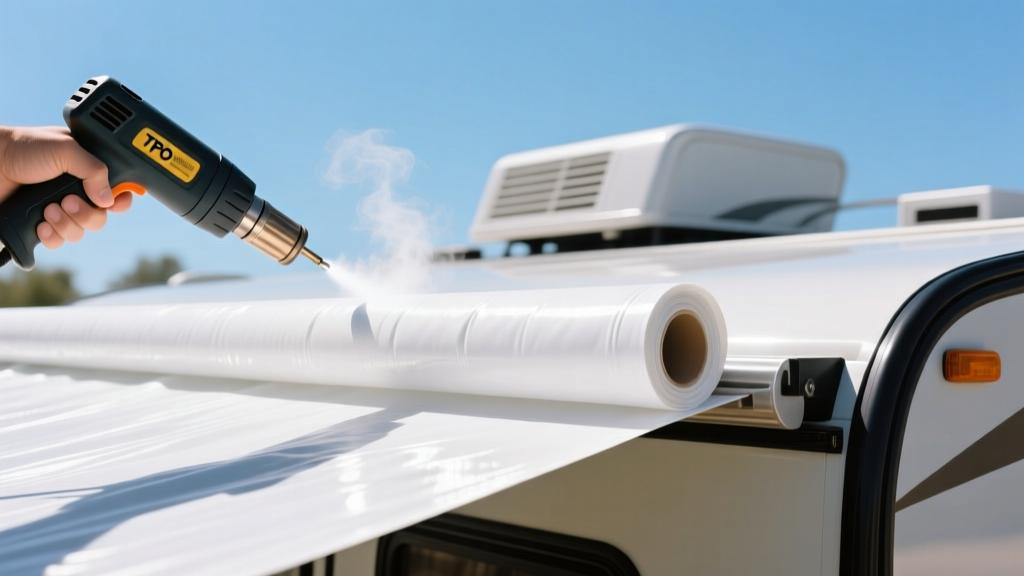
TPO has largely replaced EPDM as the OEM standard for mid-to-high-tier RVs. Unlike EPDM, TPO contains no leaching oils, meaning it will not chalk or streak the sidewalls. It is heat-welded at the seams rather than glued, creating a monolithic, watertight bond that is vastly superior to chemical adhesives. Alpha Systems, a leading OEM supplier, manufactures TPO membranes specifically formulated with extra flexibility to handle the torsional twisting of an RV chassis during highway travel—a critical distinction from rigid commercial building TPO.
Common Failure Modes: Early generations of TPO (pre-2015) suffered from cracking in extreme cold due to insufficient elastomer blending. Modern 2026 formulations have resolved this, but poor heat-welding during installation can still lead to seam delamination. TPO is also more expensive to repair locally; patching requires a heat gun and specialized primer, whereas EPDM can be patched with basic contact cement.
Fiberglass and Aluminum
Fiberglass roofs are molded, single-piece gel-coated shells found primarily on high-end fifth wheels and luxury motorhomes. They offer the best aerodynamics and structural rigidity but come at a massive premium. If a fiberglass roof cracks from impact or structural flexing, repair requires professional gel-coat matching and structural reinforcement. Aluminum roofs, once the industry standard, are now mostly relegated to budget utility trailers or vintage Airstream-style builds. Aluminum expands and contracts significantly with temperature shifts, causing the fastener holes to elongate over time, inevitably leading to leaks.
The Hidden Costs: Sealants, Coatings, and Prep
The membrane is only half the battle. The true cost of an RV roof system lies in the chemical sealants and protective coatings required to maintain watertight integrity. Budgeting for an RV roof replacement without factoring in these consumables will result in a 15% to 20% shortfall.
- Lap Sealants: Dicor Products manufactures the industry standard. You must use Dicor 501LSW (Self-Leveling) for horizontal surfaces and Dicor 551LSW (Non-Sag) for vertical edges and vent skirts. At $12 to $15 per tube, a full roof reseal requires 6 to 10 tubes ($72 - $150).
- Butyl Tape: Used underneath the membrane and flange plates for primary waterproofing. A 30-foot roll of high-grade butyl tape costs roughly $25. You will need at least two rolls for a full replacement.
- Liquid Roof Coatings: If you are restoring an aging EPDM roof rather than replacing it, liquid elastomeric coatings are required. Products like Heng's Rubber Roof Coating cost approximately $130 per 5-gallon bucket (covers ~200 sq ft). Premium polyurethane coatings like FlexArmor cost upwards of $1,500 for professional spray application but offer a lifetime warranty.
- Prep Solvents and Primers: Coatings will peel if applied over oxidized rubber. You must clean the roof with a specialized RV roof cleaner (avoiding petroleum distillates that destroy EPDM) and apply an acrylic primer. Budget $80 to $120 for prep chemicals.
Professional Installation vs. DIY Economics
RV service centers in 2026 charge between $135 and $185 per hour for roof labor. A complete tear-off and replacement of a 30-foot travel trailer roof takes two technicians approximately 12 to 16 hours. This translates to $3,240 to $5,920 in labor alone.
The DIY Route: Replacing an RV roof is highly feasible for a DIYer with basic carpentry skills, but it requires removing and reinstalling every roof penetration (AC shrouds, vent covers, antenna bases, solar mounts). The primary risk in DIY installation is improper seam tension. If the membrane is stretched too tightly across the roof deck during a hot day, it will contract in the winter, pulling the sealant away from the perimeter edges and causing catastrophic leaks. Professional installers use specialized tensioning rollers and allow for a 1/4-inch slack per 10 feet of material to account for thermal expansion.
Long-Term ROI: Cost Per Year of Service
Annualized Cost Analysis (Based on a 30ft Trailer)
EPDM Rubber: $2,160 Total / 12 Years = $180 per year (Requires $150 coating every 4 years)
TPO Membrane: $2,760 Total / 18 Years = $153 per year (Zero coating maintenance required)
Fiberglass Shell: $5,400 Total / 25 Years = $216 per year (Requires $200 waxing/gel-coat repair)
When analyzing the data, TPO emerges as the most economically efficient RV roof material over the lifespan of the vehicle. While the upfront material cost is roughly $600 higher than EPDM, the elimination of bi-annual elastomeric coating requirements and the superior heat-welded seams drastically reduce long-term maintenance costs and water damage risks.
According to maintenance guidelines published by the RV Industry Association (RVIA), the leading cause of total-loss RV claims is water intrusion stemming from neglected roof seams. Investing in a heat-welded TPO system or committing to a strict bi-annual lap sealant inspection schedule is not merely a maintenance task; it is the primary defense of the vehicle's structural integrity. When sourcing materials, always verify that the membrane is explicitly rated for mobile/vehicular torsional flex, as commercial roofing materials will crack under the dynamic loads of highway towing.
Written by
Sarah WhitfieldSarah Whitfield is a chartered quantity surveyor (MRICS) and construction cost analyst with 15 years of experience in material pricing, procurement strategy, and project budgeting. She earned her degree in Construction Management from the University of Reading (UK) and has worked on projects ranging from $2M custom homes to $180M mixed-use developments across North America and Europe. Sarah currently leads cost estimating for BuildMat Insight, maintaining a proprietary database of 4,000+ material price points updated quarterly. She is a frequent contributor to RSMeans cost data panels and has presented at the International Cost Engineering Council (ICEC) congress. Based in Denver, CO, Sarah is an avid trail runner and volunteer mentor for Women in Construction.
More from Sarah Whitfield
View all
Wood & Lumber
What Are the Different Types of Wood? A Builder's Guide
Compare structural softwoods, finish hardwoods, and engineered lumber. Analyze Janka ratings, MOE values, and 2026 pricing for construction.
Aug 4, 2026

Walls & Panels
Steel Framing vs Wood Framing: Corrosion and Moisture Defense
Compare steel framing vs wood framing for moisture resistance. Learn about galvanized coatings, condensation risks, and corrosion protection strategies.
Jul 21, 2026

Stone & Masonry
How to Cut Stone Veneer: Wet Saw vs Grinder Comparison
Compare the best tools for cutting stone veneer. We review wet saws, angle grinders, and chop saws to help you achieve clean, chip-free cuts.
Jul 21, 2026