Do Premium Shingle Colors Cost More? 2026 Pricing Guide
Calculate the true cost of shingle colors in 2026. Compare standard vs. premium palettes, cool roof energy savings, and waste factors for accurate estimates.
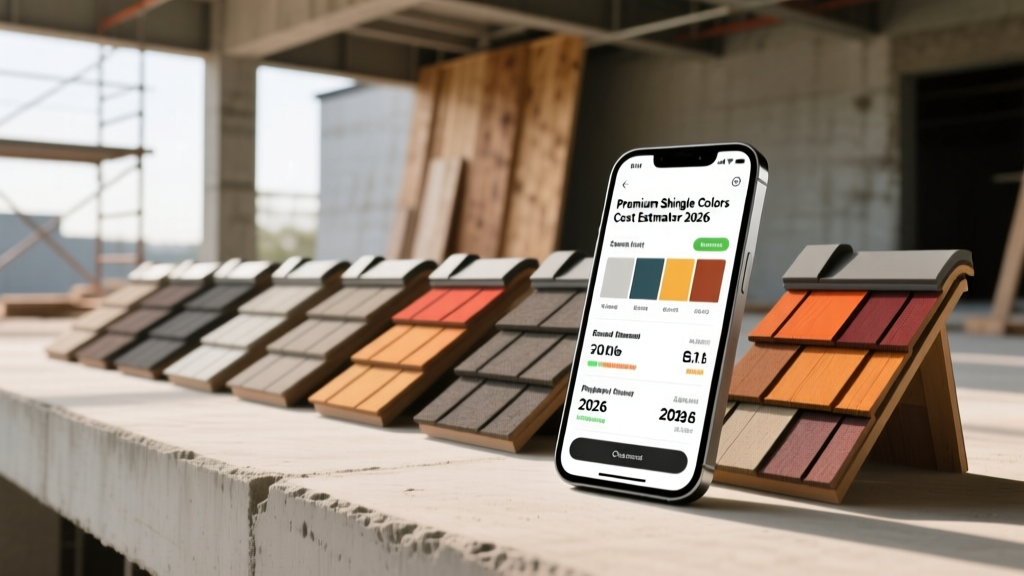
The True Cost of Shingle Colors: Standard vs. Premium Tiers
When building a roofing cost estimate, contractors and homeowners often treat color as a purely aesthetic choice with no financial impact. In 2026, this is a critical estimating error. The specific shingle colors you select directly dictate the material tier, the manufacturing process, and the final price per square (100 square feet). Asphalt shingle manufacturers segment their color palettes into distinct pricing tiers based on granule blending complexity and mat thickness.
Standard color palettes—such as basic Charcoal, Weathered Wood, or Desert Tan—utilize uniform granule sizes and single-pass color coating. These are typically found on entry-level architectural shingles. Premium and designer colors, such as GAF’s Biscayne or Owens Corning’s Aged Cedar, require multi-stage granule blending, ceramic-coated accent granules, and often a heavier fiberglass mat to support the thicker dimensional profile required to make the color variations pop.
Base Material Pricing by Color Tier (Per Square)
| Color Tier Category | Granule Technology | 2026 Avg. Material Cost |
|---|---|---|
| Standard Palette (e.g., Solid Charcoal) | Uniform size, single-color base | $115 - $145 |
| HD / High-Definition Blends | Multi-color blending, shadow bands | $140 - $185 |
| Designer / Luxury Colors | Ceramic-coated, tri-dimensional blends | $260 - $450+ |
Cool Roof Colors and Energy Cost Estimation
The thermal performance of a roof is heavily influenced by its Solar Reflectance Index (SRI). While traditional dark shingle colors (like black or dark brown) absorb up to 90% of solar radiation, specialized "cool" shingle colors utilize reflective granules that bounce infrared and ultraviolet light away from the roof deck. According to the Cool Roof Rating Council (CRRC), cool roof materials can reduce peak cooling demand by 10% to 15% in hot climates.
When estimating the lifecycle cost of a roof, you must factor in the energy savings generated by cool shingle colors to justify their higher upfront premium. Specialty cool-color lines, such as GAF Timberline CS or Owens Corning Duration COOL, cost approximately $160 to $210 per square—a 20% to 30% premium over standard colors.
Calculating Cool Color Energy ROI
To accurately estimate the payback period for premium cool shingle colors, use the following calculation framework:
- Determine Annual Cooling Load: Multiply the home's total annual kWh usage by the percentage dedicated to cooling (typically 35% to 45% in southern US climates).
- Apply the Cool Roof Reduction Factor: Multiply the cooling kWh by 0.12 (representing an average 12% reduction in cooling load via high-SRI shingle colors).
- Calculate Financial Savings: Multiply the saved kWh by the local 2026 utility rate (national average is approximately $0.16/kWh).
Example: A home using 14,000 kWh annually with 40% dedicated to cooling (5,600 kWh). A 12% reduction saves 672 kWh per year. At $0.16/kWh, the annual savings is $107.52. Over a 30-year shingle lifespan, cool shingle colors yield $3,225 in energy savings, effectively paying for the color upgrade and generating net-positive ROI.
Fading, Warranty, and Long-Term Maintenance Calculators
Color selection impacts long-term maintenance and warranty coverage. Darker, highly saturated shingle colors are more susceptible to UV degradation and visible fading over time. To combat this, manufacturers apply specialized UV-blocking acrylic coatings to premium color granules. However, the most significant maintenance cost variable tied to shingle colors is algae discoloration.
In humid climates, standard light-to-medium gray and brown shingle colors will visibly streak with Gloeocapsa magma (blue-green algae) within 5 to 7 years. This does not compromise the shingle's structural integrity, but it severely degrades the aesthetic, often prompting premature replacement or costly chemical cleaning ($300 to $500 per wash).
Quantity Calculator Adjustments for Complex Color Blends
Standard roofing quantity calculators apply a flat 10% waste factor to the total roof area to account for cuts, valleys, and hips. However, when estimating for premium designer shingle colors, this waste factor is dangerously inaccurate.
Designer shingle colors rely on high-contrast shadow lines and randomized color blending to mimic natural slate or cedar shake. If installers do not randomize bundles and carefully align the color blends across the roof plane, the result is visible "banding" or "striping" where color lots clash. To prevent this, crews must open multiple bundles simultaneously and discard more off-cuts to maintain pattern continuity.
Revised Waste Factors by Color Complexity
- Solid / Standard Colors: 10% waste factor. (20-square roof = 22 squares ordered).
- HD Architectural Blends: 10% to 12% waste factor. Slight pattern matching required at valleys.
- Designer / Luxury Colors: 13% to 15% waste factor. (20-square roof = 23 to 24 squares ordered). The extra 1 to 2 squares of premium material can add $500 to $900 to the final material cost.
- Mansard or Steep-Pitch with Designer Colors: Up to 18% waste factor due to complex scaffolding cuts and strict aesthetic requirements on highly visible planes.
2026 Market Pricing Matrix: Top Brands and Color Tiers
To build a precise estimate, cross-reference the client's color choice against the manufacturer's specific product line. A color name alone is insufficient; you must identify the exact product series that houses that color. Below is a comparative matrix of the major manufacturers' color tiers and their corresponding 2026 material costs.
| Manufacturer | Product Line (Standard Color) | Product Line (Premium Color) | Price Delta (Per Sq.) |
|---|---|---|---|
| GAF | Timberline HDZ (Charcoal) | Camelot II (Aged Cedar) | +$210 - $250 |
| Owens Corning | Duration (Onyx Black) | Berkshire (Sherwood Forest) | +$190 - $230 |
| CertainTeed | Landmark (Heather Blend) | Grand Manor (Stonegate) | +$220 - $280 |
| IKO | Cambridge (Dual Black) | Crowne Slate (Mist Green) | +$180 - $210 |
Final Estimation Checklist for Color Selection
Before finalizing your roofing proposal, verify the following color-dependent variables:
- Confirm the exact manufacturer and product line for the selected color, not just the generic color name.
- Adjust the waste factor up to 15% if the color features high-contrast, directional shadow blending.
- Check local municipal codes or HOA guidelines; some regions mandate cool roof colors (SRI > 20) for new construction, which will force a material upgrade.
- Calculate the lifecycle energy savings if a cool color is selected to offset the higher initial material quote for the client.