2026 Cost Breakdown: Choosing the Right Type of Roofing Materials
Compare the 2026 installed costs for every type of roofing materials. Deep dive into asphalt, metal, tile, and flat membrane pricing and ROI.

The True Cost of Roofing: Beyond the Shingle Price
When planning a roof replacement or new construction project, evaluating the financial commitment requires looking far beyond the sticker price of the shingles or panels. The total installed cost of any type of roofing materials is a composite of raw material pricing, specialized labor, structural prerequisites, and regional disposal fees. In 2026, supply chain stabilization has normalized base material costs, but skilled labor shortages continue to drive installation premiums, particularly for specialized systems like standing seam metal and slate.
Comprehensive Cost Matrix by Type of Roofing Materials
The following matrix breaks down the average installed costs per square foot (and per "square"—the industry term for 100 square feet) for the most common residential and commercial roofing systems in 2026. These figures include standard tear-off, disposal, synthetic underlayment, and installation labor.
| Material Type | Material Cost (per sq ft) | Labor Cost (per sq ft) | Total Installed (per sq ft) | Expected Lifespan |
|---|---|---|---|---|
| 3-Tab Asphalt Shingles | $1.20 - $1.80 | $2.00 - $3.00 | $3.20 - $4.80 | 15 - 20 Years |
| Architectural Asphalt Shingles | $1.80 - $3.50 | $2.50 - $4.00 | $4.30 - $7.50 | 25 - 30 Years |
| Standing Seam Metal | $6.00 - $10.00 | $6.00 - $9.00 | $12.00 - $19.00 | 40 - 60 Years |
| Concrete Tile | $5.00 - $8.00 | $8.00 - $12.00 | $13.00 - $20.00 | 40 - 50 Years |
| Clay Tile | $8.00 - $14.00 | $9.00 - $14.00 | $17.00 - $28.00 | 50 - 100 Years |
| TPO Membrane (Flat/Low-Slope) | $2.50 - $4.50 | $3.50 - $6.00 | $6.00 - $10.50 | 20 - 30 Years |
Architectural Asphalt Shingles: The Market Standard
Architectural (or dimensional) shingles dominate the North American market, accounting for roughly 75% of residential installations. Unlike flat 3-tab shingles, architectural variants feature a laminated, multi-dimensional profile that mimics the look of wood shake or slate at a fraction of the weight and cost.
Product Specifics & Pricing: Premium lines like the GAF Timberline UHDZ or Owens Corning Duration Flex typically cost between $160 and $220 per square (material only). These products utilize advanced sealant technologies (like GAF's StrikeZone) that allow for faster nailing and higher wind warranties, often rated up to 130 mph. However, to validate these enhanced warranties, you must install the manufacturer's complete roofing system, which includes their proprietary synthetic underlayment (e.g., TigerPaw), ice and water shield, and ridge cap shingles. This system-matching requirement can increase your total material bill by 15% to 20% compared to mixing and matching generic components.
Standing Seam Metal Roofing: The Long-Term Investment
When evaluating a highly durable type of roofing materials for severe weather climates, standing seam metal is the undisputed leader. Unlike exposed-fastener corrugated metal, standing seam systems utilize concealed clips that allow the panels to expand and contract with temperature fluctuations without compromising the weathertight seal.
Gauge and Coating Matter: For residential applications, 24-gauge Galvalume steel is the minimum recommended thickness; 26-gauge is too prone to oil-canning (visible waviness) and hail denting. Panels coated with a Kynar 500 (PVDF) paint finish, such as those from Petersen PAC-CLAD or ATAS International, resist UV fading and chalkiness far better than cheaper SMP (Silicone Modified Polyester) coatings. Expect to pay a premium of $2.00 to $4.00 per square foot for a Kynar finish, but it is strictly necessary to maintain the 30-year paint warranty.
Clay and Concrete Tile: Weight and Structural Realities
Tile roofing is a staple in the Southwest, Florida, and coastal regions due to its exceptional fire resistance and thermal mass. However, the cost of the tiles themselves is only half the financial equation.
- Concrete Tile: Brands like Boral Roofing offer concrete profiles starting around $5.50 per square foot. Concrete is heavy, weighing between 800 and 950 pounds per square.
- Clay Tile: Premium manufacturers like Ludowici produce fired clay tiles that can exceed $12.00 per square foot. Clay is slightly lighter but significantly more brittle during installation.
The Hidden Structural Cost: Because standard residential roof trusses are engineered for asphalt shingles (which weigh roughly 230 lbs per square), installing tile requires a structural engineering assessment ($500 to $1,500) and often necessitates reinforcing the trusses or upgrading the roof decking from standard 7/16" OSB to 5/8" CDX plywood. This structural reinforcement can add $3,000 to $8,000 to the overall project cost.
TPO and EPDM: Flat and Low-Slope Membranes
For modern homes with low-slope architectural elements, additions, or commercial buildings, single-ply membranes are the standard. According to the National Roofing Contractors Association (NRCA), Thermoplastic Polyolefin (TPO) has largely overtaken EPDM rubber in the commercial sector due to its reflective, energy-efficient white surface.
Installation Method Dictates Price: A 60-mil TPO membrane that is mechanically attached (screwed and plated to the decking) will cost around $6.50 per square foot installed. However, a fully adhered system (glued directly to the insulation board using low-VOC bonding adhesives) provides superior wind uplift resistance and a smoother aesthetic, pushing the cost to $9.50 or more per square foot. Furthermore, upgrading the underlying polyiso insulation board from 1.5 inches to 3.0 inches to meet 2026 IECC energy codes will add roughly $1.80 per square foot to the material cost.
Hidden Cost Variables That Derail Roofing Budgets
Homeowners frequently receive quotes that only account for the "happy path" of installation. To build an accurate budget, you must account for the following variables that contractors often list as "allowances" or exclude entirely until the tear-off is complete:
Warning: The Decking Trap. Once the old roof is torn off, contractors will inspect the wood decking. In homes built before 2005, you will likely find spaced sheathing (1x6 boards) or degraded OSB. Replacing a standard 4x8 sheet of 5/8" CDX plywood costs between $85 and $130 installed. If 30% of your 2,500 sq ft roof requires new decking, expect an unexpected invoice for $2,500 to $4,000.
- Tear-Off and Disposal Fees: Landfill tipping fees have surged in many municipalities. Tearing off two layers of existing asphalt shingles adds $1.00 to $1.75 per square foot in labor and disposal costs compared to a single-layer tear-off.
- Flashing and Penetrations: Standard quotes include step flashing for sidewalls and basic pipe boots. Upgrading to copper step flashing, custom-machined chimney crickets, or commercial-grade cast-iron pipe boots will add $800 to $2,500 to the final bill.
- Pitch and Story Multipliers: Roofs with a pitch steeper than 8:12 require specialized safety harnesses, roof jacks, and slower labor, triggering a 15% to 25% labor surcharge. Three-story homes incur similar premiums due to the time required to hoist materials via ladder or crane.
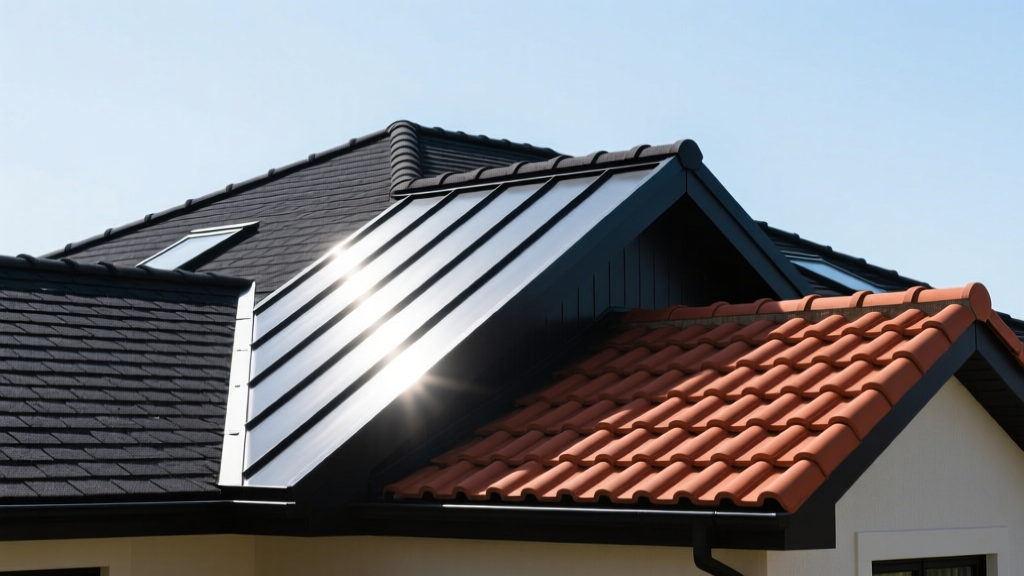
ROI and Lifespan Cost-Per-Year Analysis
Judging a roof solely by its initial installed cost is a flawed financial strategy. A more accurate metric is the Annualized Cost of Ownership, calculated by dividing the total installed cost by the realistic lifespan of the material in your specific climate zone.
For example, an architectural asphalt roof costing $14,000 that lasts 22 years yields an annualized cost of $636 per year. Conversely, a 24-gauge standing seam metal roof costing $32,000 that lasts 50 years yields an annualized cost of $640 per year. When you factor in the ENERGY STAR Certified Roof Products rebates and the reduction in cooling loads provided by reflective metal or cool-roof coatings, metal roofing often achieves a lower true cost of ownership than asphalt within the first 15 years.
Furthermore, according to Remodeling Magazine's Cost vs. Value Report, metal roof replacements consistently recoup between 45% and 55% of their cost in immediate home equity value, whereas standard asphalt replacements recoup closer to 60% of a much lower initial investment. The decision ultimately hinges on whether you plan to remain in the property long enough to realize the lifecycle benefits of premium materials.
Frequently Asked Questions
Does the color of the roofing material impact the total cost?
For asphalt shingles, standard colors (charcoal, weathered wood, black) are uniformly priced. However, premium designer colors or high-solar-reflectance "cool roof" shingles can carry a 10% to 15% material premium. For metal roofing, standard Galvalume (silver) is the cheapest, while custom Kynar 500 colors (like matte black or deep bronze) add $1.50 to $3.00 per square foot.
Can I install a metal roof over my existing asphalt shingles?
While some local building codes allow a second layer of roofing, installing a standing seam metal roof over existing shingles is generally discouraged. The uneven surface of the old shingles can cause the metal panels to telegraph imperfections, leading to oil-canning. Furthermore, it prevents the installation of a proper synthetic underlayment directly against the decking and voids most manufacturer warranties. A complete tear-off is highly recommended.
How do I verify if my contractor's quote includes synthetic underlayment?
Always demand a line-item breakdown in your contract. Look for specific brand names like GAF FeltBuster, Owens Corning ProArmor, or Epichem Titanium UDL 50. If the quote simply says "#15 felt" or "underlayment," request an upgrade to a woven synthetic underlayment, which offers vastly superior tear resistance and slip protection for the installers, ultimately resulting in a safer, longer-lasting roof deck.
Written by
Elena RodriguezElena Rodriguez is a civil engineer and technical writer specializing in concrete technology, masonry systems, and ASTM/ACI compliance. She earned her B.S. in Civil Engineering from Texas A&M University and spent a decade at a materials testing laboratory, performing over 2,000 concrete compressive strength tests and masonry prism evaluations. Elena is an ACI-certified Field Testing Technician (Grade I) and a member of ASTM Committee C12 on Natural Building Stone. She currently consults on forensic engineering cases involving concrete failures and moisture intrusion. Based in San Antonio, TX, Elena is a proud member of the Society of Women Engineers (SWE) and coaches her daughter's FIRST Robotics team.
More from Elena Rodriguez
View all
Walls & Panels
Cost Analysis: Light Gauge Steel Framing Advantages and Disadvantages
Evaluate light gauge steel framing advantages and disadvantages through a strict cost analysis lens, comparing material, labor, and lifecycle expenses.
Aug 4, 2026

Walls & Panels
Gypsum Board Types: Exact Specifications, Thickness & Dimensions
Compare standard, Type X, and moisture-resistant gypsum board types. Get exact specifications, thicknesses, dimensions, and ASTM standards for your project.
Aug 4, 2026

Fire Resistance
Best Fire-Resistant Outdoor Decking Materials: 2026 Buyer Guide
Discover the best fire-resistant outdoor decking materials for 2026. Compare Class A PVC, aluminum, and hardwood options for WUI compliance and safety.
Aug 4, 2026