2026 Cost Breakdown: Types of Roofing Materials for Homes
Compare the 2026 costs for the most popular types of roofing materials for homes. Includes per-square-foot pricing, lifespan, and hidden installation fees.
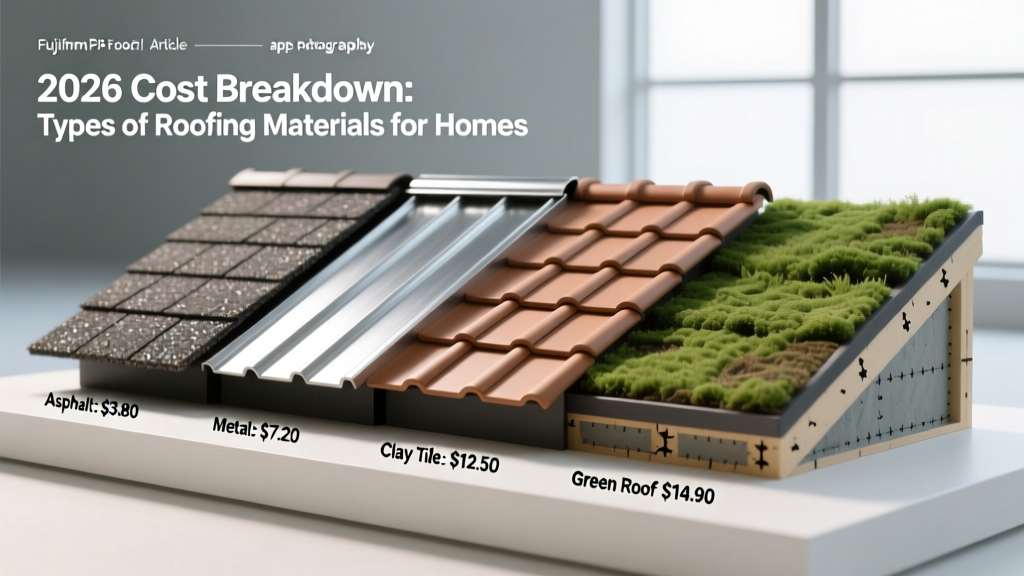
The True Financial Scope of Residential Roofing in 2026
Selecting from the various types of roofing materials for homes requires looking past the initial sticker price. In 2026, supply chain stabilization has normalized material costs, but specialized labor rates and upgraded building code requirements—particularly for wind uplift and fire resistance—have shifted the financial burden toward installation and structural preparation. A standard 2,000-square-foot roof (20 squares) can range from $9,000 for basic asphalt to over $50,000 for premium clay tile, but these baseline figures rarely reflect the final invoice.
Quick 2026 Cost Baseline (Per Square Foot Installed)
- 3-Tab Asphalt Shingles: $3.50 – $4.50
- Architectural Asphalt Shingles: $5.50 – $8.50
- Standing Seam Metal: $13.00 – $19.00
- Concrete Tile: $11.00 – $16.00
- Synthetic Slate: $16.00 – $24.00
- Natural Clay Tile: $20.00 – $32.00
Note: Prices reflect national averages for a standard 8/12 pitch roof. Steep pitches, complex valleys, and multi-story access will increase labor costs by 15% to 40%.
Material-Specific Cost and Performance Breakdown
To make an accurate budget, you must evaluate the specific product tiers within each material category. The performance gap between entry-level and premium options within the same material class is substantial.
Asphalt Shingles: The Market Standard
Asphalt remains the most common choice among the types of roofing materials for homes, but 3-tab shingles are rapidly losing market share to architectural and premium dimensional shingles. In 2026, most building codes in high-wind regions mandate architectural shingles with sealed tab technology.
- Entry-Level (3-Tab): Priced at $3.50 to $4.50 per sq. ft. installed. Models like GAF Royal Sovereign offer a 25-year warranty but lack the dimensional profile and wind resistance (typically rated to 60 mph) of upgraded options.
- Mid-Tier (Architectural): Priced at $5.50 to $8.50 per sq. ft. installed. Products like GAF Timberline HDZ or Owens Corning Duration feature proprietary nailing zones and sealants that achieve 130 mph wind ratings. They require a heavier underlayment and proper starter strips to validate the warranty.
- Premium (Designer/Luxury): Priced at $9.00 to $14.00 per sq. ft. installed. Shingles like CertainTeed Grand Manor mimic the shadow lines of slate. They require reinforced roof decking due to their weight (up to 450 lbs per square) and specialized flashing techniques.
Metal Roofing: Standing Seam vs. Exposed Fastener
Metal roofing costs vary wildly based on the fastening system and metal gauge. Exposed fastener panels (like corrugated agricultural panels) cost $7.00 to $10.00 per sq. ft. installed, but the neoprene washers on the screws degrade under UV exposure, requiring maintenance every 10 to 15 years.
For residential applications, standing seam metal is the standard. A 24-gauge Galvalume steel standing seam roof with concealed clips costs $13.00 to $19.00 per sq. ft. installed. The concealed clip system allows the metal panels to expand and contract with thermal cycling without compromising the waterproof seal. Upgrading to 0.032-inch aluminum or zinc will push costs to $22.00 to $35.00 per sq. ft., but provides total immunity to saltwater corrosion in coastal environments.
Tile Roofing: Concrete and Clay
Tile systems are exceptionally durable but introduce significant structural engineering costs. A standard concrete tile (e.g., Boral or Eagle Roofing) costs $11.00 to $16.00 per sq. ft. installed. Natural clay tile (e.g., Ludowici) ranges from $20.00 to $32.00 per sq. ft.
The hidden cost with tile is structural reinforcement. Clay tiles weigh between 600 and 900 pounds per square (100 sq. ft.). If your home was originally framed for asphalt shingles (which weigh roughly 230 lbs per square), a structural engineer must evaluate the trusses. Reinforcing roof trusses or load-bearing walls can add $4,000 to $12,000 to the total project cost before the first tile is laid.
Synthetic and Composite Slate
Manufactured from engineered polymers and recycled rubber, synthetic slate (such as DaVinci Roofscapes or EcoStar) offers the aesthetic of natural slate at a fraction of the weight and cost. Expect to pay $16.00 to $24.00 per sq. ft. installed. Unlike natural slate, which requires specialized copper flashing and slate hooks, synthetic slate can be nailed directly to standard decking using standard roofing nails, drastically reducing labor time and specialized tooling requirements.
Comprehensive Material Comparison Matrix
| Material Type | Installed Cost (Sq. Ft.) | Expected Lifespan | Weight (per Sq.) | Wind Warranty | Maintenance Level |
|---|---|---|---|---|---|
| Architectural Asphalt | $5.50 – $8.50 | 30 – 50 Years | 230 – 280 lbs | 130 mph | Low |
| Standing Seam Metal | $13.00 – $19.00 | 50 – 70 Years | 50 – 100 lbs | 140+ mph | Very Low |
| Concrete Tile | $11.00 – $16.00 | 40 – 50 Years | 600 – 800 lbs | 125 mph | Medium |
| Synthetic Slate | $16.00 – $24.00 | 50+ Years | 150 – 250 lbs | 110 mph | Low |
| Natural Clay Tile | $20.00 – $32.00 | 75 – 100+ Years | 700 – 900 lbs | 125 mph | Low |
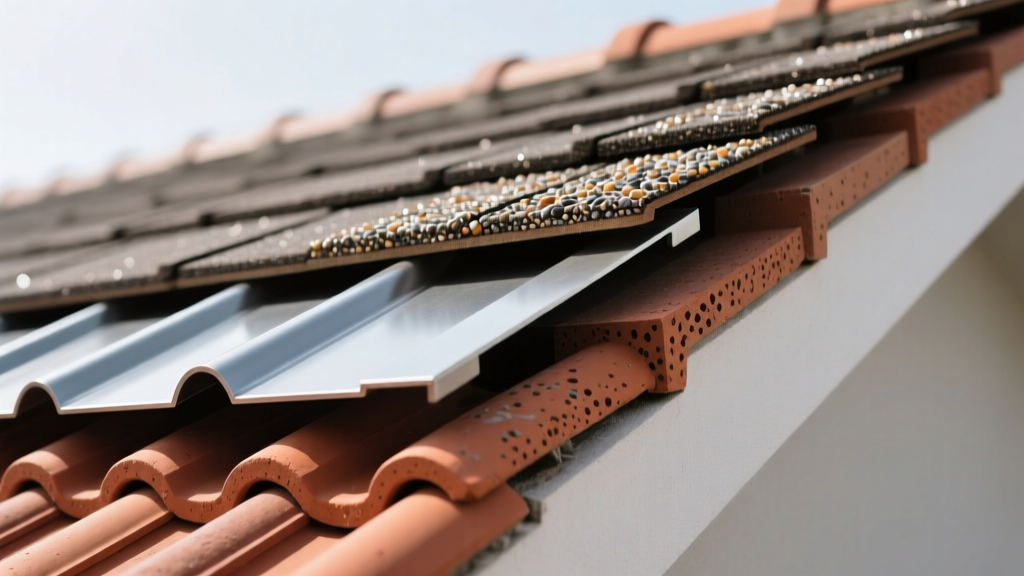
Hidden Installation Costs That Inflate Your Budget
When contractors provide a preliminary quote for types of roofing materials for homes, they often exclude critical site-specific variables. Budget for the following hidden costs to avoid mid-project change orders:
⚠️ Warning: The Tear-Off and Decking Trap
Removing an existing roof layer costs $1.50 to $3.00 per sq. ft. However, once the old material is removed, contractors often discover rotted OSB or plywood decking. In 2026, replacing a standard 4x8 sheet of 5/8-inch CDX plywood or OSB costs $85 to $135 per sheet (including material and labor). If 20% of your 2,000 sq. ft. roof deck needs replacement, expect an unbudgeted addition of $1,200 to $2,000 to your final invoice.
- Ice and Water Shield Upgrades: Standard code requires this self-adhering membrane in valleys and eaves. Upgrading to a full-deck application (highly recommended for metal roofs to prevent condensation-related rot) adds $1.20 to $1.80 per sq. ft.
- Flashing and Penetrations: Replacing standard aluminum step flashing with copper, or upgrading standard pipe boots to heavy-duty lead or stainless steel models, adds $500 to $1,500 depending on the number of roof penetrations (vents, skylights, chimneys).
- Crane Rentals for Heavy Materials: If you choose clay or concrete tile, and your home is multi-story or has tight property lines, a crane is required to hoist pallets of tile. Crane rentals and operators cost $1,500 to $3,500 per day.
Decision Framework: Matching Material to Climate and Risk
Choosing the right material is not just about aesthetics; it is about mitigating localized environmental risks. Use the National Roofing Contractors Association's consumer guidelines as a baseline, then apply these climate-specific frameworks.
High-Wind and Hurricane Zones (Coastal & Tornado Alley)
In regions prone to severe wind events, standard asphalt warranties are often voided. Homeowners should pursue the Insurance Institute for Business & Home Safety (IBHS) FORTIFIED Home standard. Achieving a FORTIFIED Roof designation requires a sealed roof deck (using tape over all decking seams), ring-shank nails spaced at specific intervals, and materials rated for 130+ mph winds. Standing seam metal with structural clips or premium architectural shingles installed with a 6-nail pattern (instead of the standard 4-nail) are the most cost-effective ways to achieve this standard, which can reduce annual windstorm insurance premiums by 15% to 30%.
Wildfire-Prone Regions (WUI Zones)
If your home is in a Wildland-Urban Interface (WUI) zone, selecting a Class A fire-rated material is non-negotiable. While asphalt shingles carry a Class A rating, they are susceptible to melting and degradation from extreme radiant heat and direct ember exposure. In these zones, standing seam metal, concrete tile, or slate are vastly superior. Embers that land in the valleys of an asphalt roof can ignite the underlying organic underlayment if the shingle tab is compromised, whereas metal and tile provide a non-combustible thermal barrier.
High-Heat and Urban Heat Island Environments
For homes in the Southwest or dense urban areas, cooling costs are a major factor. The U.S. Department of Energy notes that installing a cool roof—one that reflects more sunlight and absorbs less heat—can reduce peak cooling demand by 10% to 15%. Look for metal roofs with specialized cool-roof Kynar 500 paint systems (Solar Reflectance Index > 50) or clay tiles with natural thermal mass and air-space ventilation battens that allow air to flow beneath the tiles, drastically reducing heat transfer into the attic space.
Final ROI and Long-Term Value Considerations
When evaluating the types of roofing materials for homes, calculate the cost per year of service rather than the upfront installation cost. A $12,000 architectural asphalt roof that lasts 25 years costs $480 annually. A $35,000 standing seam metal roof that lasts 60 years costs $583 annually, but requires zero maintenance, eliminates the risk of blown-off shingles, and typically yields a 60% to 70% cost recoup upon home resale according to current real estate valuation models. Align your material choice with your planned tenure in the home: if you plan to move within 10 years, premium architectural asphalt provides the best immediate ROI; if this is your forever home, invest in metal or tile to eliminate future replacement cycles.
Written by
James ThorntonJames Thornton is a construction industry veteran with 25 years of hands-on experience in wood framing, lumber grading, and residential building codes. He started as a framing carpenter in rural Oregon, earned his ICC Residential Building Inspector certification, and eventually became a senior plan reviewer for the City of Portland Bureau of Development Services. James holds a B.S. in Wood Science & Technology from Oregon State University and is a certified lumber grader through the West Coast Lumber Inspection Bureau (WCLIB). He has inspected over 3,000 residential construction sites and authored the city's internal guide on advanced framing techniques (2x6 at 24" O.C.). James lives in Bend, OR, where he builds custom timber-frame cabins and competes in lumberjack sports.
More from James Thornton
View all
Insulation
Best Home Insulation Materials: Complete 2026 Guide
Compare top home insulation materials for 2026. Find R-values, installed costs per square foot, and best uses for fiberglass, spray foam, and mineral wool.
Aug 4, 2026

Sustainable Building
Certify Your Green Building Material for LEED and WELL
Step-by-step guide to certifying a green building material for LEED v5 and WELL v2. Master EPDs, HPDs, and VOC limits for 2026 project specifications.
Aug 4, 2026

Stone & Masonry
Veneer Stacked Stone Panels: Interior Design & Style Showcase
Discover how veneer stacked stone panels transform interiors. Explore modern design profiles, material pairings, and technical installation specs.
Aug 4, 2026