How Roof Pitch Dictates Your Shingle and Metal Brand Choice
Discover how roof pitch dictates your choice of GAF, Owens Corning, and metal roofing brands, including warranty limits and underlayment specs.
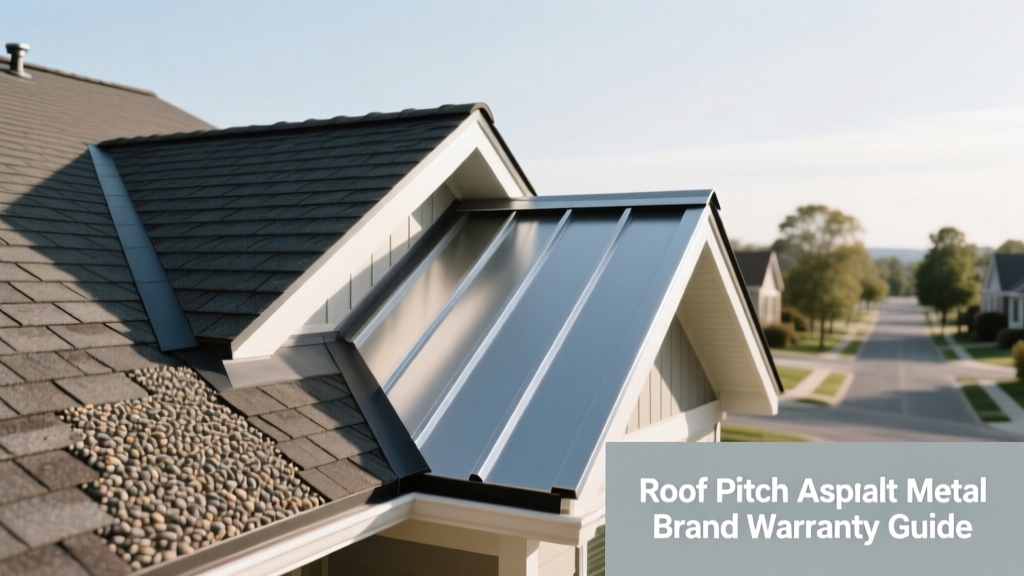
The Critical Intersection of Roof Pitch and Brand Warranties
Roof pitch is not merely an architectural aesthetic; it is the primary mechanical constraint that dictates which roofing product lines you can legally install without voiding the manufacturer's warranty. The angle of your roof determines whether the system will shed water hydrokinetically (relying on gravity and speed) or hydrostatically (relying on watertight seals to resist standing water). When contractors ignore the intersection of roof pitch and brand-specific engineering, they trigger catastrophic failure modes ranging from capillary action in metal seams to asphalt shingle delamination.
Major manufacturers like GAF, Owens Corning, MBCI, and ATAS engineer their product lines for specific slope thresholds. Installing a steep-slope product on a low-slope application does not just risk leaks—it immediately nullifies decades of coverage. According to the National Roofing Contractors Association (NRCA), slope-related installation errors remain one of the top three reasons for warranty claim denials in the commercial and residential sectors.
Asphalt Shingle Deep-Dive: GAF vs. Owens Corning on Low-Slope Roofs
The industry-standard minimum roof pitch for asphalt shingles is 2:12 (two inches of vertical rise for every twelve inches of horizontal run). However, the 'danger zone' exists between 2:12 and 4:12. In this range, water drainage slows significantly, requiring brand-specific underlayment protocols to maintain warranty validity.
GAF Timberline HDZ and Low-Slope Protocols
GAF’s flagship Timberline HDZ architectural shingles are rated for pitches down to 2:12. However, if your roof pitch falls between 2:12 and 4:12, GAF mandates the use of their Tiger Paw Synthetic Roof Deck Protection or a full application of GAF WeatherStopper Ice and Water Shield across the entire deck. Standard #15 felt is explicitly prohibited in this pitch range for Golden Pledge warranty eligibility. Furthermore, GAF requires a 6-nail fastening pattern (rather than the standard 4-nail) on slopes below 4:12 to counteract the altered wind-uplift vectors present on shallower angles.
Owens Corning Duration and Ice & Water Shield Mandates
Owens Corning takes a slightly different approach with their Duration product line. For pitches between 2:12 and 4:12, Owens Corning requires either two layers of ASTM D226 Type I underlayment or a single layer of their WeatherLock Ice and Water Barrier. If a contractor applies a single layer of standard synthetic underlayment on a 3:12 pitch, the Owens Corning Platinum Protection warranty is instantly voided. The material cost difference to upgrade to WeatherLock is approximately $0.65 to $0.85 per square foot, a necessary premium to secure the 50-year limited lifetime coverage.
Never install asphalt shingles on a roof pitch below 2:12. The Asphalt Roofing Manufacturers Association (ARMA) strictly prohibits this. Below this threshold, capillary action will draw water upward beneath the shingle laminations, causing deck rot regardless of the underlayment used. For pitches below 2:12, you must transition to a flat roof membrane (TPO, EPDM) or a hydrostatic metal system.
Metal Roofing Product Lines: Standing Seam vs. Exposed Fastener
Metal roofing offers the widest versatility for extreme roof pitches, but the product line must match the hydrostatic demands of the slope. Exposed fastener panels rely on overlapping seams and gravity, while standing seam systems utilize concealed clips and mechanical locks to resist standing water.
| Brand / Product Line | Panel Profile | Minimum Roof Pitch | Seam Type & Hydrostatic Rating |
|---|---|---|---|
| MBCI Ultra-Dek | Standing Seam | 1/4:12 | Double Lock Mechanical (Hydrostatic) |
| ATAS Advanta | Standing Seam | 1/2:12 | Snap-Lock with Sealant (Hydrostatic) |
| MBCI R-Panel | Exposed Fastener | 3:12 | Lap Seam (Hydrokinetic Only) |
| FABRAL Grandrib 3 | Exposed Fastener | 3:12 | Lap Seam (Hydrokinetic Only) |
MBCI and ATAS: Engineering for Hydrostatic Pressure
For commercial or modern residential builds with ultra-low pitches (1/4:12 to 1:12), the Metal Construction Association (MCA) recommends double-lock mechanical standing seam systems. MBCI’s Ultra-Dek and ATAS’s Attra lines are engineered with factory-applied hot-melt sealant in the seams. When field-crimped, these seams become entirely watertight, allowing the roof to hold standing water without leaking. Upgrading to a mechanical lock standing seam for a 1:12 pitch adds roughly $6.50 to $9.00 per square foot compared to exposed fastener alternatives, but it is the only viable metal option for near-flat slopes.
Synthetic and Tile Systems: Decra and Eagle Roofing
Synthetic polymers and concrete tiles represent heavy, rigid roofing materials where pitch dictates both water shedding and structural load distribution.
- DaVinci Roofscapes (Polymer Slate/Shake): Requires a strict 4:12 minimum pitch. Because the tiles are thick and rely on overlapping channels, a pitch below 4:12 allows wind-driven rain to bypass the interlocking joints.
- Eagle Roofing (Concrete Tile): The minimum pitch depends heavily on the profile. Their flat 'Bel Air' profile requires a 4:12 minimum, while their high-barrel 'Capistrano' profile can be installed down to 2.5:12, provided a 90lb felt underlayment is utilized.
- Decra Roofing (Stone-Coated Steel): Their Villa Tile and Shake profiles are rated down to a 3:12 pitch, but require a specialized eave flashing detail and a synthetic underlayment to maintain their 50-year warranty.
Decision Matrix: Selecting Your Product Line Based on Pitch
Use this framework to narrow down your brand and product line selection before requesting contractor bids:
Action: Exclude all shingles, tiles, and exposed fastener metals. Select TPO, EPDM, PVC membranes, or specialized structural standing seam metal.
Pitch: 1/4:12 to 2:12 (Low Slope)
Action: Select hydrostatic mechanical lock standing seam metal (MBCI Ultra-Dek, ATAS). Asphalt shingles and concrete tiles are strictly prohibited.
Pitch: 2:12 to 4:12 (Transitional Slope)
Action: Asphalt shingles are permitted but require premium ice and water shield coverage (GAF WeatherStopper, Owens Corning WeatherLock) and 6-nail patterns. Exposed fastener metal is permitted if side-laps are sealed with butyl tape.
Pitch: 4:12 to 12:12 (Steep Slope)
Action: All product lines are eligible. Standard 4-nail shingle patterns apply. Standard synthetic underlayment is sufficient. Focus selection on aesthetic preferences and wind-rating requirements.
Underlayment and Fastener Specs Dictated by Pitch
The roof pitch fundamentally alters the fastener pull-out resistance and underlayment slip-sheet requirements. On steep pitches (8:12 and above), gravity exerts massive sheer force on fasteners. Brands like Malarkey (Vista AR shingles) require specialized cap nails or staples for underlayment attachment on steep slopes to prevent the underlayment from tearing under the weight of the installers and the shingles before the primary fasteners are driven.
Conversely, on low pitches, the primary concern is not sheer force, but water ingress around the fastener shank. This is why exposed fastener metal roofs on 3:12 pitches require neoprene-washered screws (such as the Grip-Rite Metal Roofing Fasteners) that are driven perfectly plumb. An over-driven or angled screw on a low-pitch metal roof will compromise the neoprene seal, leading to micro-leaks that degrade the roof deck over time.
Always verify local building codes before finalizing your material selection. In high-wind velocity zones (HVHZ) like Miami-Dade County, local Notice of Acceptance (NOA) documents frequently override manufacturer minimums, often requiring a 4:12 minimum for certain shingle profiles regardless of the brand's national warranty allowances.
Ultimately, matching your roof pitch to the correct brand product line is an exercise in risk management. By strictly adhering to the manufacturer's slope thresholds, underlayment mandates, and fastener patterns, you ensure that the system performs as engineered and that your financial investment remains fully protected by the warranty.