SBS Roofing Material: A Climate-Specific Performance Guide
Discover how SBS roofing material performs across extreme climate zones. Compare cold-weather flexibility, heat resistance, and installation costs.

The Polymer Science Behind SBS Roofing Material
Styrene-Butadiene-Styrene (SBS) modified bitumen represents a highly engineered evolution of traditional built-up roofing. By blending asphalt with SBS synthetic rubber polymers, manufacturers create a thermoplastic elastomer that bridges the gap between rigid asphalt and flexible single-ply membranes. The styrene blocks provide structural integrity and tensile strength, while the butadiene blocks deliver rubber-like elasticity. This unique chemical matrix is what allows SBS roofing material to accommodate structural movement and extreme thermal shock without cracking, making it highly sensitive to—and performant in—specific regional climates.
Climate Zone Breakdown: Where SBS Excels
The performance of an SBS membrane is heavily dictated by the reinforcement scrim (polyester vs. fiberglass) and the surface coating. Here is how the material adapts to distinct North American climate zones.
Zone 1: Extreme Cold and Freeze-Thaw Cycles (Northern US & Canada)
In regions experiencing severe winter conditions, standard oxidized asphalt becomes brittle and fractures under structural shifting. SBS roofing material retains its low-temperature flexibility down to -20°F (-29°C) and, in premium formulations like GAF Ruberoid Flex, down to -40°F.
- Reinforcement Choice: Polyester-reinforced SBS is mandatory here. Polyester offers up to 40% elongation, allowing the membrane to stretch and contract with the roof deck during freeze-thaw cycles without tearing.
- Installation Constraint: Torch-applied systems become hazardous and less effective in sub-freezing, high-wind winter conditions. Cold-process adhesives (such as GAF Matrix or IKO Cold Adhesive) are required for winter installations to ensure proper bonding without the risk of fire or inadequate heat welding.
Zone 2: High Heat and UV Exposure (Southwest US)
Raw SBS polymers are highly susceptible to ultraviolet (UV) degradation. If left exposed in high-sun environments like Arizona or Nevada, the membrane will quickly alligator and lose its waterproofing integrity.
- Surface Protection: SBS must be specified with a heavy mineral granule cap sheet or a reflective aluminum/asphalt emulsion coating.
- Cool Roof Integration: To meet Title 24 or Energy Star requirements in hot zones, utilize highly reflective granular cap sheets (e.g., CertainTeed Flintlastic Cool or IKO Carrara). According to the U.S. Department of Energy, cool roof coatings on modified bitumen can reduce peak cooling demand by 10-15%, significantly offsetting the thermal expansion stresses on the membrane.
Zone 3: High Wind and Hail Prone Regions (Midwest & Plains)
Hail impacts and uplift forces require a membrane with high puncture resistance and superior adhesion.
- Impact Resistance: Specify a dual-layer system with a heavy-weight polyester base sheet and a granular cap sheet. The combined thickness (typically 160 to 180 mils) absorbs hail kinetic energy far better than single-ply TPO or EPDM.
- Uplift Mitigation: In high-wind zones, the National Roofing Contractors Association (NRCA) recommends increasing the fastener density in the base sheet insulation layers and utilizing a fully adhered SBS cap sheet rather than a mechanically fastened one to prevent edge tearing during microbursts.
SBS vs. APP: A Climate-Driven Comparison Matrix
While both are modified bitumens, Atactic Polypropylene (APP) utilizes a plastic polymer rather than a rubber polymer. Understanding the distinction is critical for climate-specific specification.
| Performance Metric | SBS (Rubber-Modified) | APP (Plastic-Modified) |
|---|---|---|
| Cold Flexibility | Excellent (Down to -20°F / -40°F) | Poor (Becomes brittle below 10°F) |
| UV / Heat Resistance | Moderate (Requires granular or coated cap) | Excellent (Inherently UV resistant) |
| Elongation / Stretch | High (Up to 40% with polyester) | Low (Rigid, prone to splitting) |
| Ideal Climate Zone | Northern, Midwest, Variable Seasons | Southwest, Hot/Dry, High UV |
| Primary Install Method | Torch, Cold Adhesive, Hot Mop | Torch Only |
2026 Installation Methods and Climate-Specific Adhesives
The installation methodology must align with both the ambient weather conditions and the building's occupancy status.
1. Torch-Applied (Heat Welding)
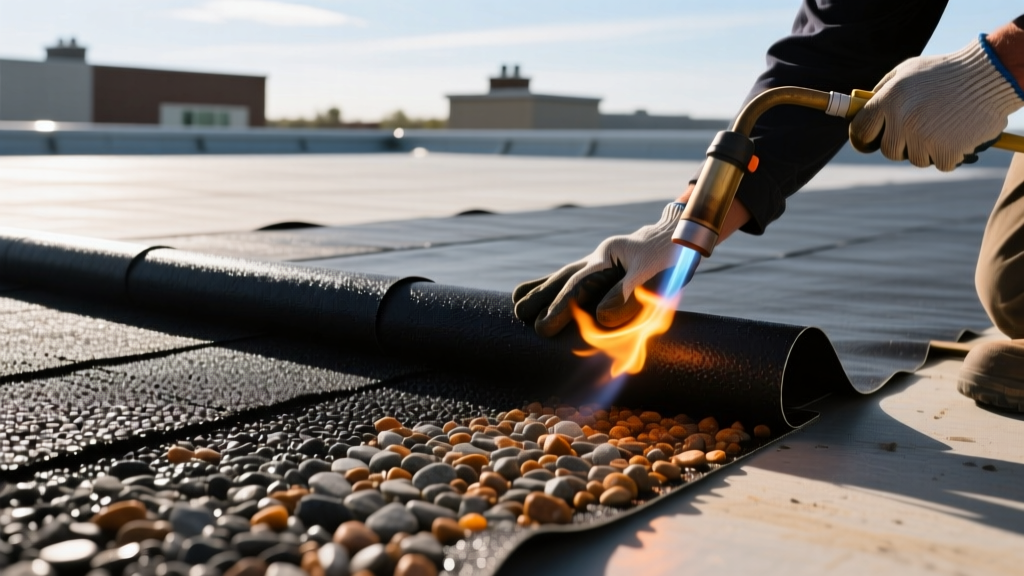
Torching melts the underside of the SBS sheet, fusing it to the substrate. It creates the strongest, most watertight bond. However, it is strictly prohibited in high-wind conditions, during dry drought seasons with high fire risk, and on occupied buildings where fumes or fire hazards are a liability. Ideal for dry, mild days (40°F to 85°F).
2. Cold-Process Adhesive
Cold adhesives are solvent-based or water-based liquid-applied bonding agents.
- Winter Advantage: Solvent-based cold adhesives can be applied in temperatures as low as 25°F, making them the only viable option for winter SBS installations in northern climates.
- Occupied Buildings: Low-VOC water-based adhesives are required for schools, hospitals, and multi-family residential buildings to prevent toxic fume infiltration through HVAC intakes.
3. Hot Mop (Asphalt Kettle)
Traditional hot asphalt mopping is still used for SBS base sheets, particularly over porous substrates like concrete or wood decking where the hot asphalt fills voids and creates a vapor barrier. It is highly effective in humid, rainy climates where moisture infiltration into the deck is a primary concern.
Real-World Cost Breakdown by Climate Zone
Pricing for SBS roofing material fluctuates based on regional labor rates, specific code requirements (like cool roof mandates), and the chosen installation method. Below are the estimated commercial low-slope costs per square foot for 2026.
Northern / Cold Zones
Material: $1.90 - $2.40 / sq.ft.
Labor (Cold Adhesive): $3.50 - $5.00 / sq.ft.
Total Installed: $5.40 - $7.40 / sq.ft.
Note: Cold adhesives and premium polyester mats increase material costs.
Southwest / Hot Zones
Material (Cool Roof Cap): $2.20 - $2.80 / sq.ft.
Labor (Torch): $2.80 - $4.20 / sq.ft.
Total Installed: $5.00 - $7.00 / sq.ft.
Note: Reflective granular cap sheets carry a 15-20% material premium.
Midwest / Hail Zones
Material (Heavy Duty): $2.10 - $2.60 / sq.ft.
Labor (Torch/Mop): $3.20 - $4.80 / sq.ft.
Total Installed: $5.30 - $7.40 / sq.ft.
Note: Requires dual-layer reinforced systems for impact rating.
Expert Troubleshooting: Climate-Induced Failure Modes
Even premium SBS roofing material will fail if the system design ignores local environmental stressors. Recognize these specific failure modes to prevent costly callbacks.
Alligatoring in High-UV Zones
Symptom: A network of interconnected cracks resembling alligator skin on the membrane surface.
Cause: UV radiation breaking down the exposed asphalt binder, usually due to delayed maintenance of an aluminum coating or specifying a smooth-surface SBS cap in a high-sun region.
Fix: Power wash the surface, apply an acrylic elastomeric roof coating (minimum 20 dry mils), and transition to a granular cap sheet during the next full replacement.
Membrane Splitting in Freeze-Thaw Zones
Symptom: Long, linear tears running parallel to roof deck joints or insulation board edges.
Cause: Using a fiberglass-reinforced SBS sheet (which has low elongation) over a substrate that expands and contracts significantly in winter. The rigid fiberglass scrim snaps under tension.
Fix: Cut out the damaged section, install a slip sheet or separation layer over the joint, and patch with a polyester-reinforced SBS membrane extending 12 inches past the tear in all directions.
Blistering in Humid / High-Rainfall Zones
Symptom: Raised, air-filled or water-filled bubbles under the membrane.
Cause: Moisture trapped in the insulation or concrete deck during installation. When the sun heats the roof, the moisture vaporizes, expands, and pushes the SBS membrane upward.
Fix: Do not pop blisters unless they are ruptured. If they exceed 2 inches in diameter, cross-cut the blister, allow the substrate to dry completely, apply cold adhesive, and patch with a new piece of granular SBS cap sheet.
Sourcing and Specifications: What to Ask Your Supplier
When procuring SBS roofing material for a specific climate, generic ordering leads to compromised performance. Provide your supplier or manufacturer representative with the following exact specifications:
- Polymer Type: Explicitly request SBS (Styrene-Butadiene-Styrene). Do not accept APP substitutes if the building is in a freeze-thaw zone.
- Reinforcement Scrim: Specify 'Polyester' (Type II) for cold/hail climates, or 'Fiberglass' (Type I) only for stable, hot climates where dimensional stability under high heat is prioritized over stretch.
- Surface Finish: Mandate 'Mineral Granular' for UV protection, specifying the exact Solar Reflectance Index (SRI) value required by local energy codes (typically SRI > 50 for cool roofs).
- Weight/Thickness: Request a minimum cap sheet weight of 72 lbs per square (approx. 145 mils) to ensure adequate asphalt coverage and durability against foot traffic.
Written by
Elena RodriguezElena Rodriguez is a civil engineer and technical writer specializing in concrete technology, masonry systems, and ASTM/ACI compliance. She earned her B.S. in Civil Engineering from Texas A&M University and spent a decade at a materials testing laboratory, performing over 2,000 concrete compressive strength tests and masonry prism evaluations. Elena is an ACI-certified Field Testing Technician (Grade I) and a member of ASTM Committee C12 on Natural Building Stone. She currently consults on forensic engineering cases involving concrete failures and moisture intrusion. Based in San Antonio, TX, Elena is a proud member of the Society of Women Engineers (SWE) and coaches her daughter's FIRST Robotics team.
More from Elena Rodriguez
View all
Walls & Panels
Cost Analysis: Light Gauge Steel Framing Advantages and Disadvantages
Evaluate light gauge steel framing advantages and disadvantages through a strict cost analysis lens, comparing material, labor, and lifecycle expenses.
Aug 4, 2026

Walls & Panels
Gypsum Board Types: Exact Specifications, Thickness & Dimensions
Compare standard, Type X, and moisture-resistant gypsum board types. Get exact specifications, thicknesses, dimensions, and ASTM standards for your project.
Aug 4, 2026

Fire Resistance
Best Fire-Resistant Outdoor Decking Materials: 2026 Buyer Guide
Discover the best fire-resistant outdoor decking materials for 2026. Compare Class A PVC, aluminum, and hardwood options for WUI compliance and safety.
Aug 4, 2026