Cheapest Roofing Material for Shed Builds: A Complete Cost Breakdown
Discover the cheapest roofing material for shed builds. We break down exact 2026 costs per square foot for rolled, shingle, metal, and rubber options.

The True Cost of 'Cheap' Shed Roofing
When searching for the cheapest roofing material for shed structures, builders often focus exclusively on the upfront price per square foot. However, a material that costs $0.50 per square foot but requires replacement every five years is ultimately more expensive than a $1.50 material that lasts three decades. Furthermore, the 'cheapest' option is entirely dependent on your shed's roof pitch. Installing asphalt products on a low-slope roof will result in immediate water intrusion, negating any initial savings.
Quick Cost Summary (Material Only)
- Absolute Cheapest: Mineral-Surfaced Rolled Roofing ($0.45 - $0.70 / sq. ft.)
- Best Value (Pitched): 29-Gauge Corrugated Steel ($1.40 - $1.90 / sq. ft.)
- Best Value (Flat/Low-Slope): 45-mil EPDM Rubber ($1.20 - $1.60 / sq. ft.)
Material-by-Material Cost Breakdown
Below is a detailed analysis of the most budget-friendly shed roofing materials available in 2026, including the specific hidden costs associated with each.
1. Mineral-Surfaced Rolled Roofing (MSR)
MSR is the undisputed champion of low upfront costs. It is essentially the same material as asphalt shingles but manufactured in long, thin rolls. A standard roll covers approximately 100 square feet (one 'square') and measures 36 inches wide by 33 feet long.
- Material Cost: $45 to $70 per roll ($0.45 - $0.70 per sq. ft.).
- Required Fasteners: 1-inch galvanized roofing nails with 3/8-inch heads, spaced 6 inches on center along the edges.
- Installation Profile: Requires a 2-inch side lap and a 4-inch end lap, sealed with roofing cement.
- Lifespan: 5 to 8 years.
The Catch: MSR is highly susceptible to UV degradation and thermal tearing. It must be installed on a roof with a minimum pitch of 2:12 (2 inches of vertical rise for every 12 inches of horizontal run). According to Family Handyman, failing to use adequate roofing cement on the overlaps is the primary cause of premature MSR failure.
2. 3-Tab Asphalt Shingles
For sheds with a steeper pitch (4:12 or greater), standard 3-tab shingles offer a more traditional aesthetic and better wind resistance than rolled roofing.
- Material Cost: $90 to $120 per square (3 bundles) ($0.90 - $1.20 per sq. ft.).
- Required Underlayment: #15 asphalt-saturated felt ($0.15 per sq. ft.). Do not skip this; bare decking will void any warranty.
- Required Fasteners: 1-1/4 inch galvanized roofing nails (4 nails per shingle).
- Lifespan: 15 to 20 years.
The Catch: 3-tab shingles require a ridge cap. You can cut the tabs off the shingles to create the cap, but this generates a 15% waste factor that must be calculated into your initial purchase. Wind warranties for budget 3-tab shingles typically max out at 60 mph.
3. 29-Gauge Corrugated Galvanized Steel
Corrugated metal panels offer the best lifecycle cost for budget builders. While the upfront material cost is higher than asphalt, the near-zero maintenance and 40-year lifespan make it the most economical choice over time.
- Material Cost: $1.40 to $1.90 per sq. ft. (for 29-gauge galvanized panels).
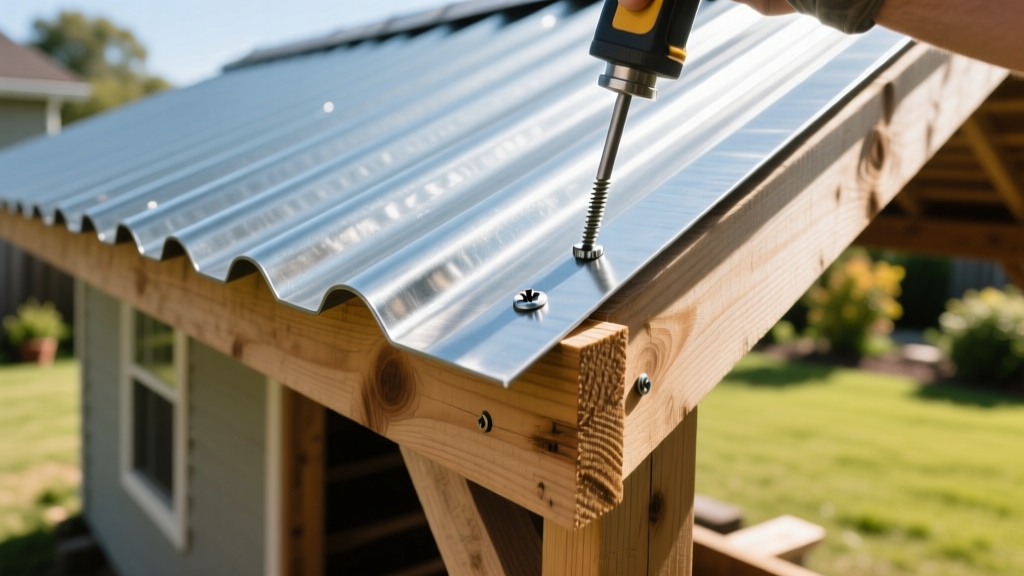
- Required Fasteners: 1.5-inch neoprene-washer woodgrip screws. Budget approximately $25 per 100 screws.
- Required Accessories: Foam closure strips for the corrugation gaps ($0.60 per linear foot) and ridge cap flashing.
- Lifespan: 30 to 50 years.
The Catch: Metal roofing requires precise cutting. Using an angle grinder burns off the galvanized zinc coating, leading to rapid rust at the cut edges. Always use electric metal shears or a nibbler. Furthermore, metal panels can be installed on pitches as low as 1/4:12 if lap seams are sealed with butyl tape, making it highly versatile.
4. 45-Mil EPDM Rubber Membrane
If your shed features a flat roof or a very low slope (under 2:12), asphalt and standard metal will leak. EPDM (ethylene propylene diene monomer) rubber is the most cost-effective solution for these specific architectural designs.
- Material Cost: $1.20 to $1.60 per sq. ft. for a 45-mil reinforced sheet.
- Required Adhesive: Water-based EPDM lap adhesive and primer ($60-$80 per gallon).
- Required Accessories: Termination bar, batten screws, and uncured EPDM flashing tape for pipe penetrations.
- Lifespan: 20 to 30 years.
The Catch: EPDM is easily punctured by falling branches or heavy foot traffic. If your shed is under a large oak tree, you must either add a protective walkway pad or choose a different material. For a comprehensive look at budget-friendly options, Bob Vila's guide to cheapest roofing materials highlights the importance of matching the membrane to the specific environmental stressors of your property.
Shed Roofing Comparison Matrix
| Material | Upfront Cost (per sq. ft.) | Min. Roof Pitch | DIY Difficulty | Hidden Cost Factor |
|---|---|---|---|---|
| Rolled Roofing (MSR) | $0.45 - $0.70 | 2:12 | Easy | High (Roofing cement, frequent replacement) |
| 3-Tab Shingles | $0.90 - $1.20 | 4:12 | Moderate | Medium (Underlayment, waste factor, drip edge) |
| Corrugated Steel | $1.40 - $1.90 | 1/4:12 (sealed) | Moderate | High (Closure strips, specialized fasteners, flashing) |
| EPDM Rubber | $1.20 - $1.60 | 0:12 (Flat) | Hard | High (Specialty adhesives, termination bars) |
Hidden Costs That Destroy Shed Roofing Budgets
Contractors and experienced DIYers know that the roofing membrane is only half the battle. To accurately budget your project, you must include the peripheral materials required for a watertight assembly.
Warning: The 'Low-Slope' Trap
Never install 3-tab shingles or standard MSR on a roof with a pitch below 2:12. Water will capillary-action backwards under the overlaps during wind-driven rain. If your shed pitch is between 1/4:12 and 2:12, you must use a continuous membrane (EPDM/TPO) or a standing-seam/lapped metal system sealed with butyl tape.
- Drip Edge Flashing: Often ignored on sheds, drip edge prevents water from wicking back under the roofing and rotting the fascia. Budget $0.80 to $1.20 per linear foot for 26-gauge galvanized drip edge.
- Fastener Overages: Always buy 20% more fasteners than your calculated square footage requires. Dropped screws and stripped neoprene washers are inevitable.
- Sealants: Do not use cheap silicone caulk on a roof. It will crack under UV exposure within two years. Use a polyurethane-based roofing sealant (such as Sikaflex-11C or OSI QUAD Max), which costs about $8 to $12 per tube but remains permanently flexible.
- Decking Repair: If you are re-roofing an existing shed, factor in the cost of replacing rotted OSB or plywood. A 4x8 sheet of 5/8-inch CDX plywood costs approximately $45 to $60 in 2026.
Pitch-Based Decision Framework
Use this exact framework to select your material based on your shed's architectural design:
- Is the roof completely flat (0:12) or very low slope (up to 2:12)?
- Action: Buy 45-mil EPDM rubber. Do not attempt to use asphalt products.
- Is the roof pitch between 2:12 and 4:12?
- Action: Choose 29-gauge corrugated steel (best lifecycle value) or Mineral-Surfaced Rolled Roofing (lowest immediate out-of-pocket cost).
- Is the roof pitch 4:12 or steeper?
- Action: You can safely use 3-tab asphalt shingles, architectural shingles, or metal panels. Choose 3-tab for the lowest upfront cost on steep pitches.
Pro-Tip for Sourcing: Check local commercial roofing suppliers for 'off-cuts' or partial rolls of EPDM and TPO. Commercial roofers frequently discard 10x10 foot sections that are too small for large buildings but perfectly sized for a standard 8x10 or 10x12 backyard shed, often available for pennies on the dollar.
By calculating the total system cost—including underlayment, specific fasteners, flashing, and sealants—rather than just the membrane price, you can accurately identify the true cheapest roofing material for shed projects that will actually keep your equipment and tools dry for decades.
Written by
Elena RodriguezElena Rodriguez is a civil engineer and technical writer specializing in concrete technology, masonry systems, and ASTM/ACI compliance. She earned her B.S. in Civil Engineering from Texas A&M University and spent a decade at a materials testing laboratory, performing over 2,000 concrete compressive strength tests and masonry prism evaluations. Elena is an ACI-certified Field Testing Technician (Grade I) and a member of ASTM Committee C12 on Natural Building Stone. She currently consults on forensic engineering cases involving concrete failures and moisture intrusion. Based in San Antonio, TX, Elena is a proud member of the Society of Women Engineers (SWE) and coaches her daughter's FIRST Robotics team.
More from Elena Rodriguez
View all
Walls & Panels
Cost Analysis: Light Gauge Steel Framing Advantages and Disadvantages
Evaluate light gauge steel framing advantages and disadvantages through a strict cost analysis lens, comparing material, labor, and lifecycle expenses.
Aug 4, 2026

Walls & Panels
Gypsum Board Types: Exact Specifications, Thickness & Dimensions
Compare standard, Type X, and moisture-resistant gypsum board types. Get exact specifications, thicknesses, dimensions, and ASTM standards for your project.
Aug 4, 2026

Fire Resistance
Best Fire-Resistant Outdoor Decking Materials: 2026 Buyer Guide
Discover the best fire-resistant outdoor decking materials for 2026. Compare Class A PVC, aluminum, and hardwood options for WUI compliance and safety.
Aug 4, 2026