Roof Rack Storage Systems: Material Taxonomy for Flat Roofs
Compare extruded aluminum, galvanized steel, and composite roof rack storage systems for commercial flat roofs. Includes load data and selection frameworks.
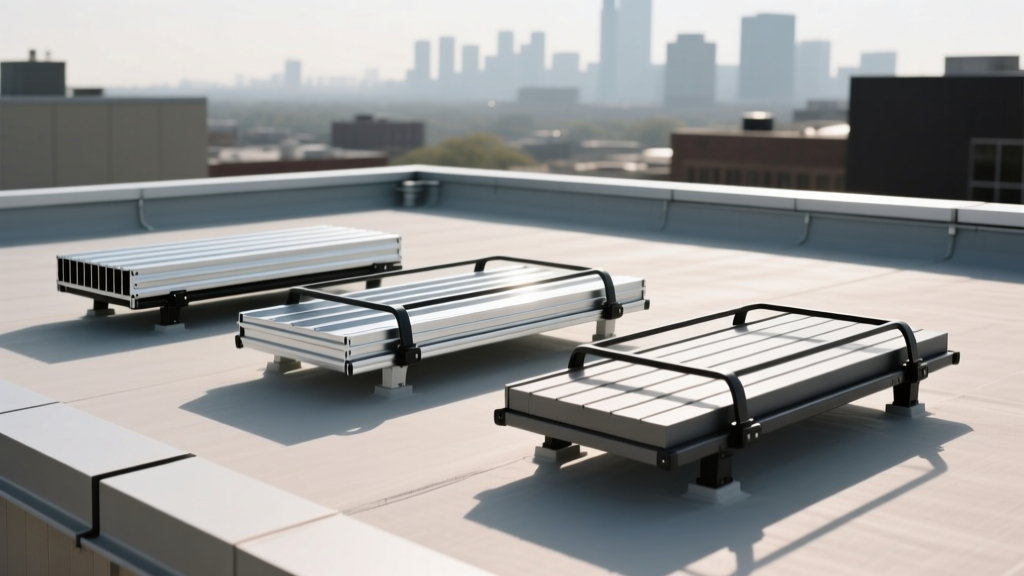
The Role of Roof Rack Storage in Membrane Protection
In commercial construction and facility management, 'roof rack storage' refers to the elevated structural frameworks used to support, organize, and store mechanical equipment, piping, solar arrays, and HVAC units above the roof membrane. Unlike residential automotive racks, commercial rooftop storage systems are critical engineering components designed to maximize usable roof space while strictly protecting the underlying waterproofing layers (TPO, EPDM, PVC, or modified bitumen).
The primary engineering mandate for any roof rack storage system is zero-penetration. Anchoring equipment directly into the roof deck creates thermal bridges, compromises structural integrity, and introduces catastrophic leak vectors. Modern roof rack storage relies on ballasted, non-penetrating base isolation paired with a rigid superstructure. Selecting the correct framework material dictates the system's longevity, wind-uplift resistance, and lifecycle cost.
Material Taxonomy: Comparing Roof Rack Frameworks
The structural framework of a roof rack storage system must withstand extreme UV exposure, thermal cycling, and high wind shear. Below is a comparative matrix of the three dominant material categories used in 2026 commercial applications.
| Material | Alloy / Grade | Weight (lbs/ft) | Avg Cost (per LF) | Corrosion Resistance | Ideal Environment |
|---|---|---|---|---|---|
| Extruded Aluminum | 6061-T6 | 1.8 - 2.4 | $55 - $85 | Excellent | Coastal, Chemical Plants |
| Galvanized Steel | A36 / Grade 50 | 4.5 - 6.2 | $35 - $55 | Moderate | Inland, High Ballast Needs |
| FRP Composite | Fiberglass / Vinyl Ester | 2.1 - 2.8 | $90 - $130 | Superior | High Acid, BIPV Solar |
Extruded Aluminum Systems (6061-T6)
Extruded aluminum is the industry standard for premium roof rack storage systems. The 6061-T6 alloy offers a tensile strength of 45,000 psi while remaining lightweight, which reduces the dead load placed on the building's structural deck. Aluminum naturally forms a protective oxide layer, making it highly resistant to atmospheric corrosion. However, specifiers must account for its high coefficient of thermal expansion (13 x 10^-6 in/in/°F). In regions with extreme temperature swings, a 50-foot continuous aluminum run can expand or contract by nearly half an inch, necessitating the use of slotted expansion joints and neoprene isolators to prevent binding and fastener shear.
Galvanized Steel and Kee Klamp Fittings
For heavy-duty storage racks supporting massive chillers or dense piping arrays, hot-dip galvanized steel (compliant with ASTM A123) provides superior compressive strength. Steel systems often utilize slip-on Kee Klamp fittings, which eliminate the need for on-site welding or threading—preserving the zinc coating and accelerating installation. The primary advantage of steel in roof rack storage is its mass; the inherent weight of the steel framework contributes to the system's overall dead load, reducing the amount of concrete ballast pavers required to counteract wind uplift. The trade-off is susceptibility to white rust and eventual red rust if the galvanized coating is scored during installation.
Fiber-Reinforced Polymer (FRP) Racks
FRP roof rack storage systems are niche but critical in highly corrosive environments, such as chemical processing facilities or coastal desalination plants. FRP is entirely non-conductive and non-magnetic, making it the mandatory choice for roof rack storage supporting sensitive telecommunications equipment or high-voltage solar inverters. While the upfront cost is roughly double that of aluminum, the zero-maintenance lifecycle in ISO 12944 C5 (very high corrosivity) environments justifies the capital expenditure.
Load Dynamics and Wind Uplift Considerations
Designing a roof rack storage system requires rigorous adherence to the ASCE 7-22 standard for minimum design loads. The framework must be engineered to resist both gravity loads (the weight of the stored equipment plus the rack itself) and environmental uplift.
- Dead Load (D): The physical weight of the rack, stored HVAC units, and ballast blocks. Most commercial flat roofs are engineered for a minimum 20 psf dead load, but localized point loads from rack feet can exceed 1,500 lbs per pad.
- Wind Uplift (W): Wind flowing over the building parapet creates negative pressure zones, particularly at the roof perimeter and corners. Roof rack storage systems act as aerofoils; if not properly ballasted, the uplift force can easily exceed the system's dead weight, causing the entire rack to slide or tip.
- Seismic Shear (V): In seismic design categories D, E, and F, the roof rack must incorporate lateral bracing and snubbers to prevent stored materials from shifting or toppling during a seismic event.
Base Isolation: Protecting the Membrane
The interface between the roof rack storage legs and the roof membrane is the most common point of failure. The National Roofing Contractors Association (NRCA) strictly advises against resting bare metal or concrete directly on single-ply membranes. Proper base isolation requires a multi-layered approach:
- Waffle Pads / Cradle Systems: Recycled rubber or EPDM waffle pads (minimum 70A Shore hardness) are placed directly on the membrane. The waffle pattern allows water to drain freely beneath the support foot, preventing ponding water and biological growth.
- Concrete Ballast Pavers: A pre-cast concrete paver (typically 24x24 inches, weighing 180-250 lbs) is placed on the waffle pad to provide the necessary mass for wind uplift resistance.
- Neoprene Shims: A 1/4-inch neoprene shim is placed between the concrete paver and the metal rack base plate to prevent galvanic corrosion and absorb micro-vibrations from HVAC compressors.
'Galvanic corrosion is the silent killer of roof rack storage systems. If you are using an aluminum superstructure, you must ensure that the aluminum base plates never make direct contact with galvanized steel ballast trays or concrete pavers with high alkaline content. Always specify dielectric neoprene separators at every junction.'
Selection Framework: Matching Material to Environment
To select the optimal roof rack storage material for your specific project, follow this diagnostic decision tree:
- Step 1: Assess Atmospheric Corrosivity. Reference the ISO 12944 standard. If the building is within 5 miles of a saltwater coastline (Category C4 or C5), eliminate galvanized steel immediately. Specify anodized 6061-T6 aluminum or FRP.
- Step 2: Calculate the Uplift-to-Dead-Load Ratio. If wind uplift calculations require more than 400 lbs of ballast per support point, aluminum racks may struggle to support the sheer mass of the required pavers without massive structural deflection. In high-ballast scenarios, transition to heavy-duty galvanized steel with reinforced gusset plates.
- Step 3: Evaluate Thermal Bridging Risks. If the roof rack storage system is penetrating an insulated parapet or tying into the building's structural steel, use FRP or thermally broken aluminum extrusions to prevent condensation and energy loss inside the building envelope.
- Step 4: Verify Roof Deck Capacity. Consult the structural drawings for the roof's live and dead load limits. If the deck is lightweight concrete or fluted steel with strict load limits, you must utilize lightweight aluminum racks and distribute the load using continuous sleeper beams rather than discrete point-load pavers.
By rigorously applying this material taxonomy and respecting the physics of wind uplift and membrane protection, facility managers and contractors can deploy roof rack storage systems that maximize rooftop utility without compromising the building's waterproofing envelope.