Torch Down Roofing Materials: Durability and Lifespan Guide
Discover how torch down roofing materials perform over time. Learn the real lifespan of SBS and APP membranes, failure modes, and maintenance tips.

The Chemistry of Durability: APP vs. SBS Membranes
When evaluating flat and low-slope commercial structures, torch down roofing materials—specifically modified bitumen (mod-bit) membranes—remain a dominant choice due to their exceptional puncture resistance and tensile strength. However, the term 'torch down' encompasses two distinct chemical formulations that dictate the roof's ultimate lifespan: Atactic Polypropylene (APP) and Styrene-Butadiene-Styrene (SBS). Understanding the polymer science behind these materials is the first step in predicting their long-term durability.
According to the Asphalt Roofing Manufacturers Association (ARMA), the modifier used in the asphalt compound fundamentally alters how the membrane reacts to thermal shock, UV radiation, and structural movement over a 20-year period.
| Feature | SBS (Styrene-Butadiene-Styrene) | APP (Atactic Polypropylene) |
|---|---|---|
| Polymer Type | Synthetic Rubber (Thermoplastic Elastomer) | Plastic (Thermoplastic Polymer) |
| Flexibility | Highly elastic; stretches up to 6x its length | Rigid; limited elongation before stress |
| Best Climate | Northern climates with extreme freeze-thaw cycles | Southern climates with high UV and sustained heat |
| Melt Temperature | Lower (approx. 350°F - 400°F at the membrane) | Higher (approx. 450°F - 500°F at the membrane) |
| Expected Base Lifespan | 15 - 20 Years | 20 - 25 Years |
SBS membranes act like rubber bands, allowing the roof to expand and contract with the building's substrate without tearing the seams. Conversely, APP membranes behave more like plastic, offering superior resistance to the sun's ultraviolet rays and high ambient temperatures, making them less prone to softening and blistering in regions where roof surface temperatures routinely exceed 160°F.
Real-World Lifespan: 2-Ply vs. 3-Ply Systems
The longevity of torch down roofing materials is not solely dependent on the chemical modifier; the physical architecture of the roof system plays an equally critical role. Modern installations typically utilize either a 2-ply or 3-ply configuration, which directly impacts both the initial capital expenditure and the time until major rehabilitation is required.
The 2-Ply System (Base Sheet + Cap Sheet)
A standard 2-ply system consists of a smooth base sheet mechanically fastened or torched to the substrate, topped with a granulated cap sheet. The cap sheet is typically 160 mils thick. As of 2026, installed costs for a high-quality 2-ply SBS system range from $5.50 to $8.00 per square foot. While economical, the single layer of waterproofing asphalt between the granules and the base sheet leaves little margin for error if the cap sheet is punctured by heavy hail or dropped HVAC equipment.
The 3-Ply System (Base + Interply + Cap Sheet)
Adding an intermediate ply (interply) creates a redundant waterproofing barrier. If a severe impact breaches the granular cap sheet, the interply membrane prevents immediate water intrusion into the building envelope. A 3-ply system pushes the expected lifespan from 20 years to 25+ years, with installed costs ranging from $8.50 to $11.50 per square foot. For facilities where interior water damage would be catastrophic, the 30% premium for the third ply yields a superior long-term ROI.
The Anatomy of a Torch Down Failure
When torch down roofing materials fail prematurely (before the 12-year mark), the culprit is rarely the material itself. According to technical bulletins from GAF's low-slope engineering division, over 80% of mod-bit failures stem from application errors and localized environmental stressors.
1. Under-Torched Seams (Cold Laps)
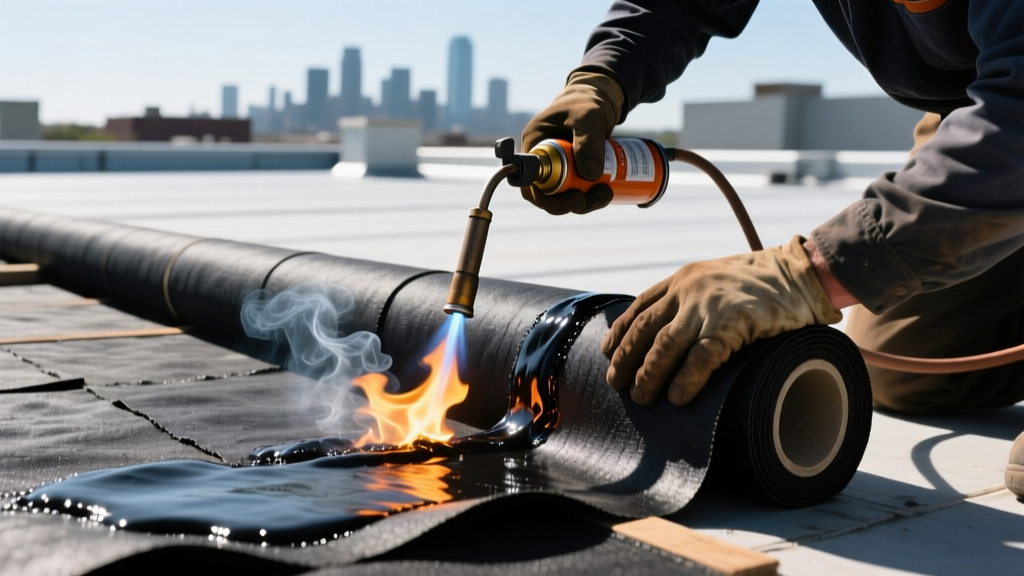
Torch application requires heating the bottom of the roll until the asphalt reaches a liquid viscosity. The installer must look for a 'bleed-out'—a continuous bead of melted asphalt squeezing out at the side and end laps. The industry standard dictates a bleed-out of exactly 1/4-inch to 3/8-inch. If the bleed-out is absent or intermittent, the seam is under-torched. Over time, thermal cycling will cause these cold laps to peel open, creating direct pathways for water ingress.
2. Over-Torched Membranes (Burn-Through)
Conversely, lingering too long with the propane torch (which burns at 1,000°F to 1,500°F at the nozzle) degrades the polymer modifiers. Over-torched SBS loses its elastic memory, becoming brittle. Visually, this presents as a scorched, bubbled texture on the seam with a bleed-out exceeding 1/2-inch. These seams will crack within 3 to 5 years under structural movement.
Modified bitumen is water-resistant, not waterproof under constant hydrostatic pressure. If a roof lacks adequate taper (minimum 1/4-inch per foot slope) and water ponds for more than 48 hours, the asphalt will eventually re-emulsify and degrade. Always specify crickets or tapered polyiso insulation to eliminate dead-level areas.
3. Granule Depletion and UV Oxidation
The ceramic-coated mineral granules on the cap sheet serve as the membrane's sunscreen. In high-wind corridors or areas with heavy foot traffic from HVAC technicians, granule loss exposes the black asphalt substrate to direct UV radiation. Once exposed, the asphalt oxidizes, leading to 'alligatoring' (a network of deep surface cracks). Once alligatoring reaches the mat reinforcement, the membrane's structural integrity is compromised, and localized patching is no longer viable.
Proactive Maintenance to Push Past 20 Years
To maximize the lifespan of torch down roofing materials, facility managers must transition from a reactive repair mindset to a predictive maintenance framework. Implement the following bi-annual protocol:
- Seam Integrity Mapping (Spring): Walk all perimeter flashings, penetrations, and field seams. Use a blunt-nosed probe to test the edges of the bleed-out. If the probe catches or lifts the seam edge, schedule immediate heat-welding repairs before the summer thermal expansion cycle widens the gap.
- Granule Loss Assessment (Autumn): Inspect areas beneath ladders, satellite dishes, and HVAC access hatches. If the substrate is visible, apply a cold-process liquid flashing or a granule-surfaced bitumen mastic to restore UV protection before winter freeze-thaw cycles begin.
- Drain and Scupper Clearance (Monthly): Ensure primary drains and secondary overflow scuppers are free of debris. A clogged scupper that allows water to pool against a parapet wall will inevitably lead to capillary action pulling water behind the flashing.
- Walkway Pad Installation: Mandate the installation of heavy-duty rubber walkway pads (minimum 3/16-inch thick) along all routes frequently used by maintenance personnel. This prevents mechanical crushing of the granules and protects the seams from repetitive compression.
When to Repair vs. When to Replace
Deciding whether to patch a failing mod-bit roof or invest in a full tear-off requires evaluating the extent of moisture infiltration within the underlying insulation. Use this decision matrix to guide capital planning:
- Targeted Repair: Isolated seam failures (affecting less than 5% of the total roof area), localized punctures from dropped tools, or minor flashing detachment. Repair costs typically range from $500 to $1,500 per incident.
- Roof Coating (Restoration): Widespread granule loss and surface oxidation, but the underlying insulation is completely dry (verified via infrared moisture scan). An elastomeric acrylic or silicone coating can add 10 years of life at roughly 40% of the cost of a full replacement.
- Full Tear-Off and Replacement: Moisture saturation in the polyiso or EPS insulation exceeding 20% of the roof area, widespread alligatoring that has penetrated the reinforcement mat, or systemic blistering across the field of the roof. Attempting to coat or patch a wet roof system will trap moisture, accelerating deck rot and causing catastrophic membrane failure within 24 months.
By matching the specific polymer chemistry to the local climate, enforcing strict bleed-out tolerances during installation, and executing a rigorous maintenance protocol, building owners can reliably extract two to three decades of high-performance service from torch down roofing materials.
Written by
Sarah WhitfieldSarah Whitfield is a chartered quantity surveyor (MRICS) and construction cost analyst with 15 years of experience in material pricing, procurement strategy, and project budgeting. She earned her degree in Construction Management from the University of Reading (UK) and has worked on projects ranging from $2M custom homes to $180M mixed-use developments across North America and Europe. Sarah currently leads cost estimating for BuildMat Insight, maintaining a proprietary database of 4,000+ material price points updated quarterly. She is a frequent contributor to RSMeans cost data panels and has presented at the International Cost Engineering Council (ICEC) congress. Based in Denver, CO, Sarah is an avid trail runner and volunteer mentor for Women in Construction.
More from Sarah Whitfield
View all
Wood & Lumber
What Are the Different Types of Wood? A Builder's Guide
Compare structural softwoods, finish hardwoods, and engineered lumber. Analyze Janka ratings, MOE values, and 2026 pricing for construction.
Aug 4, 2026

Walls & Panels
Steel Framing vs Wood Framing: Corrosion and Moisture Defense
Compare steel framing vs wood framing for moisture resistance. Learn about galvanized coatings, condensation risks, and corrosion protection strategies.
Jul 21, 2026

Stone & Masonry
How to Cut Stone Veneer: Wet Saw vs Grinder Comparison
Compare the best tools for cutting stone veneer. We review wet saws, angle grinders, and chop saws to help you achieve clean, chip-free cuts.
Jul 21, 2026