How to Choose and Apply the Right Roof Patch Material
Learn how to correctly apply roof patch material to stop active leaks on asphalt, metal, and flat roofs with this step-by-step emergency repair guide.

Matching Roof Patch Material to Your Substrate
The most common cause of premature patch failure is chemical incompatibility between the roof patch material and the existing roof substrate. Asphalt-based mastics will chemically degrade EPDM rubber membranes, while standard acrylic sealants will peel off metal roofs due to thermal expansion. Selecting the correct chemistry ensures a watertight bond that withstands UV exposure and thermal shock.
| Roof Substrate | Recommended Chemistry | Industry-Standard Product | Approx. Cost (2026) |
|---|---|---|---|
| Asphalt Shingles / Mod-Bit | Asphalt Mastic / Roof Cement | Henry 208R Rubberized Wet Patch | $18 - $24 / 10.1oz tube |
| EPDM Rubber (Single-Ply) | Butyl / EPDM Tape & Primer | EternaBond RoofSeal MicroSealant | $45 - $60 / 4" x 50' roll |
| TPO / PVC (Single-Ply) | 100% Silicone or Polyurethane | GacoRoof 100% Silicone Coating | $65 - $85 / gallon |
| Metal Roofing (Standing Seam) | Tripolymer / Elastomeric Sealant | Geocel 2300 Construction Sealant | $20 - $28 / 10.1oz tube |
Surface Preparation: The Non-Negotiable First Step
Adhesion failure accounts for over 80% of emergency roof patch failures. No roof patch material will bond to dirt, oxidized asphalt, or biological growth. Preparation protocols vary strictly by material:
- Asphalt and Mod-Bit: Remove loose gravel, blistered asphalt, and debris with a stiff wire brush. If the surface is actively leaking, use a wet-surface compatible mastic (like Henry 208R) which contains solvents that displace water molecules at the microscopic level.
- EPDM and TPO: Wipe the membrane with a dedicated membrane cleaner or denatured alcohol. Do not use standard household degreasers, which leave a surfactant residue that prevents tape adhesion. For TPO, lightly scuff the surface with a scouring pad to break the factory oxidation layer before applying primer.
- Metal Roofs: Remove rust and flaking paint down to bare metal using an abrasive flap disc. Wipe with a solvent like MEK (Methyl Ethyl Ketone) to remove cutting oils and environmental pollutants.
Application Protocol: Asphalt Mastic and Cements
When patching cracked flashing, damaged shingle tabs, or minor ponding areas on flat modified bitumen roofs, a three-layer mastic application provides the highest tensile strength.
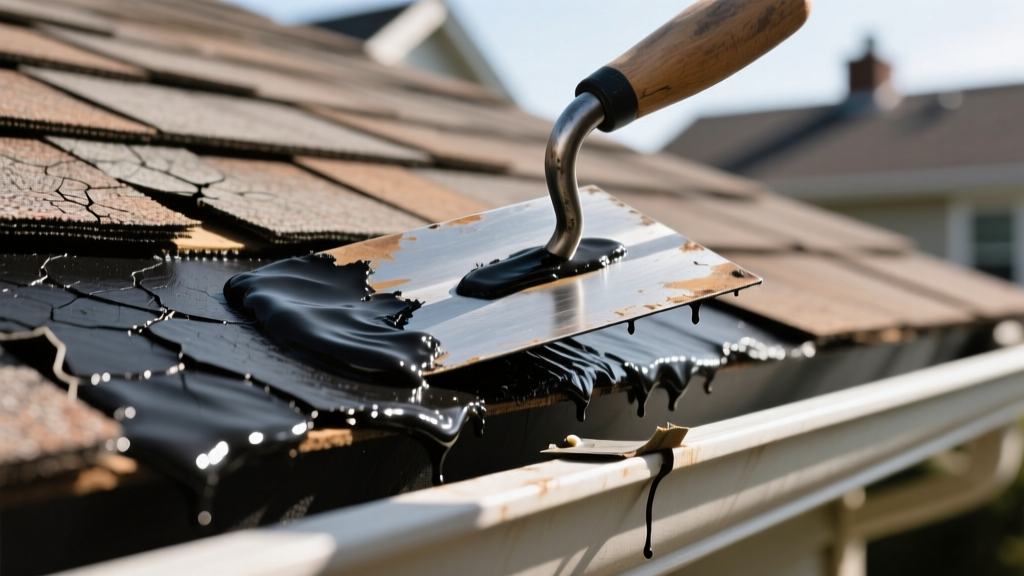
- Base Coat Application: Using a 1/8-inch notched trowel, apply a base layer of asphalt mastic extending at least 3 inches beyond the perimeter of the damage. The notched trowel ensures a uniform thickness, preventing thick ridges that trap water.
- Reinforcement Embedding: Immediately press a layer of fiberglass roofing mesh (e.g., Henry 183 Yellow Fiberglass Fabric) into the wet base coat. The mesh acts as rebar, providing structural integrity and preventing the mastic from cracking under thermal expansion.
- Top Coat and Feathering: Apply a second layer of mastic over the mesh, fully encapsulating it. Use a flat putty knife to feather the edges down to zero thickness. A hard, 90-degree edge will catch water and wind, leading to peeling within a single season.
Application Protocol: Single-Ply Membranes (EPDM/TPO)
Liquid mastics are generally prohibited on EPDM and TPO roofs because the petroleum distillates in the mastic will cause the rubber to swell, blister, and ultimately dissolve. Instead, rely on microsealant tapes or silicone-based liquids.
Installing EPDM Peel-and-Stick Tape
- Apply a thin, even coat of EPDM primer (e.g., QuickPrime Plus) to the cleaned membrane and allow it to flash off until it is tacky but does not transfer to a clean knuckle (typically 10-15 minutes).
- Unroll the EternaBond or equivalent butyl tape, keeping it taut but not stretched. Stretching the tape creates latent tension that will cause it to shrink back and pull away from the edges over time.
- Press the tape into place and immediately apply pressure using a minimum 2-pound steel seam roller. Roll from the center outward to expel trapped air bubbles. Proper pressure activates the microsealant beads embedded in the adhesive layer.
Metal Roof Fastener and Seam Repairs
Metal roofs leak primarily at fastener penetrations and horizontal end-laps where neoprene washers degrade. Do not use standard silicone caulk on metal roofs; silicone lacks the elasticity to handle the extreme thermal expansion and contraction of steel or aluminum panels.
Instead, use a high-solids tripolymer sealant like Geocel 2300 or a polyurethane roofing sealant. These materials offer 400% to 600% elongation, allowing them to stretch with the metal panels without tearing. Apply a 1/2-inch bead over the fastener head, creating a dome shape that sheds water. For larger horizontal seam gaps, inject the sealant deep into the joint before capping with a 4-inch wide strip of butyl-backed aluminum flashing tape.
Critical Failure Modes and Edge Cases
Even with the correct roof patch material, improper execution leads to rapid failure. Watch for these specific edge cases:
If water has saturated the underlying polyisocyanurate or wood fiberboard insulation, applying a surface patch will trap the moisture. When the sun heats the roof, the trapped water turns to steam, creating immense vapor pressure that will blister and blow off the patch. Always probe the substrate with a moisture meter before patching. If the insulation is wet, the roof section must be cut out and replaced, not patched.
UV Degradation of Uncured Mastics
Standard asphalt roof cements (unless specifically labeled as UV-stable or aluminum-coated) will dry out, alligator, and crack when exposed to direct sunlight for more than 12 months. If your patch is in a high-sun exposure area, you must top-coat the asphalt mastic with an aluminum roof coating or a layer of matching mineral-surfaced cap sheet to protect it from UV radiation.
Safety and Fall Protection
Emergency leak repairs often occur during or immediately after severe weather, increasing slip hazards. According to OSHA Fall Protection standards, any work on a roof with a slope greater than 4:12 requires conventional fall protection systems, such as a personal fall arrest system (PFAS) tied to a structural anchor point. Never rely on wet asphalt shingles or slick TPO membranes for traction. For low-slope commercial roofs, maintain a minimum 15-foot clearance from unprotected edges unless guardrails or warning lines are properly established per NRCA Technical Resources.
When to Abandon the Patch and Call a Professional
A roof patch material is designed for localized, acute damage (e.g., a fallen branch, a single blown-off shingle, or a minor flashing separation). It is not a cure for systemic roof failure. Consult a licensed roofing contractor and review ARMA Technical Publications for replacement guidelines if you observe any of the following:
- Widespread Alligatoring: If the flat roof surface exhibits interconnected cracking resembling alligator skin across more than 20% of the roof area, the asphalt binder has exhausted its chemical lifespan.
- Multiple Active Leaks: If you are tracking three or more distinct leaks, the membrane is likely failing at the seams or the underlayment is compromised. Patching individual leaks will result in a game of 'whack-a-mole' as water travels laterally beneath the membrane.
- Structural Deck Deflection: If the roof deck sags or feels spongy underfoot, the structural integrity of the plywood or OSB decking is compromised by long-term rot. No surface patch will adhere to a flexing, rotting substrate.
By matching the exact chemistry of the roof patch material to your substrate, executing rigorous surface preparation, and respecting the physical limits of temporary repairs, you can effectively stop active leaks and protect the building interior until permanent repairs or full replacement can be scheduled.
Written by
Elena RodriguezElena Rodriguez is a civil engineer and technical writer specializing in concrete technology, masonry systems, and ASTM/ACI compliance. She earned her B.S. in Civil Engineering from Texas A&M University and spent a decade at a materials testing laboratory, performing over 2,000 concrete compressive strength tests and masonry prism evaluations. Elena is an ACI-certified Field Testing Technician (Grade I) and a member of ASTM Committee C12 on Natural Building Stone. She currently consults on forensic engineering cases involving concrete failures and moisture intrusion. Based in San Antonio, TX, Elena is a proud member of the Society of Women Engineers (SWE) and coaches her daughter's FIRST Robotics team.
More from Elena Rodriguez
View all
Walls & Panels
Cost Analysis: Light Gauge Steel Framing Advantages and Disadvantages
Evaluate light gauge steel framing advantages and disadvantages through a strict cost analysis lens, comparing material, labor, and lifecycle expenses.
Aug 4, 2026

Walls & Panels
Gypsum Board Types: Exact Specifications, Thickness & Dimensions
Compare standard, Type X, and moisture-resistant gypsum board types. Get exact specifications, thicknesses, dimensions, and ASTM standards for your project.
Aug 4, 2026

Fire Resistance
Best Fire-Resistant Outdoor Decking Materials: 2026 Buyer Guide
Discover the best fire-resistant outdoor decking materials for 2026. Compare Class A PVC, aluminum, and hardwood options for WUI compliance and safety.
Aug 4, 2026