Roof Repair Cost Estimator: 2026 Pricing & Calculator Guide
Calculate your exact roof repair cost with our 2026 pricing guide. Break down material, labor, and hidden fees for asphalt, metal, and flat roofs.
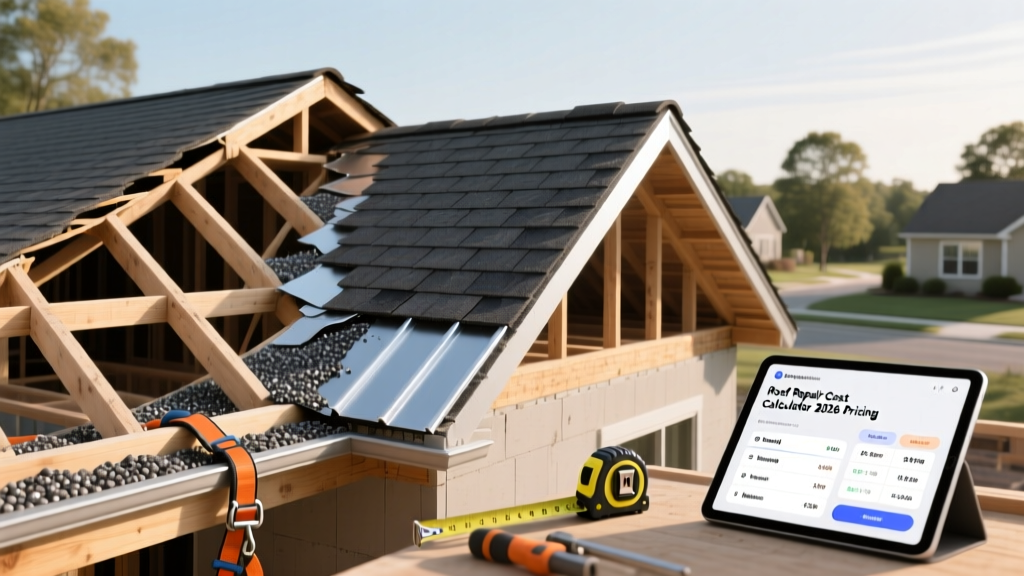
The True Roof Repair Cost: Decoding the 2026 Baseline
Estimating a roof repair cost requires moving beyond generic national averages. In 2026, the roofing industry is defined by stabilized material supply chains but a persistent premium on skilled, licensed labor. A minor leak might cost $450 to patch, while structural decking rot can push a localized repair past $3,500. To build an accurate budget, homeowners and facility managers must calculate costs based on roofing "squares," specific failure modes, and architectural complexity multipliers.
According to the National Roofing Contractors Association (NRCA), premature roof failures are most frequently caused by improper flashing installation and inadequate ventilation, not the shingles themselves. Understanding this distinction is the first step in accurately calculating your repair estimate, as labor-intensive flashing repairs carry a vastly different cost-per-square-foot than simple surface shingle replacement.
The Roof Repair Cost Calculator Formula
Professional estimators do not price repairs by the square foot; they price them by the "square" (a 10x10 foot area, equaling 100 square feet). To calculate your baseline roof repair cost, use the following framework:
Step 1: Calculate the Repair Area in Squares
Measure the length and width of the damaged roof plane (not the interior floor plan, as roof pitch increases surface area). Divide the total square footage by 100. Always add a 10% waste factor for material cuts and overlaps.
Step 2: Apply the 2026 Material and Labor Matrix
Multiply your total squares by the combined material and labor rate for your specific roofing system. The table below outlines current market rates for localized repairs (under 5 squares). Note that partial repairs often incur a 15-20% premium over full-replacement per-square rates due to the precision required to tie new materials into existing, weathered layers.
| Roofing Material | Material Cost (Per Square) | Labor Rate (Per Square) | Total Repair Cost (Per Sq. Ft.) |
|---|---|---|---|
| 3-Tab Asphalt Shingle | $95 - $130 | $175 - $250 | $2.70 - $3.80 |
| Architectural Shingle | $140 - $190 | $225 - $325 | $3.65 - $5.15 |
| Standing Seam Metal | $450 - $700 (Panel) | $350 - $500 | $12.00 - $18.00* |
| EPDM Membrane (Flat) | $110 - $160 | $200 - $300 | $3.10 - $4.60 |
| Clay / Concrete Tile | $15 - $35 (Per Tile) | $75 - $125 (Per Hr) | $12.00 - $22.00** |
*Metal roofing is typically priced by linear foot for seam repairs or per panel for impact damage.
**Tile repair costs are highly variable based on the need to remove and reinstall surrounding tiles to access the underlayment.
Cost Breakdown by Specific Failure Mode
A leak is a symptom, not the root cause. Your final roof repair cost will depend entirely on the underlying failure mode. Here is what to expect when pricing specific structural and surface repairs in 2026.
1. Flashing and Penetration Leaks
Flashing accounts for up to 90% of all roof leaks. Repairing step flashing along a wall or chimney requires carefully removing the adjacent shingles, installing new galvanized steel or copper flashing, and weaving it back into the existing courses.
- Step Flashing Replacement: $22 - $38 per linear foot.
- Chimney Cricket Rebuilding: $850 - $1,600 (requires custom framing and metalwork).
- Pipe Boot Replacement: $250 - $450 per vent (includes replacing cracked neoprene or lead boots with modern UV-resistant TPO or metal-backed alternatives).
2. Roof Decking (Sheathing) Rot
If water has bypassed the underlayment, the wood decking must be replaced. In 2026, 5/8-inch CDX plywood remains the gold standard for repairs due to its superior moisture resistance compared to OSB (Oriented Strand Board).
- CDX Plywood Replacement: $75 - $95 per 4x8 sheet installed.
- OSB Replacement: $50 - $70 per 4x8 sheet installed (Not recommended for areas prone to ice dams or high humidity).
3. Underlayment Failure
When repairing a section of the roof, upgrading the underlayment is a critical defense layer. While traditional #15 asphalt felt costs about $15 per square, synthetic underlayments (like Tyvek Protec or GAF FeltBuster) cost $25 - $35 per square. The U.S. Department of Energy notes that proper underlayment and ventilation integration is vital for cool roof systems and overall thermal envelope integrity, making the $10 upgrade per square a mandatory inclusion in any 2026 repair estimate.
Standard labor rates apply to roofs with a pitch between 4/12 and 6/12. If your roof pitch is 8/12 or steeper, contractors will apply a 20% to 30% labor multiplier due to the requirement for specialized fall arrest systems, roof jacks, and slower material staging. For pitches over 12/12, expect a 40% to 50% premium and a mandatory minimum crew size of four.
DIY vs. Professional Repair: Financial Break-Even Analysis
Deciding whether to self-perform a repair or hire a licensed contractor hinges on the intersection of safety, warranty preservation, and the "minimum call-out fee" economics.
The Professional Minimum: Most reputable roofing contractors charge a minimum diagnostic and mobilization fee of $350 to $550, regardless of how small the repair is. This covers truck rolls, insurance overhead, and initial setup.
The DIY Break-Even Point: A high-quality DIY asphalt patch kit (including roofing cement, mesh fabric, and replacement shingles) costs roughly $65. Therefore, if the damaged area is less than 2 square feet and safely accessible (e.g., a single-story porch roof with a 4/12 pitch), DIY yields a net savings of roughly $300. However, if the repair involves breaking the plane of the underlayment, working near valleys, or requires metal fabrication, the risk of voiding your primary roof warranty or causing secondary interior water damage (which the Insurance Information Institute notes is one of the most frequent and costly homeowner claims) far outweighs the initial savings.
Regional Labor Multipliers for 2026
Material costs are relatively uniform nationally due to bulk distribution networks, but labor rates fluctuate wildly based on local union prevalence, insurance requirements, and regional demand spikes following severe weather events.
- Northeast & West Coast (High Cost): Add 25-35% to baseline labor rates. Strict municipal permitting and high workers' compensation insurance premiums drive costs up. Expect $125-$175 per hour for skilled journeyman roofers.
- Midwest & Southeast (Baseline): Standard labor rates apply. Highly competitive markets keep pricing aligned with the national matrix provided above.
- Post-Storm Surge Pricing: If your repair is necessitated by a regional hail or wind event, expect a temporary 15-20% "surge" premium on labor as out-of-state contractors mobilize and local demand outpaces supply. Always verify contractor credentials to avoid storm-chaser scams.
Roof Repair Estimation FAQs
Does a repair require a municipal building permit?
Generally, cosmetic repairs (replacing fewer than 3 squares of shingles or fixing a pipe boot) do not require a permit. However, if the repair involves structural decking replacement exceeding 10% of the roof plane, or altering the drainage system on a commercial flat roof, local building codes will mandate a permit. Budget $150 to $400 for permit fees and factor in a 1-2 week delay for inspections.
How do I calculate the cost of a flat roof ponding water repair?
Ponding water on EPDM or TPO flat roofs requires building up the low areas with rigid polyiso insulation tapers before applying a new membrane layer. Calculate the volume of the depression (Length x Width x Depth in inches), convert to board feet of insulation, and add $4.50 - $7.00 per square foot for the localized membrane overlay and adhesive.
Can I repair a metal roof with exposed fasteners myself?
While replacing neoprene washer screws on an exposed-fastener agricultural metal roof is a common DIY task, overtightening the screws is the leading cause of secondary leaks. The washer must compress exactly to the diameter of the screw head—no more, no less. Use a specialized depth-sensitive screw gun attachment (approx. $45) rather than a standard impact driver to ensure uniform compression across the repair zone.