Selecting the Best Types of Commercial Flat Roofing Materials
Evaluate the top types of commercial flat roofing materials using our selection framework. Compare TPO, PVC, EPDM, and Mod-Bit costs and lifespans.

The Commercial Flat Roof Selection Matrix
Choosing from the various types of commercial flat roofing materials requires moving beyond basic price comparisons. Facility managers and architects must evaluate chemical resistance, thermal shock tolerance, deck load capacity, and long-term maintenance profiles. The following matrix establishes a baseline for the five primary low-slope systems used in modern commercial construction.
| Material | Best Application | Expected Lifespan | Chemical Resistance | Installed Cost (per sq. ft.) |
|---|---|---|---|---|
| TPO (Thermoplastic Polyolefin) | Standard retail, warehouses, offices | 20-30 years | Moderate | $4.50 - $7.00 |
| PVC (Polyvinyl Chloride) | Restaurants, chemical plants, hospitals | 25-35 years | Exceptional | $6.50 - $9.50 |
| EPDM (Ethylene Propylene Diene Monomer) | Cold climates, ballasted systems | 25-30 years | Low (degrades with oils) | $4.00 - $6.50 |
| Modified Bitumen (Mod-Bit) | High foot traffic, plazas, heavy HVAC | 20-25 years | Moderate | $5.50 - $8.50 |
| BUR (Built-Up Roofing) | Multi-layer redundancy, heavy decks | 25-40 years | Moderate | $6.00 - $10.00 |
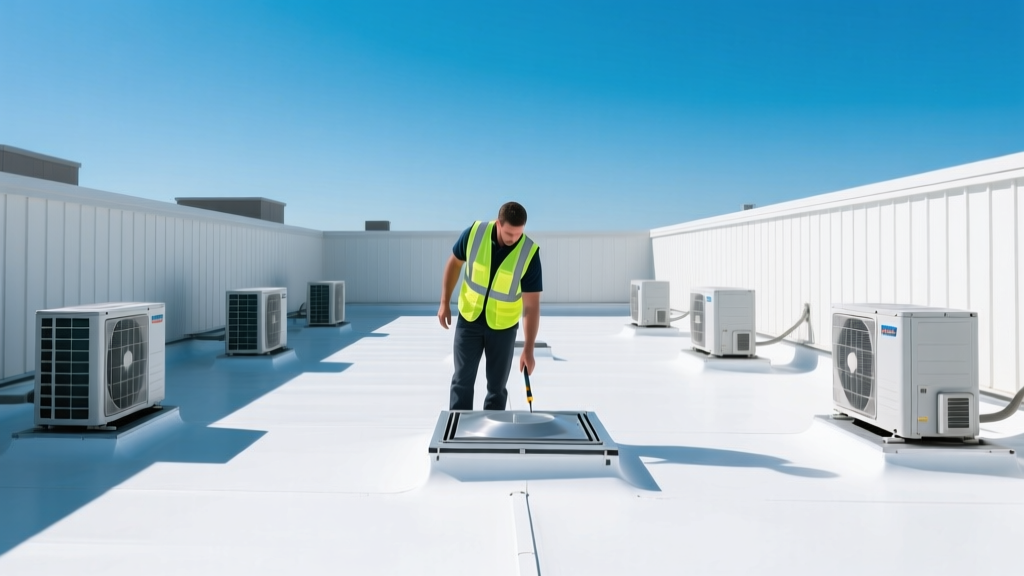
Single-Ply Membranes: TPO, PVC, and EPDM
Single-ply membranes dominate the commercial sector due to their lightweight nature and rapid installation. However, treating them as interchangeable is a critical error that leads to premature system failure.
TPO (Thermoplastic Polyolefin)
TPO is the most widely installed commercial membrane in North America. Modern TPO formulations (post-2018) have largely resolved the early-generation issues of seam degradation and top-ply cracking. For commercial applications, specify a minimum 60-mil thickness, though 80-mil reinforced TPO (such as Carlisle Sure-Weld or Elevate UltraPly) provides a 32% thicker weathering surface and significantly higher puncture resistance. Seams are heat-welded at approximately 1,000°F using automated hot-air welders, creating a monolithic bond that is stronger than the membrane itself. According to the EPA's Cool Roofs guidelines, white TPO membranes typically boast an initial solar reflectance of 0.80 or higher, drastically reducing cooling loads in sun-belt climates.
PVC (Polyvinyl Chloride)
PVC membranes, like Sika Sarnafil or Johns Manville PVC, are the mandatory choice for buildings exhausting animal fats, vegetable oils, or harsh chemicals. Unlike TPO and EPDM, PVC is inherently resistant to ketones, esters, and greases that would otherwise dissolve the polymers in competing membranes. PVC utilizes a wider weld window and can be installed using hot air or chemical solvents. For retrofit projects over existing asphaltic roofs, specify a fleece-backed PVC to prevent the plasticizers in the PVC from migrating into the asphalt below, which causes catastrophic membrane embrittlement.
EPDM (Ethylene Propylene Diene Monomer)
EPDM remains a staple due to its proven track record and exceptional performance in extreme cold. It does not become brittle in sub-zero temperatures, making it ideal for northern climates. While 45-mil EPDM was once standard, current commercial specifications demand 60-mil non-reinforced or reinforced EPDM. Black EPDM absorbs heat, which can be advantageous in heating-dominated climates, while white EPDM requires a titanium dioxide coating that can wear over time. Fully adhered EPDM systems utilizing water-based or low-VOC bonding adhesives outperform ballasted systems in high-wind zones, provided the substrate is properly primed.
Never install TPO or EPDM beneath kitchen exhaust hoods or industrial grease vents. Animal fats and vegetable oils will cause these membranes to swell, soften, and ultimately split at the seams within 24 to 36 months. Always transition to a PVC membrane or install a specialized grease-containment curb system in these zones.
Asphaltic Systems: Modified Bitumen and BUR
For buildings requiring extreme puncture resistance or supporting heavy rooftop equipment, asphaltic systems provide unmatched durability through redundant layering.
Modified Bitumen (Mod-Bit)
Mod-Bit combines the redundancy of asphalt with polymer modifiers for enhanced elasticity. The two primary modifiers dictate the installation method and climate suitability:
- SBS (Styrene-Butadiene-Styrene): Rubberized asphalt that offers high flexibility and elongation. Ideal for cold climates and structural movement. Can be torch-applied, mopped, or installed with cold-process adhesives.
- APP (Atactic Polypropylene): Plasticized asphalt that flows smoothly when heated. Best suited for hot climates and primarily installed via torch application. APP lacks the cold-weather flexibility of SBS.
For high-traffic rooftops, a granular-surfaced cap sheet (such as GAF Ruberoid) provides built-in UV protection and slip resistance, eliminating the need for separate walkway pads.
Built-Up Roofing (BUR)
BUR consists of alternating layers of bitumen (asphalt or coal tar) and reinforcing fabrics (ply sheets), topped with a surfacing of gravel or mineral granules. While labor-intensive and heavy, a 4-ply BUR system offers unmatched redundancy; a single puncture will not compromise the entire roof's watertight integrity. It is best suited for concrete decks that can support the immense dead load of the system, especially when ballasted with river stone.
The Decision Framework: Matching Material to Building Profile
Use this sequential logic flow to narrow down the optimal material for your specific facility:
- Assess Exhaust and Chemical Profiles: Does the building house a restaurant, laboratory, or manufacturing plant with airborne lipids or solvents? If Yes: PVC. If No: Proceed to Step 2.
- Evaluate Deck Load Capacity: Is the deck lightweight metal or wood, and is structural reinforcement prohibitively expensive? If Yes: Single-Ply (TPO/EPDM). If the deck is heavy concrete and requires high puncture resistance: Mod-Bit or BUR.
- Analyze Climate and Thermal Shock: Does the region experience extreme temperature swings (e.g., 100°F days dropping to 30°F nights)? If Yes: TPO or PVC (superior dimensional stability). If the climate is consistently freezing: EPDM or SBS Mod-Bit.
- Determine Wind Uplift Requirements: Is the building in a high-velocity hurricane zone (HVHZ)? If Yes: Fully adhered 80-mil TPO/PVC or mechanically attached systems with enhanced HD (Heavy Duty) fastener plates and 3-inch galvanized screws spaced at 12 inches on center in the perimeter.
2026 Installed Cost and Lifecycle Expectations
Pricing for commercial flat roofs fluctuates based on petroleum indices, membrane thickness, and insulation requirements (such as upgrading to meet IECC 2024/2026 continuous insulation R-value mandates). The costs below reflect fully installed systems, including tear-off of one existing layer, new polyiso insulation to achieve R-30, cover boards, and the membrane.
According to the National Roofing Contractors Association (NRCA), incorporating a high-density cover board (such as 1/4-inch gypsum or glass-mat faced polyiso) beneath single-ply membranes can extend the functional lifespan of the roof by up to 15 years by protecting the insulation from compression and the membrane from back-surface punctures.
When calculating lifecycle cost, factor in the maintenance regimen. TPO and PVC require annual seam inspections and occasional re-welding of localized failures, while EPDM requires monitoring of lap sealants and flashings. Mod-Bit requires periodic re-coating of the granular surface to maintain UV reflectivity.
Common Failure Modes and Edge Cases
Even the best materials fail when installed incorrectly. Be aware of these specific edge cases during your selection and bidding process:
- TPO Shrinkage and Seam Stress: While TPO does not shrink like early PVC, improper stress-relief at inside and outside corners can cause the membrane to pull away from the substrate. Ensure your specification mandates pre-fabricated, molded corner flashings rather than field-fabricated cuts.
- EPDM Lap Sealant Failure: The primary failure point in mechanically attached EPDM is the lap seam. Over time, liquid lap sealants dry out and crack. Specify the use of 3-inch or 6-inch seam tape with primer, or liquid-applied flashing systems at all penetrations, rather than relying solely on caulking.
- Mod-Bit Torch Hazards: Torch-applied Mod-Bit on wood decks or near combustible parapets presents a severe fire risk. In these scenarios, mandate cold-process adhesives or self-adhering Mod-Bit membranes (like GAF Liberty SBS Self-Adhering) to eliminate open flames on the job site.
- PVC Plasticizer Migration: As noted, installing non-fleece-backed PVC directly over EPS (expanded polystyrene) insulation or existing asphalt will cause the plasticizers to leach out. Always verify the compatibility of the PVC backing with the underlying substrate and insulation type.
By aligning the specific chemical, structural, and climatic demands of your building with the precise material properties outlined above, you can specify a commercial flat roof that delivers predictable, long-term performance without premature capital expenditure.
Written by
Marcus ChenMarcus Chen is a licensed structural engineer (PE) and building materials analyst with over 12 years of experience across residential, commercial, and industrial construction. He holds a Master of Science in Civil Engineering from UC Berkeley and spent six years at Thornton Tomasetti before transitioning to independent consulting and technical writing. Marcus specializes in material selection for seismic-prone regions, concrete reinforcement strategies, and lifecycle cost analysis. His work has been cited by the American Concrete Institute (ACI) and the Structural Engineers Association of California (SEAOC). When he is not on a job site or at his desk, you will find him hiking the Sierra Nevada or restoring a 1920s craftsman bungalow in Oakland, CA.
More from Marcus Chen
View all
Construction Cost
How Much Did the Eiffel Tower Cost to Build?
How much did the Eiffel Tower cost to build in 1889? We adjust for inflation and compare its budget to modern skyscraper construction.
Aug 4, 2026

Fire Resistance
What Is a Fire Resistant Material? Testing & Certification Guide
Discover what is a fire resistant material through ASTM and UL testing. Learn how fire ratings, certifications, and assemblies work in construction.
Aug 4, 2026

Construction Cost
How Much Did the Burj Khalifa Cost to Build?
How much did the Burj Khalifa cost to build? We break down the $1.5B project and extract 5 money-saving strategies for your next build.
Jul 30, 2026