Rubber Roofing Durability: EPDM vs TPO Lifespan Analysis
Compare EPDM and TPO rubber roofing durability. Analyze lifespans, failure modes, thickness requirements, and real-world weathering performance.
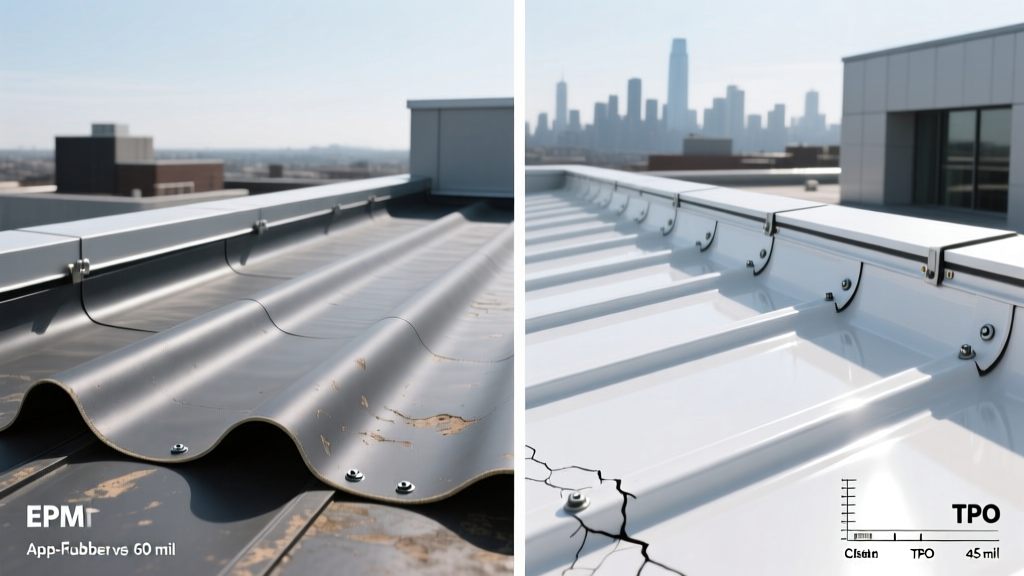
The Polymer Divide: Thermoset vs. Thermoplastic Membranes
When evaluating rubber roofing for low-slope and flat commercial applications, the term encompasses two fundamentally distinct chemical categories: thermoset and thermoplastic membranes. Understanding this molecular divide is the first step in accurately predicting lifespan and long-term durability. Ethylene Propylene Diene Monomer (EPDM) represents the thermoset category, while Thermoplastic Polyolefin (TPO) dominates the thermoplastic sector. Both are colloquially referred to as rubber roofing, but their aging characteristics, repair protocols, and environmental tolerances differ drastically.
EPDM: The Vulcanized Workhorse
EPDM is a synthetic rubber compounded with carbon black (for black membranes) or titanium dioxide (for white membranes), which is then vulcanized. Vulcanization creates permanent cross-links between polymer chains. Once cured, EPDM cannot be remelted. This chemical stability grants EPDM exceptional resistance to ozone, extreme temperature cycling, and long-term UV exposure. However, the cross-linking process does not entirely stop at the factory; it continues slowly on the roof, which leads to the material's primary vulnerability: long-term shrinkage.
TPO: The Heat-Weldable Challenger
TPO is a blend of polypropylene and ethylene-propylene rubber, reinforced with polyester or fiberglass scrim. Unlike EPDM, TPO is not vulcanized. Its polymer chains are not permanently cross-linked, meaning the material can be repeatedly heated, melted, and reformed. This thermoplastic nature is TPO's greatest asset for longevity: it allows seams to be hot-air welded into a single, monolithic piece of material, eliminating the adhesive failures that plague other systems. Modern TPO formulations incorporate hindered amine light stabilizers (HALS) to prevent the UV degradation and surface cracking that plagued early-generation TPO membranes installed in the late 1990s and early 2000s.
Mil Thickness and Puncture Resistance Matrix
Specifying the correct membrane thickness (measured in mils, where 1 mil = 0.001 inches) is the most critical factor in determining the physical lifespan of a rubber roof. A thicker membrane does not necessarily resist UV degradation better, but it exponentially increases puncture resistance, hail tolerance, and the ability to withstand foot traffic during HVAC maintenance.
| Membrane Type | Thickness (Mils) | ASTM Standard | Puncture Resistance | Expected Lifespan | Best Application |
|---|---|---|---|---|---|
| EPDM (Non-reinforced) | 45 mil | ASTM D4637 | ~12 lbf | 15 - 20 Years | Residential low-slope, light commercial |
| EPDM (Non-reinforced) | 60 mil | ASTM D4637 | ~18 lbf | 25 - 30 Years | Standard commercial, moderate hail zones |
| EPDM (Reinforced) | 60 mil | ASTM D4637 | ~40+ lbf | 30+ Years | High traffic, ballasted systems |
| TPO (Standard) | 60 mil | ASTM D6878 | ~25 lbf | 20 - 25 Years | New construction, energy-efficient retrofits |
| TPO (Fleece-backed) | 80 mil | ASTM D6878 | ~55+ lbf | 30+ Years | Retrievals over existing BUR or EPS foam |
For commercial projects in regions prone to severe hail (such as the US Midwest and Texas), specifying a minimum of 90-mil EPDM or an 80-mil fleece-backed TPO is non-negotiable to prevent membrane fracturing upon impact.
Primary Failure Modes and Environmental Degradation
Rubber roofing membranes rarely fail due to the center-of-field material simply wearing out. Catastrophic failures almost always originate at the perimeters, penetrations, and seams. Understanding these specific failure modes allows facility managers to target their maintenance budgets effectively.
EPDM Shrinkage and Flashing Tension
As EPDM continues to cross-link on the roof, it undergoes dimensional shrinkage, often pulling inward at a rate of 1% to 2% over its lifespan. On a 10,000-square-foot roof, this translates to several inches of lateral movement. If the membrane was installed fully adhered without sufficient slack at the parapets, this shrinkage creates immense tension on the flashing details. The resulting stress frequently tears the membrane at the inside and outside corners of parapet walls, leading to concealed water infiltration into the building envelope.
TPO Surface Chalking and Scrim Exposure
While modern TPO resists catastrophic UV failure, it does experience surface erosion. Over 15 to 20 years, the top layer of the TPO membrane will slowly chalk and erode. If the erosion reaches the internal polyester reinforcing scrim, the membrane's structural integrity is compromised, and moisture can wick laterally through the exposed fibers. High-reflectivity white TPO is particularly susceptible to biological staining (algae and mold) in humid climates, which can degrade the surface polymers if not cleaned periodically.
Warning: The Ponding Water Threat
Neither EPDM nor TPO is designed for continuous submersion. While the membranes themselves are waterproof, ponding water (standing water for more than 48 hours) accelerates the degradation of seam adhesives in EPDM and promotes biological growth on TPO. According to the Environmental Protection Agency (EPA), ensuring positive roof drainage through tapered insulation or crickets is mandatory to achieve the advertised lifespan of any single-ply rubber system. Warranties are routinely voided if ponding water exceeds 0.25 inches in depth.
The Seam Bottleneck: Tape vs. Hot-Air Welding
The most significant divergence in lifespan between EPDM and TPO lies in how the sheets are joined. A roof is only as durable as its weakest seam.
"The field of the membrane will outlast the building; the seams will dictate the replacement cycle." — Industry maxim among commercial roofing consultants.
EPDM: The Adhesive Vulnerability
EPDM seams are traditionally joined using double-sided butyl tape and liquid primers, or liquid-applied splice adhesives. While these adhesives possess high initial shear strength, they are subject to long-term plasticizer migration and UV degradation at the seam edges. After 15 to 20 years of thermal cycling, EPDM seam tapes routinely lose their bond, resulting in 'fish-mouth' openings that allow wind-driven rain to bypass the membrane. Re-taping seams is a standard mid-life maintenance requirement for EPDM systems.
TPO: Monolithic Hot-Air Welding
TPO seams are fused using automated hot-air welders that blow air heated to 800°F–1000°F across the overlapping membrane edges, followed immediately by a silicone pressure roller. This process melts the top layers of both sheets, fusing them into a single, homogeneous piece of material. A properly executed TPO weld is actually stronger than the parent membrane itself. Because there is no adhesive to degrade, the seam lifespan matches the field lifespan, effectively eliminating the most common failure point found in single-ply roofing.
Lifecycle Economics and Energy Efficiency
When analyzing durability, the financial lifecycle must be considered. Black EPDM remains the most cost-effective upfront option, typically installed at $4.50 to $7.00 per square foot. However, its low solar reflectance index (SRI) increases building cooling loads. White TPO costs approximately 10% to 15% more upfront ($5.50 to $8.50 per square foot) but offers an SRI of 100+. Data from the Department of Energy (DOE) indicates that cool roofs like white TPO can reduce peak cooling demand by 10% to 15%, effectively paying for the initial premium through HVAC energy savings within the first seven years of the roof's lifecycle.
Furthermore, TPO's heat-welded seams reduce mid-life maintenance costs. An EPDM roof will typically require a comprehensive seam inspection and re-taping protocol at year 15, costing $1.00 to $1.50 per linear foot of seam. TPO requires no such seam intervention, altering the 30-year net present value (NPV) in TPO's favor for climate-controlled commercial buildings.
Proactive Maintenance Protocols to Maximize Life
To push a rubber roofing system to the upper limits of its expected lifespan, facility managers must move beyond reactive leak-chasing and implement predictive maintenance.
- Bi-Annual Seam Audits: For EPDM, conduct a manual 'pull-test' on a random sampling of 5% of all seam overlaps every spring and fall to check for adhesive delamination before wind events can exploit weaknesses.
- Infrared Moisture Surveys: Every 3 to 5 years, commission an infrared thermographic scan. Water trapped beneath the membrane retains heat longer than dry insulation, showing up clearly on thermal cameras at dusk. This allows for targeted surgical repairs before the wet insulation degrades the roof deck.
- Penetration Collar Checks: Pipe boots and HVAC curb flashings experience the highest thermal movement. Inspect all neoprene or EPDM pipe collars for dry-rot cracking every 24 months, and apply a compatible liquid flashing sealant (such as a silicone or butyl-based mastic) to the base of the collar proactively.
- Debris and Drain Clearing: Ensure all scuppers and internal drains are fitted with gravel guards and cleared of debris monthly during autumn. A blocked drain can turn a flat roof into a temporary swimming pool, adding 5.2 lbs of dead load per square inch for every foot of water depth, risking structural collapse and guaranteed membrane degradation.
By matching the correct polymer chemistry to the specific environmental stressors of the building site, specifying adequate mil thickness for local weather patterns, and executing rigorous seam-quality control during installation, rubber roofing systems can reliably protect commercial assets for three decades or more.