How to Cut Metal Roofing Material: Best Tools Compared
Compare the best tools for cutting metal roofing material. Learn cold-cutting vs. hot-cutting methods, specific tool models, and edge protection protocols.

The Metallurgy Factor: Why Cutting Method Dictates Panel Lifespan
The method you choose to cut metal roofing material directly determines the lifespan of the panel edge and the validity of the manufacturer's warranty. Metal roofing panels—particularly Galvalume (ASTM A792) and painted aluminum—rely on complex metallic and polymer coatings to resist corrosion. When you apply high-friction heat to these panels, you compromise these protective layers.
Galvalume steel features a coating of 55% aluminum, 43.4% zinc, and 1.6% silicone. This alloy protects the steel substrate through both barrier protection and galvanic sacrifice. However, exposing the cut edge to temperatures exceeding 600°F (315°C) alters the crystalline structure of the zinc-aluminum coating, destroying its galvanic properties and accelerating edge creep (rust).
Material-Specific Cutting Tolerances
- Galvalume Steel (24ga - 26ga): Highly sensitive to heat and swarf (molten metal sparks). Requires cold-cutting or low-RPM carbide saws. Abrasive grinders will void almost all manufacturer warranties.
- Aluminum (.032" - .040"): Softer and prone to galling (material sticking to the cutting blade). Requires sharp, high-clearance shears or nibblers. Hot-cutting melts the edge, creating a brittle, jagged finish.
- Copper (16oz - 20oz): Extremely malleable. Best cut with aviation snips or electric shears to maintain a clean, workable edge for soldering or mechanical seaming.
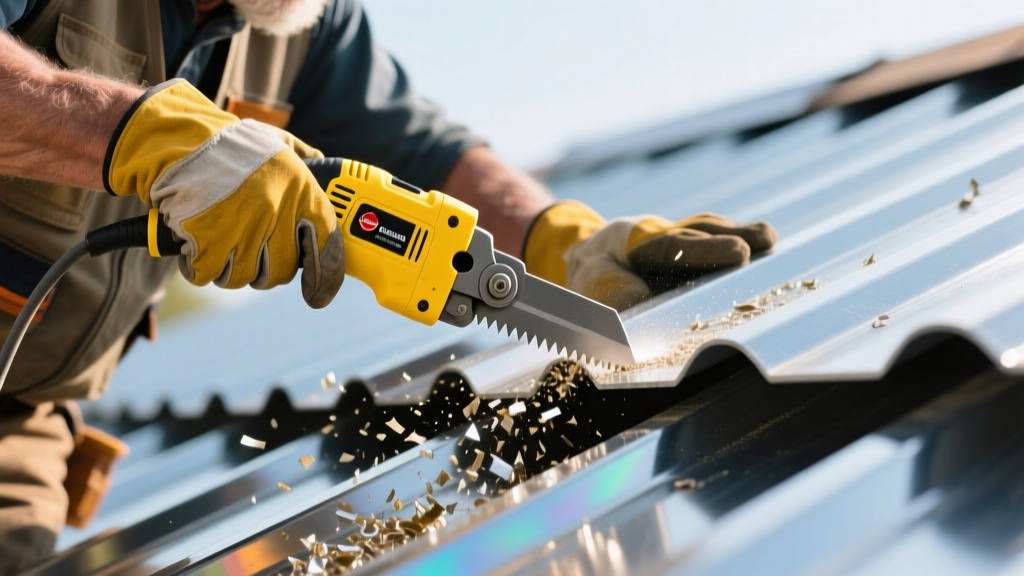
Tool Comparison Matrix: Nibblers, Shears, Saws, and Grinders
Selecting the right tool depends on the cut geometry (straight vs. curved), the metal gauge, and the acceptable level of edge distortion. Below is a comparative analysis of the primary cutting methods used by professional roofing contractors in 2026.
| Tool Type | Best Application | Edge Quality | Heat/Swarf Risk | Avg. Pro Cost |
|---|---|---|---|---|
| Electric Nibblers | Curves, notches, complex penetrations | Excellent (zero distortion) | None (Cold-cut) | $300 - $450 |
| Electric Shears | Long straight cuts, trimming eaves | Good (slight edge curl) | None (Cold-cut) | $250 - $400 |
| Carbide Circular Saw | Long cross-cuts, ripping panels | Excellent (factory-like) | Low (if RPM controlled) | $200 - $350 |
| Aviation Snips (Hand) | Detail work, flashings, trim | Fair (requires edge rolling) | None (Cold-cut) | $30 - $60 |
| Angle Grinder (Abrasive) | Demolition only (Not for install) | Poor (melted, burred) | Extreme (Voids warranty) | $50 - $150 |
Deep Dive: Cold-Cutting vs. Hot-Cutting Methods
The industry standard, heavily enforced by the Metal Construction Association (MCA), is to prioritize cold-cutting methods. Cold-cutting physically removes or shears the metal without generating enough friction to alter the coating's metallurgy.
Recommended Cold-Cutting Tools
For complex roof penetrations (pipes, vents, skylights), the Makita XNJ01Z 18V LXT Lithium-Ion Cordless Nibbler is the current industry benchmark. It cuts up to 16-gauge mild steel and leaves a 3mm kerf. Because it punches out tiny half-moon chips of metal, the panel remains perfectly flat with zero thermal distortion. For long, straight rip cuts along the eaves, the DeWalt DW899 Electric Shear provides a clean shear line, though it requires a secondary pass with a hand seamer to flatten the slight edge curl it produces.
For hand-snipping, professionals rely on the Wiss Metalmaster series. Use the M1R (Red handles) for left-cutting curves, the M2R (Green handles) for right-cutting curves, and the M3R (Yellow handles) for straight cuts. Using the wrong snip for the curve direction will warp the metal and fatigue your wrist.
Using an angle grinder with an abrasive cutoff wheel is the most common mistake made by novice installers. The friction generates temperatures exceeding 2,000°F, instantly vaporizing the Galvalume coating. Furthermore, it throws molten steel swarf across the roof. These tiny, superheated steel balls embed themselves into the painted finish of adjacent panels. Within 6 to 12 months, the embedded swarf will rust, creating hundreds of pinpoint rust spots that cannot be washed off and will void the paint warranty. Never use abrasive discs on a metal roof installation.
When Hot-Cutting is Unavoidable: The Carbide Saw Protocol
Sometimes, cold-cutting tools lack the speed required for large commercial projects. In these cases, a circular saw equipped with a carbide-tipped ferrous metal blade (such as the Evolution EVOSAW185) is acceptable, provided strict RPM limits are observed. The saw must operate at or below 2,500 RPM. Higher RPMs generate excessive heat. Always cut from the underside of the panel so that any minimal swarf generated falls away from the finished painted surface, rather than being dragged across it by the blade teeth.
Step-by-Step Framework for Complex Roofing Cuts (Valleys & Ridges)
Cutting panels for open valleys requires precision to maintain the proper clearance for water flow while ensuring the panel edge is structurally supported. Follow this sequence for a watertight valley intersection:
- Establish the Clearance Line: Snap a chalk line parallel to the valley centerline, exactly 4 inches away on both sides. This 8-inch total open valley width prevents debris damming and allows high-volume water shedding.
- Scribe the Panel: Lay the roofing panel over the valley flashing. Use a scribe or a sharp soapstone to mark the cut line on the panel rib, transferring the 4-inch clearance line onto the metal.
- Drill Relief Holes: At the top and bottom corners of your scribed line, drill a 1/4-inch hole using a step bit. This prevents the metal from tearing or cracking when you change cutting directions.
- Execute the Cut: Using an electric nibbler or straight-cut aviation snips (Wiss M3R), cut along the scribed line, stopping precisely at the relief holes. Do not overcut.
- Deburr and Fold: Use a flat file to remove any micro-burrs from the cut edge. Then, use a hand seamer to fold the bottom 1/2-inch of the cut edge downward (a drip edge hem). This prevents capillary action from drawing water back up under the panel.
Post-Cut Edge Protection and Touch-Up Protocols
Even with perfect cold-cutting techniques, the raw edge of a steel panel exposes the bare substrate to the elements. While the galvanic action of the Galvalume coating will protect minor scratches, large exposed cross-cuts require proactive treatment.
For unpainted Galvalume panels, apply a clear, penetrating edge sealer like Tectyl 506 to the cut line. This displaces moisture and halts edge oxidation. For pre-painted architectural panels (PVDF/Kynar 500 finishes), you must use a manufacturer-matched touch-up paint. According to guidelines from major suppliers like Sheffield Metals, touch-up paint should only be applied to the raw edge using a small brush or dauber. Never spray or brush touch-up paint over the main panel surface; PVDF touch-up paints lack the UV stabilizers of the factory-baked coil coating and will chalk and fade noticeably within two years, creating an unsightly patchwork roof.
Frequently Asked Questions
Can I use a jigsaw to cut metal roofing?
You can, but it is not recommended for long cuts. A jigsaw with a fine-tooth bi-metal blade (21-24 TPI) works for small, curved notches around pipes. However, the reciprocating action tends to vibrate and scratch the painted finish if the base plate is not heavily taped. Nibblers are vastly superior for curved cuts.
What PPE is required when cutting metal panels?
OSHA mandates specific personal protective equipment for metalworking. At a minimum, wear ANSI Z87.1-rated safety glasses to protect against flying metal chips, cut-resistant Kevlar gloves (ANSI Cut Level A4 or higher) to handle the razor-sharp panel edges, and hearing protection when operating electric nibblers or carbide saws, which routinely exceed 85 decibels.
Why does my circular saw leave a black mark on the metal?
Black scorch marks indicate that your blade is either dull, you are pushing the saw too slowly (causing friction rather than cutting), or your RPM is too high. Replace the carbide blade immediately, as a dull blade will generate enough heat to compromise the zinc-aluminum coating, leading to premature edge rust.
Written by
Priya KapoorPriya Kapoor is a real estate market analyst and construction economics researcher with expertise in housing affordability, development feasibility, and infrastructure investment. She holds a Master of Regional Planning from Cornell University and previously worked as a senior analyst at CBRE's Investment Properties group, where she modeled returns for $4B in mixed-use development pipelines. Priya now runs an independent research practice advising developers, municipalities, and REITs on construction cost forecasting and market timing. She publishes the quarterly "BuildMat Market Pulse" report tracking material price indices across 12 commodity categories. Based in Austin, TX, Priya serves on the board of Habitat for Humanity Austin and is a marathon runner.
More from Priya Kapoor
View all
Construction Cost
Cost to Build a 1600 Sq Ft Home in 2026: Full Breakdown
Accurate 2026 cost to build a 1600 sq ft home—material, labor, and regional pricing breakdowns included. Plan your budget with real-time estimates.
Aug 11, 2026

Wood & Lumber
Name the Types of Wood for Pressure Treatment and Preservation
Learn how to name the types of wood best suited for pressure treatment. Compare species treatability, chemical retention levels, and 2026 preservation costs.
Aug 4, 2026

Stone & Masonry
Stone Veneer Suppliers Lindenhurst: 2026 Cost Analysis
Analyze 2026 stone veneer costs in Lindenhurst, NY. Compare local supplier pricing, delivery fees, and Suffolk County installation labor rates.
Aug 4, 2026