Three Tab Shingles: Wind, Fire, and Impact Performance Specs
Analyze three tab shingles performance ratings, including ASTM wind, fire, and impact specs, plus installation requirements for maximum durability.
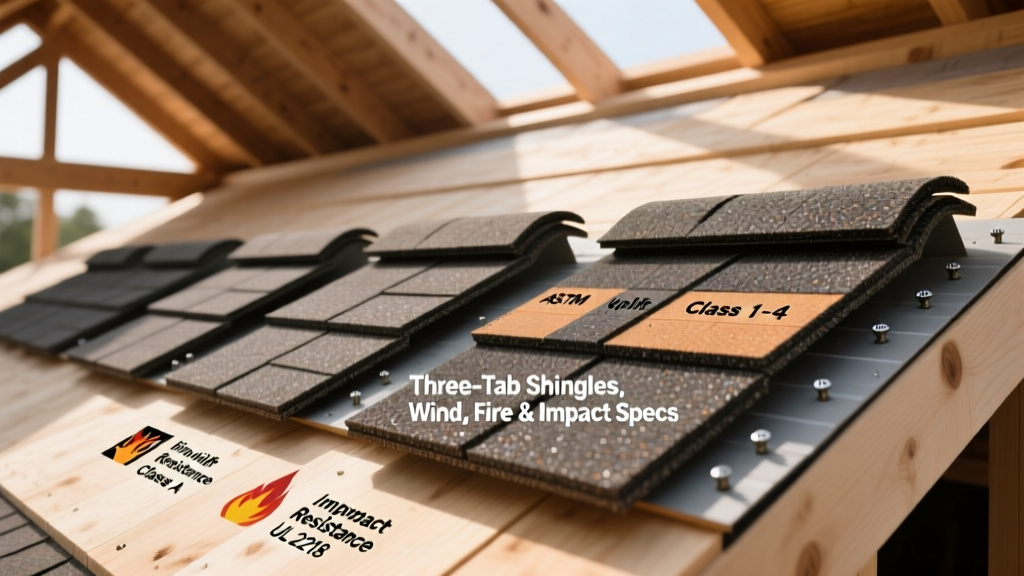
Governing ASTM Standards for 3-Tab Asphalt Shingles
Three tab shingles represent the baseline specification for residential steep-slope roofing. Unlike architectural (dimensional) shingles, which utilize a thicker, multi-layered laminate construction, 3-tab shingles consist of a single layer of asphalt-coated fiberglass mat with uniform cutouts (tabs) along the lower edge. Understanding their performance limitations and testing standards is critical for specifying them correctly in 2026 construction projects.
The manufacturing and performance baseline for these products is dictated by ASTM D225 (Standard Specification for Asphalt Shingles Made from Glass Felt and Surfaced with Mineral Granules). According to the Asphalt Roofing Manufacturers Association (ARMA), ASTM D225 mandates minimum physical properties, including:
- Net Mass of Glass Felt: Minimum 235 g/m² (approx. 4.8 oz/ft²) before asphalt saturation.
- Moisture Content: Must not exceed 1.0% at the time of packaging.
- Granule Adhesion: Tested to ensure mineral surfacing remains intact under UV and thermal cycling.
- Tear Strength: Minimum 1.7 kg (3.7 lbs) to prevent tearing during installation and wind uplift events.
Wind Uplift Resistance: Class D vs. Class F Ratings
Wind resistance is the most frequent failure point for 3-tab shingle systems. Testing is conducted under ASTM D3161 (Standard Test Method for Wind Resistance of Steep Slope Roofing Products), which utilizes a fan-induced wind tunnel to simulate uplift pressures.
| Wind Class | Test Velocity | Standard Fastener Pattern | Typical 3-Tab Warranty |
|---|---|---|---|
| Class A | 60 mph | 4 nails per shingle | Rarely specified today |
| Class D | 90 mph | 4 nails per shingle | Standard limited wind warranty |
| Class F | 110 mph | 6 nails per shingle | Enhanced wind warranty (requires 6-nail upgrade) |
| Class H | 150 mph | 6+ nails / specific sealing | Not achievable for standard 3-tab |
The Thermal Activation Vulnerability
A critical, often overlooked specification in 3-tab wind performance is the reliance on thermally activated asphalt sealant strips. Unlike architectural shingles, which have a large surface area and multiple sealant dabs, 3-tab shingles typically feature a single continuous sealant bead. If installed in ambient temperatures below 40°F (4°C), or on roof slopes below 4:12, the sealant may never fully activate. Until activation occurs, the shingle's effective wind resistance drops to near zero, relying solely on mechanical fasteners. For winter installations, manual sealing with three 1-inch diameter spots of asphalt plastic cement under each tab is required by the National Roofing Contractors Association (NRCA) to maintain rated performance.
Fire Classification Specifications (UL 790 / ASTM E108)
Modern 3-tab shingles utilize a fiberglass mat base, which inherently provides superior fire resistance compared to legacy organic felt mats. Almost all contemporary 3-tab products carry a Class A fire rating under UL 790 or ASTM E108.
A Class A rating indicates the roofing assembly is effective against severe fire test exposure. Specifically, the assembly must meet three criteria:
- Flame Spread: Maximum flame spread of 6 feet across the roof surface.
- Brand Resistance: No penetration of the roof deck by burning brands (simulating flying embers from wildfires).
- Intermittent Flame: No structural failure or deck exposure after repeated gas flame exposure.
Code Compliance Check: In Wildland-Urban Interface (WUI) zones governed by the International Wildland-Urban Interface Code (IWUIC), a Class A rated 3-tab shingle is legally permissible, provided the underlying underlayment also meets the specific fire-resistance requirements of the local jurisdiction (often requiring a fire-resistant barrier board or specific synthetic underlayment).
Impact Resistance (UL 2218) and Hail Vulnerability
While 3-tab shingles excel in fire ratings, they perform poorly in impact resistance testing under UL 2218 (Standard for Impact Resistance of Prepared Roof Covering Materials). The test involves dropping a 2-inch steel ball from varying heights to simulate hail.
- Class 1: 12-inch drop (Survived by most standard 3-tab shingles).
- Class 2: 15-inch drop (Marginal survival for 3-tab).
- Class 3: 17-inch drop (Fails standard 3-tab).
- Class 4: 20-inch drop (Fails standard 3-tab; requires specialized polymer-modified architectural shingles).
Because the single-layer construction of a 3-tab shingle lacks the redundant mat layers and thicker asphalt binder of dimensional shingles, a 1.5-inch hailstone will typically fracture the fiberglass mat. This micro-fracture compromises the waterproofing integrity, leading to granule loss and eventual leaks. In regions with high hail frequency (e.g., Texas, Colorado, the Midwest), specifying 3-tab shingles is a false economy; insurance premium discounts for Class 4 impact resistance will not apply, and replacement cycles will accelerate.
2026 Market Leaders: Specification Breakdown
When sourcing 3-tab shingles, contractors and homeowners typically select from three primary manufacturers. Below is a specification matrix comparing the flagship 3-tab models available in 2026.
| Manufacturer / Model | Material Warranty | Wind Rating | Algae Resistance | Est. Cost per Square (100 sq ft) |
|---|---|---|---|---|
| GAF Royal Sovereign | 25-Year Limited | Class D (60 mph standard) / Class F (110 mph w/ 6 nails) | 10-Year StainGuard | $90 - $105 |
| Owens Corning Supreme | 25-Year Limited | 60 mph standard / 110 mph w/ 6 nails | 10-Year Algae Resistance | $85 - $95 |
| CertainTeed XT 25 | 25-Year Limited | Class D (90 mph) / Class F (110 mph w/ 6 nails) | 10-Year StreakFighter | $95 - $110 |
Critical Installation Specs to Maintain Rated Performance
A 3-tab shingle's laboratory ratings are entirely voided if field installation deviates from manufacturer specifications. The following parameters must be strictly enforced on the job site:
1. Fastener Specifications
Use only 11-gauge or 12-gauge hot-dipped galvanized roofing nails. Electro-galvanized nails will corrode and cause rust stains within 3-5 years. The nail head must have a minimum diameter of 3/8-inch. Nail length must be sufficient to penetrate a minimum of 3/4-inch into the roof deck (typically 15/32-inch OSB or plywood). For roof penetrations or remodels where the deck thickness is unknown, 1.25-inch nails are the minimum safe standard.
2. Nail Placement Matrix
Improper nail placement is the leading cause of wind blow-offs. For standard 3-tab shingles (typically 12 inches by 36 inches):
- Standard 4-Nail Pattern: Place nails 1 inch from each end, and two evenly spaced in the middle, all positioned exactly 5-5/8 inches from the bottom edge of the shingle. This ensures the nail penetrates both the top and bottom layers of the shingle overlap.
- High-Wind 6-Nail Pattern: Add two additional nails 2 inches inward from the outer nails. This pattern is mandatory to trigger the 110 mph (Class F) wind warranty.
Pneumatic nail guns must be calibrated daily. An over-driven nail (head cutting into the fiberglass mat) reduces pull-through resistance by up to 60%. An under-driven nail (head protruding) prevents the overlapping shingle from lying flat, creating a channel for wind-driven rain and preventing the sealant strip from bonding.
3. Slope and Underlayment Requirements
Three tab shingles are strictly prohibited for use on roof slopes below 2:12. For slopes between 2:12 and 4:12, the NRCA mandates a double layer of ASTM D226 Type I asphalt-saturated felt underlayment, or a single layer of synthetic underlayment combined with an ice and water shield covering the entire roof deck. Standard single-layer underlayment is only permissible on slopes of 4:12 or greater.