Synthetic Thatch Roofing Material: Durability and Lifespan Guide
Discover the true lifespan of synthetic thatch roofing material. Compare HDPE vs PVC, analyze 50-year costs, and learn wind-resistant installation specs.

The Reality of Synthetic Thatch Longevity
Natural thatch requires re-ridging every 5 to 8 years and full replacement every 15 to 20 years, depending on the climate and organic material used. Synthetic thatch roofing material shifts this paradigm entirely, offering a documented functional lifespan of 50 years or more. However, marketing claims of 'lifetime' roofs often obscure the mechanical and chemical realities of polymer degradation. Achieving a half-century of service life is not automatic; it depends entirely on the specific polymer matrix used, the UV stabilization package, and strict adherence to wind-uplift installation protocols.
Material Composition: Why Polymers Outlast Nature
The durability of synthetic thatch is dictated by its base resin and the chemical additives mixed during extrusion. The industry relies primarily on two thermoplastics: High-Density Polyethylene (HDPE) and Polyvinyl Chloride (PVC). Both materials are impervious to the biological decay that destroys natural thatch—namely, mold, algae, and insect infestation. However, their response to ultraviolet (UV) radiation and thermal cycling differs significantly.
HDPE vs. PVC: A Structural Comparison
HDPE, utilized by industry leaders like Viro (Thatchmarket), is favored for its flexibility and superior impact resistance. To prevent UV degradation, HDPE must be compounded with Hindered Amine Light Stabilizers (HALS). These molecules scavenge free radicals generated by UV exposure, effectively halting the polymer chain breakdown that causes plastic to become brittle. PVC, used by manufacturers like Palmex, is inherently more rigid and possesses natural fire-retardant properties due to its chlorine content, but it can become brittle in extreme sub-zero temperatures.
| Property | HDPE (High-Density Polyethylene) | PVC (Polyvinyl Chloride) |
|---|---|---|
| UV Resistance | Excellent (Requires HALS additives) | Good (Degrades faster without TiO2) |
| Cold Weather Flexibility | High (Remains flexible to -40°F) | Low (Can shatter on impact below 20°F) |
| Fire Rating (Out of Box) | Class B/C (Requires FR treatment for Class A) | Class A (Inherently self-extinguishing) |
| Wind Uplift Tolerance | High (Tears before fastener pulls through) | Moderate (Stiffness can cause cracking at nail line) |
Environmental Stressors and Actual Failure Modes
When synthetic thatch roofing material fails before its 50-year warranty expires, the culprit is rarely UV degradation. Modern HALS packages and titanium dioxide (TiO2) pigments easily shield the core polymer from solar radiation for decades. The true enemies of synthetic thatch are mechanical and thermal.
1. Wind Uplift and Fastener Back-Out
Synthetic thatch shingles are thick and layered, creating a high profile that catches wind. According to the Insurance Institute for Business & Home Safety (IBHS), roof edges and ridges experience the highest localized wind pressures. If standard smooth-shank nails are used, the thermal expansion and contraction of the plastic shingles will gradually work the nails loose over a few seasons. Once a fastener backs out even a fraction of an inch, a 90-mph gust can peel the entire shingle course off the deck.
2. Thermal Expansion and Contraction
Plastics expand and contract at a much higher rate than wood or asphalt. HDPE has a linear thermal expansion coefficient of roughly 1.0 x 10^-4 in/in/°F. On a 100-foot roof run, a temperature swing from 40°F at night to 130°F on the shingle surface during a summer afternoon results in significant dimensional movement. If shingles are pinned too tightly without allowing for lateral slippage, the material will buckle, warp, or tear around the fastener holes.
Fire Ratings and Building Code Compliance
One of the primary drivers for adopting synthetic thatch roofing material in commercial resorts and residential developments is fire safety. Natural thatch is a severe fire hazard, often banned in wildland-urban interface (WUI) zones. Premium synthetic thatch is engineered to achieve a Class A fire rating, the highest rating available for roof coverings. This is tested under ASTM E108 (Standard Test Methods for Fire Tests of Roof Coverings), which evaluates flame spread, brand resistance, and flying brand generation. When specifying materials for commercial projects in California (Chapter 7A) or Colorado's WUI zones, ensure the specific product line carries an active UL or Intertek Class A listing, as some cheaper imported HDPE variants only achieve Class C.
Lifecycle Cost Analysis: Synthetic vs. Natural Thatch
While the initial material cost of synthetic thatch is comparable to high-grade natural water reed, the lifecycle cost over a 50-year period reveals a massive divergence. Natural thatch requires annual maintenance, including moss removal, fire-retardant re-spraying, and ridge cap replacements.
| Cost Factor (Per Sq. Ft.) | Natural Palm / Reed Thatch | Synthetic Thatch (HDPE/PVC) |
|---|---|---|
| Initial Installation | $18.00 - $28.00 | $14.00 - $22.00 |
| 50-Year Replacement Cycles | 2 to 4 Full Replacements ($72 - $112) | 0 Replacements ($0) |
| Annual Maintenance (Pest/Fire) | $0.50/yr ($25.00 total) | $0.00 ($0) |
| Total 50-Year Cost | $115.00 - $165.00 | $14.00 - $22.00 |
Maximizing Lifespan: Installation Protocols
To ensure your synthetic thatch roofing material reaches its 50-year lifecycle, contractors must adhere to strict installation parameters. The most common cause of premature failure is improper deck preparation and fastening.
- Roof Pitch Requirement: Synthetic thatch relies on gravity for water shedding; it is not a waterproof membrane. The absolute minimum roof pitch is 30 degrees (approximately a 7:12 pitch). Installing on lower slopes will result in capillary action drawing water up under the shingles, leading to deck rot.
- Decking Specifications: Use a solid deck (minimum 5/8-inch OSB or plywood) or closely spaced battens (1x4 or 2x4 lumber spaced no more than 12 inches on-center). Solid decking is highly recommended in high-wind zones to provide superior nail-holding strength.
- Fastener Selection: Use 1.5-inch or 2-inch stainless steel ring-shank roofing nails with a 3/8-inch head. Alternatively, self-tapping stainless steel screws with neoprene washers can be used. Never use galvanized or electroplated nails, as the zinc coating will corrode within a decade, leading to fastener failure.
- Ridge Cap Engineering: The ridge is the most vulnerable point on a thatch roof. Use the manufacturer's proprietary molded ridge caps, overlapping them by a minimum of 6 inches, and secure them with fasteners placed in the pre-drilled nailing flanges, concealed by the next overlapping piece.
UV Reflection and Heat Mitigation
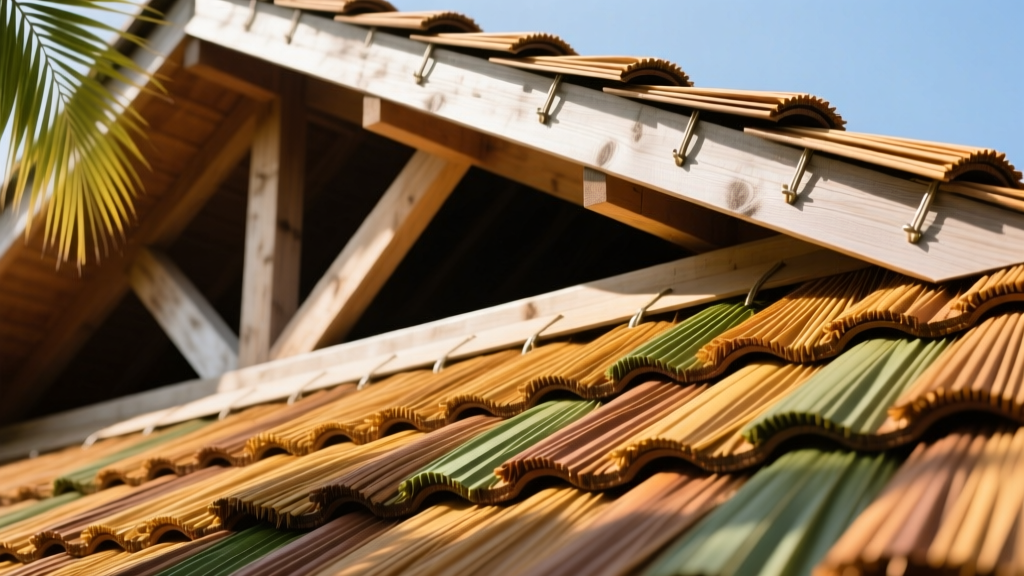
Darker synthetic thatch colors (like deep browns and charcoals) can reach surface temperatures exceeding 150°F in direct summer sunlight. While the HALS additives protect the polymer from breaking down, this heat transfers into the building envelope. According to the U.S. Department of Energy, utilizing lighter-colored roofing or incorporating a radiant barrier beneath the deck can significantly reduce cooling loads. If specifying synthetic thatch for a tropical resort or a residential home in a hot climate, opt for lighter 'bleached palm' or 'straw' colorways to minimize thermal transfer and reduce the thermal expansion stress on the fasteners.
Frequently Asked Questions
Can synthetic thatch be installed over an existing asphalt shingle roof?
No. Synthetic thatch requires a specific nailing pattern and direct contact with a solid wood deck or battens to ensure proper wind-uplift resistance and water drainage. Installing it over existing asphalt shingles will trap moisture, void the warranty, and prevent the fasteners from achieving the required penetration depth into the structural decking.
Does synthetic thatch fade over time?
All exterior polymers experience some degree of color shift over 50 years. High-quality synthetic thatch uses solid-color extrusion (where the pigment is mixed throughout the resin) rather than surface painting. While it may 'chalk' or lighten slightly due to UV exposure, it will not peel, flake, or lose its structural integrity. Some manufacturers offer UV-reflective coatings that can be reapplied every 15-20 years to restore the original color vibrancy.
Is synthetic thatch noisy during heavy rain?
Unlike metal roofing, HDPE and PVC thatch shingles absorb the impact of rain and hail, making them exceptionally quiet. However, because they are typically installed over open battens or thin solid decking without the mass of an asphalt underlayment, ensuring adequate attic insulation is necessary to dampen acoustic transmission into the living space below.
Written by
Elena RodriguezElena Rodriguez is a civil engineer and technical writer specializing in concrete technology, masonry systems, and ASTM/ACI compliance. She earned her B.S. in Civil Engineering from Texas A&M University and spent a decade at a materials testing laboratory, performing over 2,000 concrete compressive strength tests and masonry prism evaluations. Elena is an ACI-certified Field Testing Technician (Grade I) and a member of ASTM Committee C12 on Natural Building Stone. She currently consults on forensic engineering cases involving concrete failures and moisture intrusion. Based in San Antonio, TX, Elena is a proud member of the Society of Women Engineers (SWE) and coaches her daughter's FIRST Robotics team.
More from Elena Rodriguez
View all
Walls & Panels
Cost Analysis: Light Gauge Steel Framing Advantages and Disadvantages
Evaluate light gauge steel framing advantages and disadvantages through a strict cost analysis lens, comparing material, labor, and lifecycle expenses.
Aug 4, 2026

Walls & Panels
Gypsum Board Types: Exact Specifications, Thickness & Dimensions
Compare standard, Type X, and moisture-resistant gypsum board types. Get exact specifications, thicknesses, dimensions, and ASTM standards for your project.
Aug 4, 2026

Fire Resistance
Best Fire-Resistant Outdoor Decking Materials: 2026 Buyer Guide
Discover the best fire-resistant outdoor decking materials for 2026. Compare Class A PVC, aluminum, and hardwood options for WUI compliance and safety.
Aug 4, 2026