TPO Material Roof Selection Framework: 2026 Buyer Guide
Master the TPO material roof selection framework for 2026. Compare mil thicknesses, attachment methods, brand specs, and installed costs for flat roofs.

The Core Anatomy: What Separates Premium TPO from Commodity Grades
Thermoplastic Polyolefin (TPO) dominates the commercial low-slope market due to its balance of heat-weldable seams, UV reflectivity, and cost-efficiency. However, treating all TPO membranes as identical is a critical procurement error. A high-performance TPO material roof relies on a precise blend of polypropylene (PP) and ethylene-propylene rubber (EPR), fortified with a polyester scrim reinforcement.
The scrim is the structural backbone of the membrane. In premium 2026 formulations, the scrim is positioned in the upper third of the membrane cross-section, maximizing puncture resistance from above while allowing a thicker bottom layer for secure hot-air welding. Commodity-grade TPO often centers the scrim, resulting in weaker weld flaps and higher susceptibility to surface tearing under foot traffic.
2026 Formulation Shift: Leading manufacturers have integrated advanced anti-fungal and anti-microbial additives directly into the top ply. This addresses the historical vulnerability of TPO to algae and mold streaking in high-humidity climates, a common complaint with early-generation membranes produced prior to 2018.
Selection Matrix: Matching Mil Thickness to Roof Traffic & Climate
ASTM D6878 dictates the baseline physical properties for TPO, but thickness selection must be driven by your specific roof geometry, HVAC density, and local weather patterns. While 45-mil is technically code-compliant in many jurisdictions, it is rarely the optimal choice for commercial longevity.
| Thickness | Best Application | Hail / Puncture Resistance | Expected Lifespan |
|---|---|---|---|
| 45-Mil | Residential low-slope, covered ballast systems, minimal foot traffic. | Low. Vulnerable to dropped tools and severe hail. | 12-15 Years |
| 60-Mil | Standard commercial, retail, moderate HVAC maintenance traffic. | Moderate. Industry standard for warranty compliance. | 15-22 Years |
| 80-Mil | Heavy industrial, high hail zones (TX, CO, Midwest), dense rooftop equipment. | High. Superior protection against impact and membrane fatigue. | 20-30 Years |
For retrofit projects over existing EPDM or modified bitumen, specify a fleece-back TPO (typically 60-mil TPO laminated to a 45-mil polyester fleece). The fleece acts as a separation layer, preventing substrate irregularities from telegraphing through the new membrane and providing superior adhesive bonding surfaces.
Attachment Systems: Fully Adhered vs. Mechanically Fastened
The method used to secure the TPO material roof to the insulation layer fundamentally alters both the wind-uplift rating and the aesthetic profile of the finished roof.
Mechanically Attached (MA)
Membrane is fastened using heavy-duty screws and barbed plates along the seams, with the next sheet overlapping and covering the fasteners.
- Pros: Fastest installation, lowest labor cost, accommodates minor substrate movement.
- Cons: Creates visible "billowing" between fastener rows during high winds; requires strict fastener spacing patterns (e.g., 12" on-center in perimeters) to meet FM 1-90 wind uplift ratings.
Fully Adhered (FA)
The membrane is bonded to the cover board using low-rise polyurethane adhesive or water-based bonding adhesives applied in ribbons or full-spread patterns.
- Pros: Smooth, billow-free aesthetic; superior wind uplift resistance (often achieving FM 1-105 or higher); ideal for complex geometries and tall parapets.
- Cons: 20-30% higher installed cost; highly weather-dependent during installation (adhesives fail to cure properly below 40°F or in high humidity).
Brand Ecosystem: Carlisle vs. GAF vs. Johns Manville
While all major manufacturers meet baseline ASTM standards, their proprietary weathering packages and accessory ecosystems differ significantly.
- Carlisle Sure-Weld: Features the patented Octaguard weathering package, which provides enhanced protection against UV degradation and chemical exposure. Carlisle's TPO is widely considered the premium benchmark, often specifying heavier scrim weights in their 60-mil and 80-mil offerings.
- GAF EverGuard: Utilizes a diamond-coated release film that prevents the membrane from blocking (sticking to itself) during storage in hot shipping containers. GAF offers highly competitive pricing and integrates seamlessly with their EnergyGuard polyiso insulation systems for single-source warranty advantages. Read more about GAF EverGuard TPO specifications.
- Johns Manville (JM): Known for excellent heat-welding windows (the temperature range in which a successful weld occurs). JM's TPO is highly forgiving for roofing crews working in extreme temperature fluctuations, reducing the risk of cold or burnt welds.
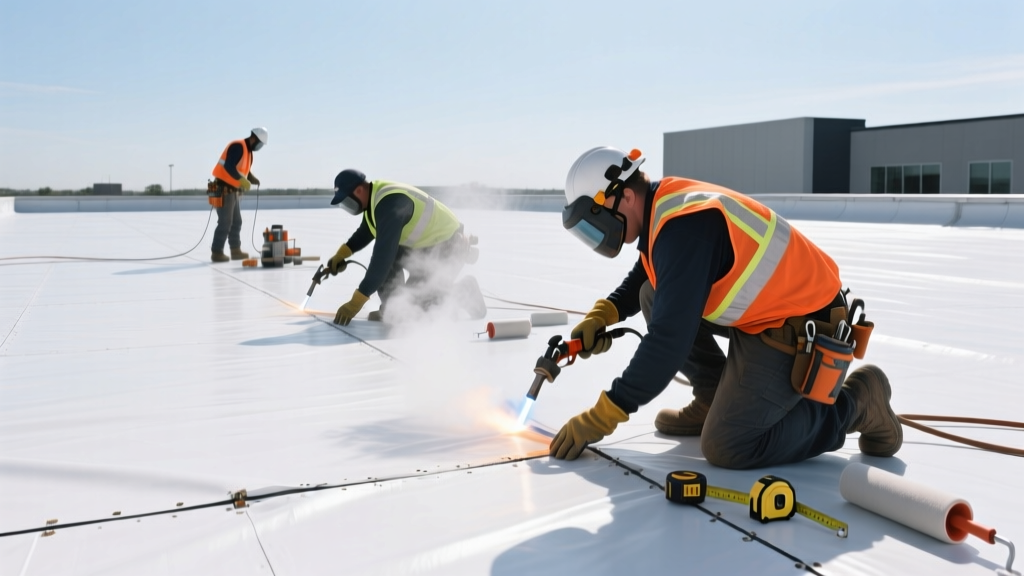
The Critical Failure Point: Hot-Air Welding Parameters
Over 85% of premature TPO material roof failures occur at the seams. TPO relies on hot-air welding to fuse the overlapping membranes into a monolithic, watertight bond. This requires precise calibration of automated welders (such as the Herz ROOFON or Leister VARIMAT).
Warning: The 2026 Welding Calibration Standard
Ambient temperature and humidity dictate welder settings. In 75°F weather, standard settings are 1050°F to 1100°F at a travel speed of 12 to 15 feet per minute. If ambient temps drop below 50°F, temperatures must be increased to 1150°F and speed reduced to 10 fpm. Always perform destructive peel tests on test strips every morning and after every weather change before proceeding with production welding.
Hand-welding with a Leister Triac is reserved for details, penetrations, and inside/outside corners. Ensure the silicone pressure roller is applied immediately behind the hot-air nozzle to fuse the polymer while it is in a semi-liquid state.
Energy Efficiency and Cool Roof Compliance
White TPO membranes possess an initial solar reflectance index (SRI) of 80 or higher, making them a primary driver for LEED certification and ASHRAE 90.1 compliance. According to the U.S. Department of Energy's Cool Roofs initiative, highly reflective TPO roofs can reduce peak cooling demand by 10-15%, significantly shrinking HVAC operational costs.
However, reflectivity degrades as the roof accumulates dirt and biological growth. To maintain Energy Star and Cool Roof Rating Council (CRRC) compliance over the warranty period, specify a TPO membrane with a smooth, non-porous surface finish and implement a biennial low-pressure washing protocol.
2026 Cost Projections & Lifecycle ROI
Material costs for TPO have stabilized following the supply chain disruptions of the early 2020s, but specialized labor for hot-air welding continues to drive installed pricing upward. Below is the current national average for commercial installations.
| System Configuration | Material Cost (per sq. ft.) | Installed Cost (per sq. ft.) |
|---|---|---|
| 45-Mil Mechanically Attached | $1.25 - $1.60 | $7.50 - $9.00 |
| 60-Mil Mechanically Attached | $1.65 - $2.10 | $8.50 - $10.50 |
| 60-Mil Fully Adhered | $2.20 - $2.80 (incl. adhesive) | $10.50 - $13.00 |
| 80-Mil Fully Adhered | $2.80 - $3.50 (incl. adhesive) | $12.50 - $15.50 |
Note: Costs assume a standard commercial roof over 10,000 sq. ft. with polyiso insulation and cover board. Smaller footprints or complex parapet details will increase labor costs by 15-25%.
Pre-Purchase Decision Flowchart
Use this conditional framework to finalize your TPO specification:
- Is the roof located in a severe hail corridor (e.g., Texas, Colorado)?
Yes: Mandate 80-mil TPO with a heavy-duty polyester scrim and a 1/2" high-density polyiso cover board.
No: Proceed to step 2. - Will the roof experience heavy, repeated foot traffic for HVAC maintenance?
Yes: Specify 60-mil or 80-mil TPO and install sacrificial TPO walkway pads along all primary service routes.
No: 60-mil is sufficient. - Is the building located in a high-wind coastal zone or exceed 45 feet in height?
Yes: Specify a Fully Adhered attachment method to eliminate billowing and maximize FM wind-uplift ratings.
No: Mechanically Attached is the most cost-effective route. - Are you retrofitting over an existing EPDM roof?
Yes: You must use a Fleece-Back TPO membrane and fully adhere it using a compatible water-based adhesive to prevent chemical incompatibility and substrate telegraphing.
Written by
Priya KapoorPriya Kapoor is a real estate market analyst and construction economics researcher with expertise in housing affordability, development feasibility, and infrastructure investment. She holds a Master of Regional Planning from Cornell University and previously worked as a senior analyst at CBRE's Investment Properties group, where she modeled returns for $4B in mixed-use development pipelines. Priya now runs an independent research practice advising developers, municipalities, and REITs on construction cost forecasting and market timing. She publishes the quarterly "BuildMat Market Pulse" report tracking material price indices across 12 commodity categories. Based in Austin, TX, Priya serves on the board of Habitat for Humanity Austin and is a marathon runner.
More from Priya Kapoor
View all
Construction Cost
Cost to Build a 1600 Sq Ft Home in 2026: Full Breakdown
Accurate 2026 cost to build a 1600 sq ft home—material, labor, and regional pricing breakdowns included. Plan your budget with real-time estimates.
Aug 11, 2026

Wood & Lumber
Name the Types of Wood for Pressure Treatment and Preservation
Learn how to name the types of wood best suited for pressure treatment. Compare species treatability, chemical retention levels, and 2026 preservation costs.
Aug 4, 2026

Stone & Masonry
Stone Veneer Suppliers Lindenhurst: 2026 Cost Analysis
Analyze 2026 stone veneer costs in Lindenhurst, NY. Compare local supplier pricing, delivery fees, and Suffolk County installation labor rates.
Aug 4, 2026