Coordinating 3PL Roofing Materials Companies for Installation
Master job site logistics with our guide to coordinating 3PL roofing materials companies for efficient staging, receiving, and installation workflows.

Integrating third-party logistics (3PL) into your roofing installation workflow shifts the burden of inventory management, warehousing, and freight coordination to specialized providers. As supply chain networks have matured through 2026, commercial and residential roofing contractors are no longer using 3PLs merely for overflow storage. Instead, they are leveraging these partners for synchronized, just-in-time (JIT) job site deliveries that align precisely with installation phases. However, a 3PL's efficiency is only as good as the contractor's site staging and receiving protocols. Poor coordination leads to damaged membranes, wet insulation, and crane bottlenecks. This guide details the exact operational frameworks required to coordinate 3PL roofing materials companies for seamless job site installation.
The Pre-Installation Logistics Framework
Before a single bundle of shingles or roll of TPO membrane arrives on site, the general contractor or roofing foreman must establish a logistics baseline with the 3PL provider. Roofing materials are exceptionally dense and highly susceptible to environmental degradation during the staging phase. Polyiso insulation loses its R-value if the facers delaminate due to moisture, and PVC membranes can suffer from plasticizer migration if stored improperly in direct UV exposure before installation.
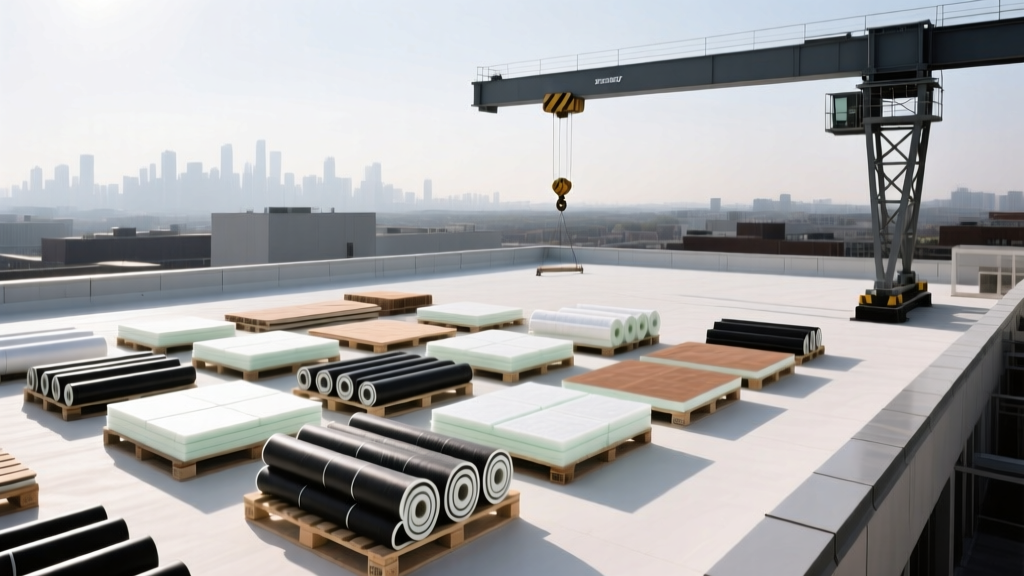
Step-by-Step Site Staging and Receiving Protocol
When the 3PL dispatches the freight, the on-site receiving protocol dictates the success of the subsequent installation. Follow this sequence to ensure material integrity and compliance with safety standards.
1. Site Assessment and Staging Zone Delineation
Identify a staging zone that is level, well-drained, and clear of overhead obstructions. According to OSHA Standard 1926.250 for material storage, stacked roofing materials must be stable and secured against sliding or collapse. For flat commercial roofs, designate a primary hoist zone and a secondary distribution path to prevent workers from carrying 80-pound bundles across the entire deck.
2. Just-In-Time (JIT) Scheduling
Coordinate the 3PL delivery window to occur exactly 24 to 48 hours before the installation crew begins work. Roofing materials should not sit exposed on a job site for more than 72 hours. Schedule the 3PL drop for early morning (between 6:00 AM and 8:00 AM) to avoid conflicts with local traffic restrictions and to give the crew ample daylight to hoist and secure the materials.
3. Receiving and Bill of Lading (BOL) Inspection
Never sign a clean Bill of Lading without a physical inspection. 3PL carriers are responsible for the freight until the BOL is signed. Inspect the shrink wrap on polyiso pallets for punctures, check the edges of asphalt shingle bundles for crushed corners, and verify that TPO rolls are standing vertically on their ends to prevent telescoping. If damage is found, note the exact exceptions on the driver's BOL, take timestamped photographs, and immediately notify the 3PL dispatcher.
4. Weatherproofing Staged Materials
If materials must remain on the ground or roof deck overnight, they must be weatherproofed. The National Roofing Contractors Association (NRCA) strictly advises against leaving insulation exposed to the elements. Use 6-mil polyethylene sheeting to cover ground-staged insulation, securing the edges with sandbags rather than tape, which can fail in high winds.
Material-Specific Handling Matrix
Different roofing systems require distinct handling parameters from the 3PL warehouse to the roof deck. Use the matrix below to configure your 3PL service level agreements (SLAs) based on the specific materials being installed.
| Material Type | 3PL Transit & Storage Mode | Max Uncovered Staging Time | Crane/Hoist Load Limit per Pallet | Installation Edge Case |
|---|---|---|---|---|
| 60-mil TPO Membrane | Climate-controlled transit; store vertically on ends. | 48 hours (UV degrades uninstalled surface) | 1,800 lbs (Standard 10-roll pallet) | Rolls stored flat will telescope, causing edge wrinkles during unrolling. |
| Polyiso Insulation (4x8) | Enclosed dry van only; strict moisture barrier. | 0 hours (Must be covered immediately if outside) | 2,200 lbs (Depends on thickness) | Wet facers will delaminate under heat-welded TPO, causing membrane blisters. |
| Architectural Shingles | Flatbed or LTL; tarped if weather is poor. | 72 hours (Asphalt sealant can fuse in extreme heat) | 3,500 lbs (Standard bundle pallet) | Pallets left in direct 95°F+ sun can cause shingles to fuse together, tearing upon separation. |
| Standing Seam Metal Panels | Custom crating; A-frame or flat rack with edge protectors. | 24 hours (Risk of micro-scratches from debris) | 1,500 lbs (Highly dependent on gauge/length) | Lifting panels by the center without spreader bars causes permanent creasing at the ribs. |
Integrating 3PL Deliveries with Crane and Hoist Operations
The physical transfer of materials from the 3PL delivery truck to the roof deck is the highest-risk phase of the logistics chain. For commercial flat roofs utilizing mobile cranes or material hoists, the 3PL pallet configuration must match your lifting equipment's capacity.
Expert Insight: Always require your 3PL to band pallets with a minimum of four heavy-duty steel or PET plastic bands (two horizontal, two vertical). Standard shrink wrap is insufficient for crane lifting. If the 3PL delivers loosely wrapped insulation, your crew must re-band the pallets on the ground before attaching the crane spreader bar, adding 45 minutes of non-billable labor per lift.
For residential steep-slope projects utilizing conveyor belts or ladder hoists, instruct the 3PL to deliver shingles in 'break-down' configurations. Some advanced 3PL roofing materials companies now offer pre-sorted, color-coded pallets that match the roof planes (e.g., main roof, dormers, valleys), allowing the ground crew to feed the hoist in the exact sequence the installers need them, eliminating deck-side shuffling.
Troubleshooting Common 3PL Delivery and Staging Failures
Even with meticulous planning, logistics failures occur. Here is how to troubleshoot the most common edge cases when working with 3PL roofing materials companies:
- Failure: Wet Polyiso Insulation Delivered. Fix: Do not accept the load. Note 'Subject to hidden moisture damage' on the BOL. Use a moisture meter on the facers. If readings exceed manufacturer thresholds (typically above 15% moisture content by weight), reject the pallet and trigger the 3PL's expedited replacement clause.
- Failure: LTL Freight Arrives with Crushed Shingle Bundles. Fix: Crushed bundles compromise the nailing line and sealant strips. Segregate the damaged bundles. Use them only for starter rows or ridge caps where they will be cut down, and file a freight claim with the 3PL for the remainder.
- Failure: 3PL Misses the JIT Delivery Window. Fix: Maintain a 'buffer stock' agreement with your 3PL. For commercial jobs, the 3PL should hold 5% overage of membrane and fasteners in their local cross-dock facility. If the primary FTL truck breaks down, dispatch a local hot-shot box truck to pull the buffer stock and keep the installation crew working.
Contractor Checklist for 3PL Coordination
Use this final checklist to audit your 3PL partnership before signing the service agreement for your next major installation:
- Verify the 3PL carries specific cargo insurance covering building materials (standard freight insurance often excludes moisture damage to insulation).
- Confirm the 3PL uses RFID or barcode scanning at their warehouse to prevent mis-ships of fastener lengths (e.g., sending 2-inch screws instead of 3-inch screws for multi-layer polyiso).
- Establish a direct communication channel with the 3PL dispatch desk, bypassing general customer service, for day-of-delivery adjustments.
- Review the 3PL's equipment fleet to ensure they possess trucks with Moffett forklifts for sites lacking loading docks or ground-level staging space.
By treating 3PL roofing materials companies as an extension of your installation crew rather than a simple freight vendor, you eliminate job site bottlenecks, protect material warranties, and ensure your roofers spend their time installing, not waiting.
Written by
Sarah WhitfieldSarah Whitfield is a chartered quantity surveyor (MRICS) and construction cost analyst with 15 years of experience in material pricing, procurement strategy, and project budgeting. She earned her degree in Construction Management from the University of Reading (UK) and has worked on projects ranging from $2M custom homes to $180M mixed-use developments across North America and Europe. Sarah currently leads cost estimating for BuildMat Insight, maintaining a proprietary database of 4,000+ material price points updated quarterly. She is a frequent contributor to RSMeans cost data panels and has presented at the International Cost Engineering Council (ICEC) congress. Based in Denver, CO, Sarah is an avid trail runner and volunteer mentor for Women in Construction.
More from Sarah Whitfield
View all
Wood & Lumber
What Are the Different Types of Wood? A Builder's Guide
Compare structural softwoods, finish hardwoods, and engineered lumber. Analyze Janka ratings, MOE values, and 2026 pricing for construction.
Aug 4, 2026

Walls & Panels
Steel Framing vs Wood Framing: Corrosion and Moisture Defense
Compare steel framing vs wood framing for moisture resistance. Learn about galvanized coatings, condensation risks, and corrosion protection strategies.
Jul 21, 2026

Stone & Masonry
How to Cut Stone Veneer: Wet Saw vs Grinder Comparison
Compare the best tools for cutting stone veneer. We review wet saws, angle grinders, and chop saws to help you achieve clean, chip-free cuts.
Jul 21, 2026