TPO Roof Material Lifespan: Durability and Failure Modes
Explore the real-world lifespan of TPO roof material. Compare generations, thickness options, failure modes, and maintenance for maximum durability.

Thermoplastic Polyolefin (TPO) currently commands over 40% of the commercial low-slope roofing market due to its heat-reflective properties and cost-effectiveness. However, the actual field lifespan of TPO roof material varies drastically—from premature failure at 12 years to exceptional performance exceeding 30 years. This variance is not random; it is dictated by membrane generation, thickness, installation precision, and environmental stressors. Understanding the technical nuances of TPO durability is critical for facility managers and contractors making long-term capital decisions.
The Real-World Lifespan of TPO Roof Material
While manufacturers offer warranties ranging from 15 to 30 years, a warranty is a financial instrument, not a guarantee of physical lifespan. According to long-term field studies referenced by the Whole Building Design Guide, a properly installed, modern 60-mil TPO system in a moderate climate will reliably perform for 22 to 25 years before requiring major membrane replacement. In high-UV environments (such as the US Southwest or Florida), the top ply weathering layer degrades faster, often reducing the functional lifespan to 18–20 years unless premium formulations are specified.
Manufacturing Generations: Why Formulation Dictates Longevity
The most critical factor in TPO durability is the manufacturing generation. Early TPO membranes suffered from severe formulation flaws that led to widespread premature cracking and seam delamination. Modern TPO relies on advanced Hindered Amine Light Stabilizers (HALS) and optimized polypropylene-ethylene blends to resist UV and thermal shock.
| Generation | Production Era | Key Characteristics & Flaws | Avg. Field Lifespan |
|---|---|---|---|
| Gen 1 | 1993 – 2004 | Lacked sufficient UV stabilizers; top ply degraded rapidly, leading to micro-cracking and scrim exposure. | 10 – 15 Years |
| Gen 2 | 2005 – 2010 | Improved UV resistance, but suffered from narrow heat-welding windows, causing widespread seam failures. | 15 – 20 Years |
| Gen 3 & 4 | 2011 – Present | Advanced HALS packages, thicker top weathering plies, and broader welding windows (e.g., GAF EverGuard Extreme, Carlisle Sure-Weld). | 22 – 30+ Years |
When specifying TPO roof material in 2026, always verify that the product meets or exceeds the latest ASTM D6878 standard specification, which mandates rigorous weathering and physical property tests that effectively filter out outdated Gen 2 formulations.
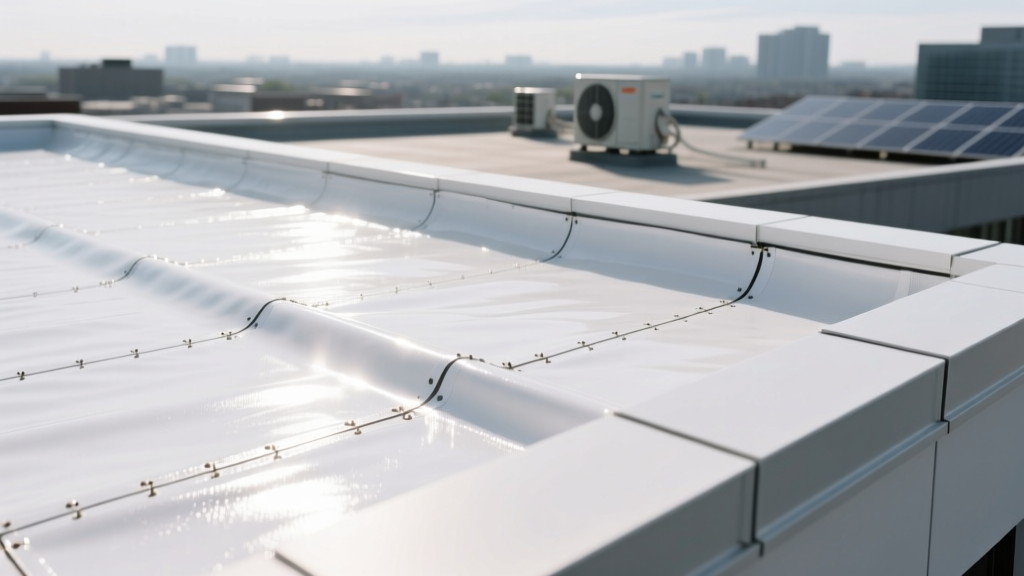
Membrane Thickness: 45-Mil vs. 60-Mil vs. 80-Mil
TPO is manufactured primarily in three thicknesses. The choice directly impacts puncture resistance, wind uplift capacity, and overall longevity. The National Roofing Contractors Association (NRCA) consistently recommends 60-mil as the minimum baseline for commercial applications.
- 45-Mil: The absolute minimum code allowance in many jurisdictions. Highly susceptible to puncture from hail or foot traffic. Expected lifespan: 15–18 years. Best for: Budget-constrained, low-traffic warehouses with minimal HVAC rooftop units.
- 60-Mil: The industry standard. Provides a robust top ply (typically 24-28 mils above the scrim) to withstand UV degradation. Expected lifespan: 22–25 years. Best for: Standard commercial retail, offices, and schools.
- 80-Mil: Premium heavy-duty membrane. Features a massive top ply that dramatically delays scrim exposure and offers superior hail resistance (FM 1-90 rated). Expected lifespan: 28–30+ years. Best for: Hospitals, data centers, and buildings in severe hail zones.
Primary Failure Modes and Edge Cases
Even the best Gen 4 TPO roof material will fail prematurely if subjected to specific edge cases. Understanding these failure modes allows for proactive design mitigation.
1. Cold Welding and Seam Delamination
TPO seams are fused using hot air welders (such as the Leister Twinny T) at temperatures between 950°F and 1,150°F. If the ambient temperature drops or wind speed increases, and the contractor fails to adjust the welder's heat and speed, a "cold weld" occurs. Cold welds look intact initially but will peel apart under thermal expansion and contraction cycles within 2 to 4 years.
2. Ponding Water and Plasticizer Loss
While TPO is inherently water-resistant, constant ponding water (standing for more than 48 hours) accelerates the leaching of fire-retardant chemicals and plasticizers from the membrane surface. Over a decade, this leaves the TPO brittle and prone to splitting at the seams.
3. Winter Foot Traffic Cracking
Maintenance Protocols to Reach 30 Years
Achieving the upper limit of a TPO membrane's lifespan requires moving from reactive repairs to predictive maintenance.
"The difference between a 20-year TPO roof and a 30-year TPO roof is rarely the membrane itself; it is the rigor of the bi-annual seam inspection and the immediate remediation of minor flashings failures." — Commercial Roofing Forensics Report
- Bi-Annual Visual Inspections: Check all pipe boots, inside/outside corners, and termination bars. TPO flashing details are inherently weaker than the field membrane due to the complexity of hand-welding.
- Annual Seam Probing: Use a blunt-nosed seam probe to test a random 10% sample of field seams. If the probe catches or penetrates the weld line, a robotic welder re-pass is required immediately.
- Quinquennial Infrared Surveys: Every 5 years, commission an infrared moisture survey to detect trapped water within the polyiso insulation beneath the TPO. Wet insulation loses R-value and degrades the membrane from below via vapor drive.
- UV Coating Application: At the 15-year mark, consider applying a silicone or acrylic roof coating. This encapsulates the TPO, halting UV degradation and resetting the weathering clock for another 10 to 15 years.
Expert Verdict: Is TPO the Right Long-Term Investment?
TPO roof material remains the most cost-effective, energy-efficient single-ply membrane on the market, provided you specify a Gen 3 or Gen 4 formulation at a minimum of 60-mil thickness. For buildings where roof access is frequent (requiring high puncture resistance) or where the roof features complex penetrations that make heat-welding difficult, PVC may offer superior long-term durability due to its solvent-welded seams and inherent chemical resistance. However, for vast, open commercial decks where automated heat-welding can be executed flawlessly, modern TPO delivers an unbeatable balance of initial cost, solar reflectance, and a reliable 25-year service life.
Written by
Priya KapoorPriya Kapoor is a real estate market analyst and construction economics researcher with expertise in housing affordability, development feasibility, and infrastructure investment. She holds a Master of Regional Planning from Cornell University and previously worked as a senior analyst at CBRE's Investment Properties group, where she modeled returns for $4B in mixed-use development pipelines. Priya now runs an independent research practice advising developers, municipalities, and REITs on construction cost forecasting and market timing. She publishes the quarterly "BuildMat Market Pulse" report tracking material price indices across 12 commodity categories. Based in Austin, TX, Priya serves on the board of Habitat for Humanity Austin and is a marathon runner.
More from Priya Kapoor
View all
Construction Cost
Cost to Build a 1600 Sq Ft Home in 2026: Full Breakdown
Accurate 2026 cost to build a 1600 sq ft home—material, labor, and regional pricing breakdowns included. Plan your budget with real-time estimates.
Aug 11, 2026

Wood & Lumber
Name the Types of Wood for Pressure Treatment and Preservation
Learn how to name the types of wood best suited for pressure treatment. Compare species treatability, chemical retention levels, and 2026 preservation costs.
Aug 4, 2026

Stone & Masonry
Stone Veneer Suppliers Lindenhurst: 2026 Cost Analysis
Analyze 2026 stone veneer costs in Lindenhurst, NY. Compare local supplier pricing, delivery fees, and Suffolk County installation labor rates.
Aug 4, 2026