Selecting Hot Mop Roof Materials: A Builder's Framework
A technical framework for selecting hot mop roof materials, covering asphalt grades, ply sheets, insulation compatibility, and 2026 cost data.

The Hot Mop System Architecture
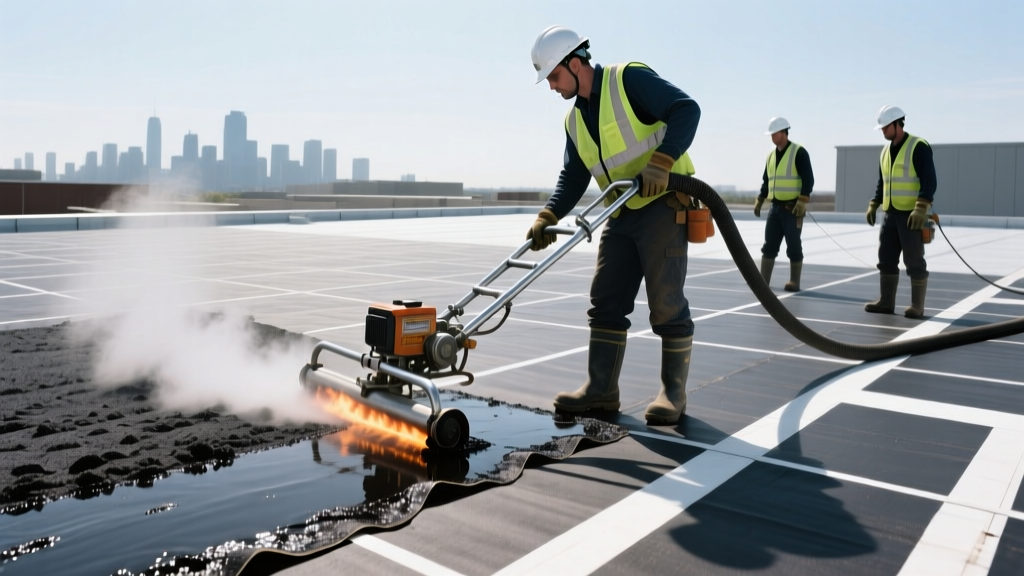
Hot mop roofing, formally known as Built-Up Roofing (BUR) or hot-applied modified bitumen, remains a premier choice for low-slope commercial applications in 2026. Its superiority lies in redundancy: multiple plies of reinforcing felts fused together with hot asphalt create a continuous, self-flashing membrane that is exceptionally resistant to puncture and wind uplift. However, the system's longevity is entirely dependent on precise material selection. Specifying the wrong asphalt grade for your climate zone, or pairing hot asphalt with incompatible insulation, will result in catastrophic membrane failure within the first three years.
This framework provides roofing contractors, architects, and facility managers with the technical criteria required to select hot mop roof materials, ensuring compliance with current ASTM standards and optimal lifecycle performance.
Decision Matrix: Selecting the Right Asphalt Grade
The most critical decision in a hot mop system is selecting the correct asphalt grade. Roofing asphalts are categorized by their Equiviscous Temperature (EVT)—the temperature at which the asphalt reaches the optimal viscosity for application and adhesion. According to ASTM International standard D312, asphalts are divided into four distinct types based on their softening points and intended roof slopes.
| Asphalt Type | ASTM D312 Designation | EVT Range (°F) | Maximum Roof Slope | Primary Climate / Application |
|---|---|---|---|---|
| Type I | Dead Flat | 415°F - 435°F | 1/4" per foot | Southern US, high ambient heat, dead-level roofs |
| Type II | Standard | 440°F - 460°F | 1/2" per foot | Transitional climates, standard commercial low-slope |
| Type III | Steep | 465°F - 485°F | 1" per foot | Northern US, moderate slopes, high wind zones |
| Type IV | Special Steep | 500°F - 525°F | 2" per foot | Extreme cold, steep transitions, vertical flashings |
Application Rule: Never use a Type III asphalt on a dead-flat roof in a high-heat climate. The high softening point will cause the asphalt to remain brittle in cooler weather, leading to alligatoring and thermal cracking. Conversely, using Type I on a sloped roof in a cold climate will result in summer slippage and membrane ridging.
Ply Sheet Selection: Fiberglass vs. Organic
The reinforcing plies provide the tensile strength of the BUR system. Material selection here dictates the roof's dimensional stability and fire resistance.
- Fiberglass Ply Sheets (ASTM D2178 Type IV or VI): The industry standard for 2026. Fiberglass offers superior dimensional stability, meaning it will not shrink or expand with temperature fluctuations. It also inherently improves the UL fire rating of the assembly. Use Type IV for standard interply mopping and Type VI for heavier, more puncture-resistant applications.
- Organic Felts (ASTM D2178 Type 43): Made from cellulose fibers. While organic felts offer higher elongation and flexibility (useful for roofs with significant structural deflection), they are highly susceptible to moisture absorption during storage. If organic felts are left on a damp roof deck overnight before mopping, trapped moisture will vaporize under the 450°F asphalt, causing immediate blistering.
Kettle Management and EVT Verification
A common field error is assuming the kettle temperature equals the application temperature. Asphalt loses 25°F to 50°F between the kettle and the roof deck. If your kettle is set to 450°F, the asphalt hitting the felt may be 400°F—below the EVT for Type II asphalt. This results in 'cold mopping,' where the asphalt acts as a thick paste rather than a penetrating adhesive, leading to interply delamination. Always use inline thermometers and verify mopping temperatures at the spreader.
The Insulation Compatibility Trap
WARNING: Polyiso and Hot Asphalt
Polyisocyanurate (polyiso) is the most common commercial roof insulation, but its standard facers will melt and delaminate when exposed to 450°F hot asphalt. Never apply hot asphalt directly to polyiso.
The Fix: You must install a thermal barrier or cover board between the polyiso and the first hot mop ply. Specify a minimum 1/2-inch perlite board, high-density fiberglass cover board, or specialized asphalt-compatible gypsum board. This adds approximately $0.45 to $0.80 per square foot to material costs but prevents catastrophic facer failure and voided manufacturer warranties.
Surfacing Strategies and Cool Roof Compliance
The top surface of a hot mop roof protects the asphalt plies from UV degradation and physical damage. Your selection must balance durability with local energy codes.
1. Aggregate Surfacing (Gravel/Slag)
Applied at 400-500 lbs per square (100 sq ft) over a flood coat of asphalt. Aggregate provides the highest impact resistance and naturally shields the asphalt from UV rays. However, it adds significant dead load (approx. 4-5 lbs per sq ft) and is increasingly restricted by municipal codes due to wind-scour and reflective heat island effects.
2. Mineral-Surfaced Cap Sheets
ASTM D3909 or D6380 mineral cap sheets are embedded directly into the final mop application. They offer excellent UV protection with minimal weight penalty. For enhanced longevity, specify ceramic-coated granules which resist weathering better than standard slate granules.
3. Reflective Coatings (Cool Roofs)
To meet stringent 2026 energy codes (such as Title 24 in California or IECC requirements), a smooth-surface BUR is often coated with an aluminum asphalt roof coating or a water-based acrylic elastomeric coating. According to the Department of Energy's Cool Roof Guide, highly reflective coatings can reduce peak cooling demand by 10-15%. Ensure the BUR system cures for a minimum of 90 days before applying water-based acrylics to prevent asphalt bleed-through.
2026 Material Cost and Procurement Framework
Material pricing for hot mop systems has stabilized following the supply chain volatility of previous years, though regional asphalt refinery capacities still cause localized variances. Below is a baseline material cost framework for a standard 3-ply fiberglass BUR system with a mineral cap sheet (prices per 100 sq ft / 1 square).
| Material Component | Specification / Type | Est. Material Cost (Per Square) |
|---|---|---|
| Base Sheet | Heavyweight Fiberglass, mechanically attached | $35.00 - $45.00 |
| Hot Asphalt (Interply) | Type II or III (approx. 75 lbs total) | $45.00 - $60.00 |
| Ply Sheets (x2) | ASTM D2178 Type IV Fiberglass | $50.00 - $70.00 |
| Flood Coat Asphalt | Type II or III (approx. 50 lbs) | $30.00 - $40.00 |
| Cap Sheet / Surfacing | Mineral Surfaced Cap Sheet | $65.00 - $95.00 |
| Cover Board (If over Polyiso) | 1/2" Perlite or HD Fiberglass | $45.00 - $80.00 |
| Total Material Cost | Excluding Insulation & Fasteners | $270.00 - $390.00 |
Note: Installed costs, including labor, equipment (kettles, hoists), and insurance, typically range from $5.50 to $9.00 per square foot for commercial projects in 2026. For precise regional labor rates, consult local bidding data from the National Roofing Contractors Association (NRCA).
Diagnostic Troubleshooting: Material-Driven Failures
When a hot mop roof fails prematurely, the root cause almost always traces back to a material selection or procurement error. Use this diagnostic framework to identify and prevent common failures:
- Symptom: Widespread Blistering.
Cause: Moisture trapped in organic felts or damp insulation vaporizing under hot asphalt. Prevention: Mandate the use of fiberglass plies (which do not absorb moisture) and enforce strict 'dry-in' protocols for insulation storage. - Symptom: Alligatoring (Interconnected cracking) within 2 years.
Cause: Asphalt grade mismatch. Using a high-melt-point asphalt (Type IV) on a low-slope roof in a moderate climate causes the asphalt to lose volatiles rapidly and become brittle. Prevention: Strictly align asphalt EVT with the roof slope and local ambient temperature profiles. - Symptom: Ridging at Insulation Joints.
Cause: Thermal expansion of polyiso boards pushing against each other, telegraphing through the plies. Prevention: Stagger insulation joints and utilize a heavy cover board to distribute thermal movement stresses.
"The redundancy of a hot mop system is only as strong as its weakest interply bond. Specifying the correct EVT and verifying kettle temperatures at the deck level separates a 20-year roof from a 5-year failure." — Commercial Roofing Forensic Consultant
Selecting hot mop roof materials requires moving beyond generic specifications. By rigorously matching asphalt grades to slope and climate, enforcing cover board protocols over polyiso, and managing application temperatures, builders can deliver flat roof systems that reliably outlast single-ply alternatives.
Written by
Marcus ChenMarcus Chen is a licensed structural engineer (PE) and building materials analyst with over 12 years of experience across residential, commercial, and industrial construction. He holds a Master of Science in Civil Engineering from UC Berkeley and spent six years at Thornton Tomasetti before transitioning to independent consulting and technical writing. Marcus specializes in material selection for seismic-prone regions, concrete reinforcement strategies, and lifecycle cost analysis. His work has been cited by the American Concrete Institute (ACI) and the Structural Engineers Association of California (SEAOC). When he is not on a job site or at his desk, you will find him hiking the Sierra Nevada or restoring a 1920s craftsman bungalow in Oakland, CA.
More from Marcus Chen
View all
Construction Cost
How Much Did the Eiffel Tower Cost to Build?
How much did the Eiffel Tower cost to build in 1889? We adjust for inflation and compare its budget to modern skyscraper construction.
Aug 4, 2026

Fire Resistance
What Is a Fire Resistant Material? Testing & Certification Guide
Discover what is a fire resistant material through ASTM and UL testing. Learn how fire ratings, certifications, and assemblies work in construction.
Aug 4, 2026

Construction Cost
How Much Did the Burj Khalifa Cost to Build?
How much did the Burj Khalifa cost to build? We break down the $1.5B project and extract 5 money-saving strategies for your next build.
Jul 30, 2026