TPO Roofing Application Fit: Best Scenarios and Use Cases
Discover when to install TPO roofing and when to avoid it. Match your commercial building scenario to the right membrane thickness and attachment.
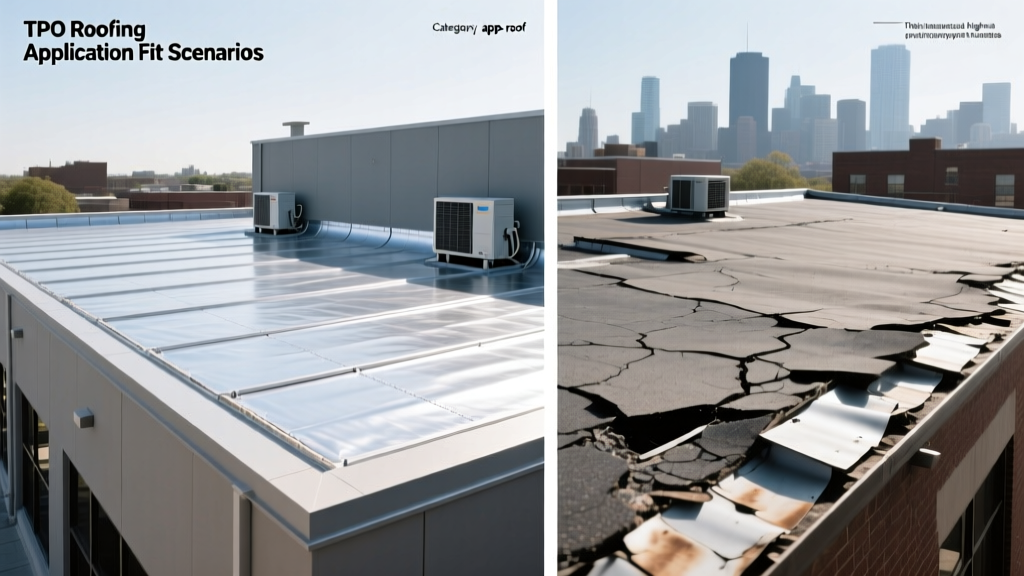
The TPO Roofing Decision Matrix
Thermoplastic Polyolefin (TPO) commands over 40% of the commercial low-slope roofing market due to its balance of cost, reflectivity, and heat-welded seam strength. However, specifying TPO based solely on market popularity leads to premature membrane failure in incompatible environments. TPO is a highly specific tool, not a universal solution. To determine if TPO is the correct application for your facility, you must match the building's operational profile, climate zone, and rooftop traffic to the membrane's physical properties.
- High-UV / Hot Climate Warehouse: Excellent Fit (60-mil, Mechanically Attached)
- Restaurant with Rooftop Grease Vents: Critical Failure Risk (Use PVC instead)
- High-Wind Coastal Hospital: Good Fit (80-mil, Fully Adhered)
- Heavy HVAC Maintenance Traffic: Poor Fit (Requires extensive walkway pads or EPDM)
Ideal Scenarios for TPO Membrane Systems
High-UV and Hot Climate Commercial Buildings
TPO's primary advantage is its native solar reflectivity. White TPO membranes typically debut with a Solar Reflectance Index (SRI) of 100 or higher, drastically reducing cooling loads in Sunbelt climates. According to the EPA Heat Island Effect guidelines, maintaining a high SRI is critical for mitigating urban heat islands and reducing peak energy demand. For facilities in Arizona, Texas, or Florida, specifying a reinforced TPO like GAF EverGuard Extreme or Carlisle SynTec Sure-Weld provides superior UV resistance. Unlike older TPO formulations that suffered from surface cracking and plasticizer loss after 7-10 years, modern formulations utilize advanced UV stabilizers and halogen-free fire retardants that maintain structural integrity under intense solar radiation.
Budget-Conscious Large Footprint Warehouses
For distribution centers and big-box retail spanning 50,000 to 200,000 square feet, material and labor costs dictate the bottom line. TPO excels here because it is generally 15% to 20% less expensive than PVC and significantly cheaper than multi-ply modified bitumen systems. A standard 60-mil mechanically attached TPO system installed over polyiso insulation typically ranges from $4.50 to $6.50 per square foot in 2026. The heat-welding process for TPO seams is also faster than EPDM tape or PVC welding, allowing crews to cover up to 20,000 square feet per day under optimal conditions.
Scenarios Where TPO Fails (And What to Use Instead)
Chemical Exposure and Restaurant Grease Vents
This is the most common and costly specification error in commercial roofing. TPO is highly vulnerable to animal fats, vegetable oils, and certain industrial chemicals. When exhaust from restaurant kitchen hoods or manufacturing vents deposits grease onto a TPO membrane, the lipids break down the polymer chains, causing the membrane to soften, swell, and eventually dissolve. If your building houses a restaurant, food processing plant, or chemical manufacturing facility, do not use TPO. You must specify a PVC (Polyvinyl Chloride) membrane, such as Sarnafil or FiberTite, which possesses inherent chemical resistance to fats and oils.
Heavy Foot Traffic and Complex Rooftop Penetrations
While TPO seams are incredibly strong (often exceeding the strength of the membrane itself), the field of the membrane is susceptible to puncture. Facilities that require frequent rooftop access for HVAC maintenance, window washing rigs, or solar panel servicing will experience accelerated wear. If TPO must be used in these scenarios, the specification must mandate the installation of sacrificial TPO walkway pads (minimum 120-mil thickness) along all primary traffic routes and around all HVAC units. Alternatively, a thicker 90-mil EPDM or a high-density PVC membrane may offer better out-of-the-box puncture resistance without requiring secondary walkway installations.
Thickness and Attachment Method Matching
Selecting TPO is only the first step; matching the mil thickness and attachment method to the building's structural and environmental demands is where the actual engineering occurs. All commercial TPO must meet Department of Energy Cool Roof standards and ASTM D6878 specifications, but baseline compliance does not guarantee longevity.
| Membrane Thickness | Best Application Scenario | Wind Uplift / Hail Rating | Estimated Material Cost (per sq ft) |
|---|---|---|---|
| 45-Mil | Basic residential low-slope, enclosed porches, budget re-covers with minimal hail risk. | FM 1-60 / Class 3 Hail | $0.85 - $1.10 |
| 60-Mil | Standard commercial warehouses, retail strip malls, standard office buildings (Industry Standard). | FM 1-90 / Class 4 Hail | $1.15 - $1.45 |
| 80-Mil | Coastal high-wind zones, critical infrastructure (hospitals), buildings in severe hail corridors. | FM 1-120+ / Class 4 Severe | $1.60 - $2.10 |
Attachment Methodologies
- Mechanically Attached: The membrane is fastened to the deck using plates and screws, with the seams heat-welded over the fasteners. This is the fastest and most cost-effective method, ideal for standard steel deck warehouses. However, it is limited by wind uplift ratings and can exhibit "billowing" in high winds.
- Fully Adhered: The membrane is glued directly to the insulation substrate using low-VOC water-based or solvent-based adhesives. This method eliminates billowing, provides a superior aesthetic, and achieves the highest FM Global wind uplift ratings (often required for buildings in hurricane-prone zones or high-rise structures). Expect labor costs to increase by 20-30% compared to mechanical attachment.
- Induction Welded (e.g., RhinoBond): A hybrid approach where specialized plates are mechanically fastened, and the TPO membrane is bonded to the plates using electromagnetic induction welding from the top surface. This avoids fastener penetration through the membrane field and is excellent for complex roof geometries.
Real-World Installation Nuances and Failure Modes
TPO requires precise hot-air welding, typically between 900°F and 1,100°F. Unlike PVC, which has a broad welding temperature window, TPO's welding window is narrow. If the ambient temperature drops below 40°F or if high winds dissipate the heat from the welding nozzle, the seams will experience "cold welds" that will peel open within the first thermal cycling season. Always mandate that your contractor performs daily test welds and performs peel-tests before commencing full-scale seaming.
Another frequent failure mode occurs at the interface between the TPO membrane and incompatible underlying materials. TPO should never be installed in direct contact with asphalt-based products, modified bitumen, or certain types of foam insulation without a proper separation layer (like a glass-faced polyiso or a specialized slip sheet). Plasticizer migration from underlying materials can cause the TPO to degrade from the bottom up, a failure that is often misdiagnosed as top-surface UV degradation.
Final Application Checklist
Before signing a contract for a TPO roofing system, verify the following parameters with your architect or roofing consultant:
- Chemical Audit: Confirm zero exposure to animal fats, vegetable oils, or harsh solvents.
- Traffic Plan: Map out HVAC maintenance routes and specify 120-mil walkway pads for those zones.
- Wind Uplift Calculation: Ensure the specified attachment method (mechanical vs. adhered) meets the local building code's ASCE 7 wind uplift requirements for your specific roof zone (perimeter and corners require higher fastener density).
- Membrane Reinforcement: Verify that the TPO specified is polyester-reinforced (the industry standard for commercial roofs), as unreinforced TPO is only suitable for flashings and details.
By rigorously matching the building's operational reality to TPO's specific material properties, facility managers can secure a highly reflective, cost-effective roof that reliably achieves its 20 to 25-year life expectancy.