Tar Roofing Material Cost Breakdown & 2026 Pricing Guide
Explore our 2026 tar roofing material cost breakdown. Get exact per-square-foot pricing for BUR, modified bitumen, labor, and tear-off expenses.

The Nomenclature Problem: Defining "Tar" in Modern Roofing
Before calculating project expenses, it is critical to clarify industry terminology. In commercial and residential low-slope roofing, "tar" is a colloquial catch-all that causes significant pricing confusion. Technically, true tar refers to Coal Tar Pitch, a specialized, highly viscous membrane derived from coal. However, in 95% of contractor estimates and property owner inquiries, "tar roofing material" actually refers to Asphalt Built-Up Roofing (BUR) or Modified Bitumen (Mod-Bit).
Asphalt and coal tar possess vastly different chemical profiles, application temperatures, and cost structures. According to the Asphalt Roofing Manufacturers Association (ARMA), asphalt BUR remains one of the most prevalent low-slope systems in North America due to its redundancy and puncture resistance, while coal tar is reserved for specific dead-level applications. This guide breaks down the exact 2026 per-square-foot costs for all three systems commonly mislabeled as "tar," alongside the ancillary expenses that dictate your final invoice.
2026 Tar Roofing Material Cost Matrix
The following matrix reflects Q1 2026 national averages for material and labor costs per square foot (100 square feet = 1 roofing square). Labor rates assume a union or highly rated non-union commercial roofing crew equipped with hot-mopping kettles and safety tie-off systems.
| System Type | Material Cost (per sq. ft.) | Labor Cost (per sq. ft.) | Total Installed Cost | Expected Lifespan |
|---|---|---|---|---|
| Asphalt BUR (4-Ply) | $2.50 – $3.80 | $3.00 – $4.50 | $5.50 – $8.30 | 20 – 30 Years |
| SBS Modified Bitumen (Torch) | $2.00 – $3.20 | $2.50 – $4.00 | $4.50 – $7.20 | 15 – 25 Years |
| APP Modified Bitumen (Heat Weld) | $2.20 – $3.40 | $2.60 – $4.20 | $4.80 – $7.60 | 15 – 25 Years |
| Coal Tar Pitch BUR | $4.50 – $6.50 | $5.50 – $8.00 | $10.00 – $14.50 | 30 – 50+ Years |
Deconstructing the Asphalt Built-Up Roofing (BUR) System
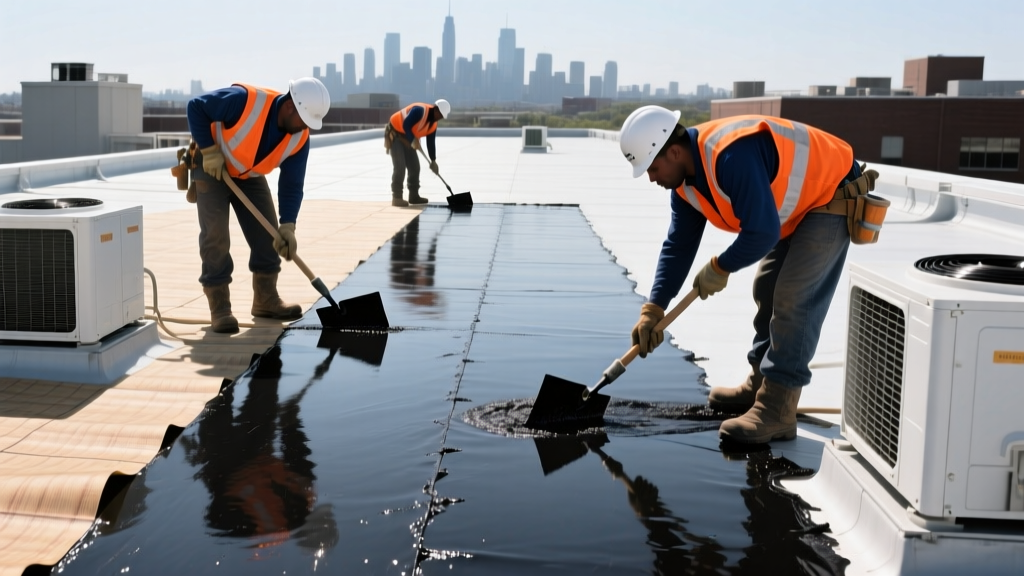
To understand where your budget is going, you must understand the anatomy of an Asphalt BUR system. A standard 4-ply BUR system is not just "painted on"; it is a laminated composite engineered for redundancy. The National Roofing Contractors Association (NRCA) outlines the standard assembly as follows:
- Base Sheet: Mechanically fastened or cold-adhered to the insulation or deck, providing the first line of defense and allowing for minor substrate movement.
- Interply Mopping & Ply Sheets: Three to four layers of ASTM D2178 Type IV fiberglass felts are embedded in hot-mopped asphalt (ASTM D312 Type III or IV). The asphalt is heated in a kettle to precisely 450°F–500°F. If the asphalt is too cool, it results in "cold mopping" (voids and blisters); if too hot, the asphalt cokes and loses its waterproofing elasticity.
- Flood Coat: A heavy top pour of hot asphalt that acts as the bed for the final surfacing.
- Surfacing (Aggregate or Cap Sheet): Either a mineral-surfaced cap sheet or a layer of slag/gravel aggregate. Aggregate is critical for protecting the underlying bitumen from UV degradation and physical puncture.
The Insulation Imperative
Tar roofing materials are only as effective as the substrate beneath them. Current 2024/2026 International Energy Conservation Code (IECC) adoptions require R-30 to R-35 continuous insulation for commercial low-slope roofs in most climate zones. This necessitates installing two staggered layers of 2.5-inch or 3-inch polyisocyanurate (polyiso) board to eliminate thermal bridging at the joints. Budget an additional $2.80 to $4.20 per square foot for code-compliant polyiso insulation and mechanical fasteners.
The Coal Tar Pitch Premium: When to Pay Double
Coal Tar Pitch (ASTM D450 Type I) is the original "tar roof." It is vastly more expensive than asphalt due to limited refining sources, stringent environmental handling requirements, and the specialized labor required to apply it. However, it possesses a unique chemical property: self-healing. When heated by the sun, coal tar pitch flows slightly, closing micro-fissures that would cause an asphalt roof to leak.
Coal tar is exclusively specified for dead-level roofs (slopes less than 1/8" per foot) or roofs with complex, shallow ponding issues, as its cold-flow properties allow it to remain watertight even under standing water—a scenario that will rapidly destroy an asphalt BUR system.
Ancillary Costs: Tear-Off, Deck Prep, and the "Detail Tax"
The per-square-foot membrane costs above only tell half the story. Real-world 2026 roofing estimates are heavily influenced by site conditions and structural detailing.
Tear-Off and Disposal
Removing an existing multi-ply tar roof is labor-intensive and heavy. A 4-ply BUR system with gravel aggregate can weigh upwards of 600 to 800 pounds per square (100 sq. ft.).
- Standard Tear-Off (1-2 layers): $1.50 – $2.50 per sq. ft.
- Heavy Tear-Off (3+ layers, gravel): $2.50 – $4.00 per sq. ft.
- Asbestos Abatement: If the existing roof was installed pre-1985, mastic and flashing may contain asbestos. Abatement adds $5.00 – $12.00+ per sq. ft. and requires licensed environmental contractors.
The "Detail Tax": Flashing and Penetrations
Industry data consistently shows that over 90% of flat roof leaks occur at penetrations, edges, and transitions, not in the field of the membrane. Detailing HVAC curbs, plumbing stacks, and parapet walls requires meticulous base flashing, counter-flashing, and sometimes metal reglets.
"A roofer's profit margin is made in the field, but a building owner's financial ruin happens at the penetrations. Never value-engineer your flashing details." — Standard NRCA Roofing Manual Guidance.Expect contractors to charge a premium of $45 to $85 per linear foot for parapet wall flashing, and $150 to $300 per penetration for properly detailed pipe boots and HVAC curb wrapping using modified bitumen flashings and pitch pans.
Long-Term Lifecycle and Maintenance Economics
When evaluating the cost of tar roofing material, facility managers must look at the 30-year lifecycle cost, not just day-one installation. The U.S. Department of Energy notes that maintaining the thermal and reflective properties of low-slope roofs is critical for HVAC efficiency.
- Asphalt BUR Maintenance: Requires a reflective aluminum or silicone roof coating every 7 to 10 years to prevent UV alligatoring and reduce cooling loads. Budget $2.50 – $4.00 per sq. ft. for re-coating.
- Coal Tar Pitch Maintenance: Requires virtually no UV coating due to its inherent resistance and self-healing nature, but periodic infrared moisture scans ($0.05 – $0.10 per sq. ft.) are recommended to check for trapped interply moisture.
- Modified Bitumen Maintenance: SBS (torch-down) systems require periodic seam inspections and may need a granular cap sheet replacement or elastomeric coating after 15 years.
Decision Framework: Is Tar Roofing Right for Your Project?
Use this framework to determine if a bitumen-based system is the correct financial and structural choice for your 2026 project:
Choose Asphalt BUR if:
- You require a highly puncture-resistant roof for areas with heavy foot traffic or falling debris.
- You want a redundant, multi-ply system where a single cut or tear will not compromise the entire roof.
- Your roof has a minimum slope of 1/4" per foot to ensure positive drainage.
Choose Coal Tar Pitch if:
- Your roof is completely dead-level and prone to ponding water.
- The building houses chemical processing facilities (coal tar is highly resistant to chemical fumes and grease exhaust).
- Budget is secondary to achieving a 40+ year lifecycle with minimal membrane maintenance.
Look at Alternatives (TPO/EPDM/PVC) if:
- Open-flame torching or hot-mopping kettles are prohibited by your building's insurance or local fire marshals.
- You require a highly reflective, energy-efficient "cool roof" straight out of the box without applying secondary coatings.
- The structural deck cannot support the immense dead load of a 4-ply gravel-surfaced BUR system.
By understanding the precise material distinctions, labor variables, and hidden detailing costs, property owners can accurately forecast their capital expenditures and avoid the costly change orders that plague poorly specified low-slope roofing projects.
Written by
Marcus ChenMarcus Chen is a licensed structural engineer (PE) and building materials analyst with over 12 years of experience across residential, commercial, and industrial construction. He holds a Master of Science in Civil Engineering from UC Berkeley and spent six years at Thornton Tomasetti before transitioning to independent consulting and technical writing. Marcus specializes in material selection for seismic-prone regions, concrete reinforcement strategies, and lifecycle cost analysis. His work has been cited by the American Concrete Institute (ACI) and the Structural Engineers Association of California (SEAOC). When he is not on a job site or at his desk, you will find him hiking the Sierra Nevada or restoring a 1920s craftsman bungalow in Oakland, CA.
More from Marcus Chen
View all
Construction Cost
How Much Did the Eiffel Tower Cost to Build?
How much did the Eiffel Tower cost to build in 1889? We adjust for inflation and compare its budget to modern skyscraper construction.
Aug 4, 2026

Fire Resistance
What Is a Fire Resistant Material? Testing & Certification Guide
Discover what is a fire resistant material through ASTM and UL testing. Learn how fire ratings, certifications, and assemblies work in construction.
Aug 4, 2026

Construction Cost
How Much Did the Burj Khalifa Cost to Build?
How much did the Burj Khalifa cost to build? We break down the $1.5B project and extract 5 money-saving strategies for your next build.
Jul 30, 2026