Impact Resistant Shingles: Scenario Matching & Application Guide
Discover when to install impact resistant shingles. Match Class 3 and Class 4 asphalt shingles to your hail zone, budget, and insurance profile.
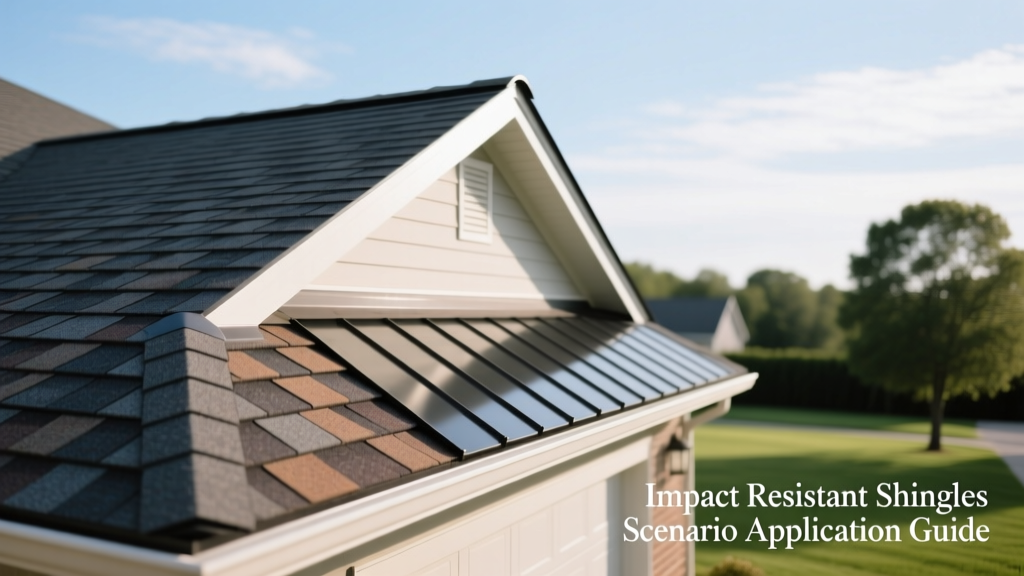
Hail and wind-driven debris cause over $15 billion in annual property damage in the United States, with roofing systems bearing the brunt of the financial impact. While standard architectural asphalt shingles provide adequate protection in mild climates, they fracture easily under high-velocity kinetic strikes. This has driven a massive shift toward impact resistant shingles, which utilize modified asphalt binders to absorb and dissipate impact energy. However, upgrading to a Class 4 impact-rated roof carries a 25% to 45% material premium. Determining whether this investment yields a positive return on investment requires a rigorous application-fit and scenario-matching analysis.
The UL 2218 Standard: Class 3 vs. Class 4 Impact Shingles
The benchmark for impact resistance in asphalt roofing is the UL 2218 standard, which tests a shingle's ability to withstand the impact of a steel ball dropped from a specific height without cracking, tearing, or fracturing the fiberglass mat.
- Class 3: Withstands a 1.75-inch steel ball dropped from 20 feet (simulates moderate hail up to 1.75 inches).
- Class 4: Withstands a 2.0-inch steel ball dropped from 20 feet (simulates severe hail up to 2.0 inches, the size of a golf ball).
For a shingle to pass, the reverse side must show no evidence of cracking, splitting, or rupture in the fiberglass reinforcement mat after two impacts on the same test area.
While Class 3 shingles exist, the residential market has heavily standardized around Class 4 impact resistant shingles. The marginal cost difference between Class 3 and Class 4 is negligible (often less than $0.05 per square foot), but the insurance premium discounts heavily favor Class 4. Therefore, scenario matching in this guide focuses primarily on Class 4 applications.
Scenario Matching Matrix: When to Upgrade
Not every roof requires a premium impact-resistant system. Use the following decision matrix to evaluate whether the application justifies the material and labor premium.
| Scenario Variable | Standard Architectural Shingles | Class 4 Impact Resistant Shingles |
|---|---|---|
| Hail Frequency | Less than 1 severe hail event per decade | 1 or more severe hail events per year (Hail Alley) |
| Tree Canopy Cover | Open exposure or deciduous trees only | Dense evergreen canopy with frequent limb drops |
| Roof Pitch | Standard pitch (4:12 to 9:12) | Low pitch (2:12 to 4:12) where hail strikes at a steeper, more damaging angle |
| Insurance Profile | Actual Cash Value (ACV) policies or no wind/hail endorsements | Replacement Cost Value (RCV) policies in states mandating hail premium discounts |
| Expected Lifespan | Owner plans to sell within 5-7 years | Long-term hold (15+ years) or strict HOA durability mandates |
Geographic Risk Profiling: The Hail Map
Application-fit is heavily dictated by geography. According to the Insurance Institute for Business & Home Safety (IBHS), the highest concentration of severe hail events occurs in a corridor known as "Hail Alley." If your project falls within these zones, Class 4 impact resistant shingles transition from an optional upgrade to a structural necessity.
- Tier 1 (Mandatory Application Fit): Nebraska, South Dakota, Iowa, Kansas, Oklahoma, and Northern Texas. These states average 9 to 12 days of severe hail annually. Standard shingles here typically fail within 7 to 10 years due to cumulative micro-fractures.
- Tier 2 (High Recommendation): Colorado (specifically the Front Range), Wyoming, Missouri, and Minnesota. Hail events are slightly less frequent but often feature larger stone diameters due to higher atmospheric freezing levels.
- Tier 3 (Situational Fit): The Southeast (Georgia, Alabama, Mississippi) and Gulf Coast. Here, the primary threat is wind-driven debris (pine straw, branches) rather than pure hail. Impact shingles offer secondary benefits here due to their heavier weight and reinforced nail zones, which improve wind uplift resistance.
Premium Product Specifications & Material Costs
The 2026 market for impact resistant shingles is dominated by SBS (Styrene-Butadiene-Styrene) polymer-modified asphalt. SBS acts like a rubber band within the asphalt matrix, allowing the shingle to flex and rebound upon impact rather than shatter. Below is a specification and pricing breakdown of top-tier Class 4 products.
| Manufacturer & Model | Modifier Tech | Wind Rating | Material Cost (per sq. ft.) |
|---|---|---|---|
| GAF Timberline AS II | SBS Modified | 130 mph (WindProven) | $1.75 - $1.95 |
| Owens Corning Duration Storm | SBS + SureNail Fabric | 130 mph | $1.80 - $2.10 |
| Malarkey Vista AR | NEX Rubberized Asphalt | 110 mph (130 w/ 6 nails) | $1.90 - $2.25 |
| CertainTeed Landmark IR | SBS Modified | 110 mph (130 w/ 6 nails) | $1.70 - $1.90 |
Note: Material costs reflect 2026 wholesale-to-contractor pricing. Installed costs (including tear-off, synthetic underlayment, and labor) typically range from $5.50 to $7.50 per square foot for Class 4 systems.
Hidden Failure Modes & Installation Edge Cases
Installing impact resistant shingles requires specific adjustments to standard roofing protocols. The National Roofing Contractors Association (NRCA) highlights several edge cases where improper handling of SBS-modified shingles leads to premature failure.
1. Thermal Scuffing During High-Heat Installation
SBS-modified shingles have a lower softening point than standard oxidized asphalt shingles. If installed when ambient temperatures exceed 85°F (or roof surface temperatures exceed 120°F), the shingles become highly susceptible to scuffing and granule loss from foot traffic. Protocol: Schedule installations for early morning or late evening during summer months. Roofers must wear soft-soled shoes and avoid pivoting on the heels.
2. Fastener Penetration and Sealant Activation
Because the SBS matrix is thicker and more rubberized, standard 1-inch roofing nails may fail to penetrate fully through the roof decking, especially over existing board sheathing or thick synthetic underlayments. Protocol: Mandate 1.25-inch ring-shank or cap nails for all Class 4 installations to ensure the nail head sits flush and does not overdrive, which can fracture the fiberglass mat beneath the rubberized layer.
3. The Underlayment Bottleneck
Pairing a premium Class 4 shingle with a standard 15lb felt underlayment negates the system's impact resilience. If a hailstone fractures the shingle's surface, water will immediately hit the underlayment. Protocol: Always pair impact shingles with a high-tensile synthetic underlayment (e.g., GAF FeltBuster or Owens Corning ProArmor) or, in Tier 1 hail zones, a fully adhered ice and water shield across the entire roof deck (a requirement for the IBHS FORTIFIED Roof designation).
Calculating the Insurance Premium ROI
The primary financial justification for impact resistant shingles is the reduction in homeowner's insurance premiums. Many states mandate that insurers offer discounts for UL 2218 Class 4 roofs, though the exact percentage varies wildly.
The ROI Breakeven Formula:
(Material Premium + Labor Premium) ÷ (Annual Insurance Premium × Discount Percentage) = Breakeven in Years.
Example Calculation:
A 2,500 sq. ft. roof (25 squares) in Colorado.
- Standard architectural roof cost: $12,500
- Class 4 impact roof cost: $16,000 (a $3,500 premium)
- Annual Homeowner's Insurance: $3,200
- State-mandated Class 4 discount: 25% ($800 annual savings)
- Breakeven: $3,500 ÷ $800 = 4.37 years.
Given that a quality SBS shingle will last 20 to 25 years, the system pays for itself nearly five times over in insurance savings alone, not including the avoidance of out-of-pocket deductibles (which can range from 1% to 2% of the home's insured value in hail-prone states) following a storm event.
Frequently Asked Questions
Do impact resistant shingles look different from standard shingles?
Modern Class 4 shingles are virtually indistinguishable from standard architectural shingles. The SBS modifier is blended into the asphalt coating, and manufacturers use the same ceramic granule blends and shadow lines for both product lines.
Are metal roofs more impact-resistant than Class 4 shingles?