Gorilla Waterproof Patch & Seal Tape Cost & Quantity Calculator
Calculate exact costs and quantities for Gorilla Waterproof Patch & Seal Tape. Get 2026 pricing, yield formulas, and surface prep requirements.
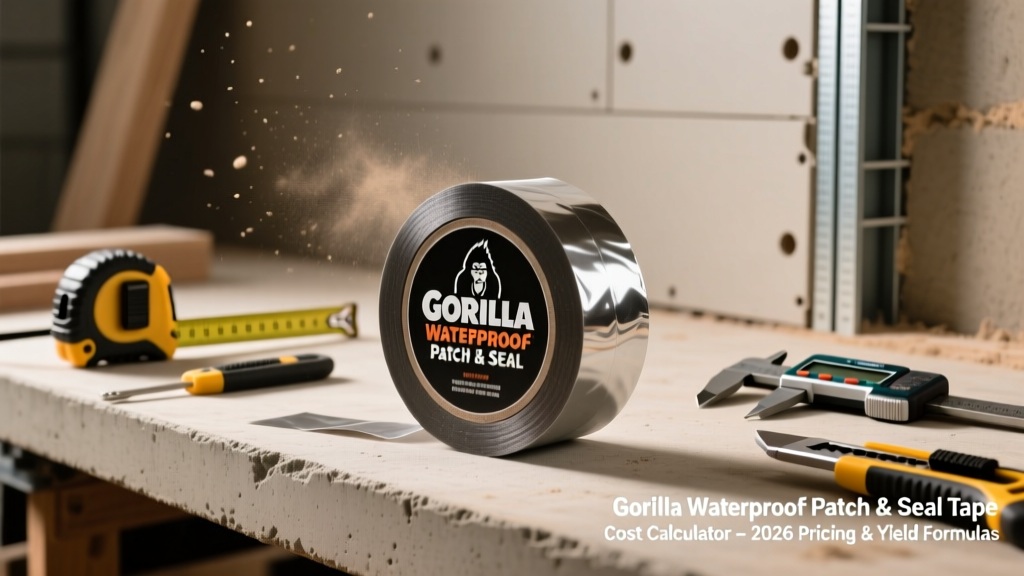
The True Cost of Gorilla Waterproof Patch & Seal Tape in 2026
When estimating repair budgets for emergency leak mitigation, facility maintenance, or RV restoration, Gorilla Waterproof Patch & Seal Tape is a frequent specification due to its aggressive butyl-rubber adhesive and UV-resistant backing. However, calculating the true project cost requires moving beyond the sticker price of a single roll. You must account for mandatory overlap requirements, surface preparation solvents, and substrate-specific primers.
As of early 2026, retail and contractor pricing for the Gorilla Waterproof Patch & Seal Tape lineup has stabilized following recent supply chain adjustments in synthetic rubber manufacturing. Below is the current baseline pricing matrix across the three primary colorways (Black, White, and Crystal Clear) and standard dimensions.
2026 Pricing & Yield Matrix
| SKU Variant | Dimensions | Avg. Retail Price | Cost Per Sq. Ft. |
|---|---|---|---|
| Standard (4" Width) | 4 in. x 10 ft. | $13.98 | $4.19 |
| Standard (4" Width) | 4 in. x 25 ft. | $27.48 | $3.30 |
| Wide (8" Width) | 8 in. x 10 ft. | $21.98 | $3.30 |
| Wide (8" Width) | 8 in. x 25 ft. | $48.98 | $2.94 |
Note: Crystal Clear variants typically carry a 5-8% price premium over Black/White due to the specialized UV-inhibiting polyurethane backing.
Quantity Calculator: How Much Tape Do You Actually Need?
The most common estimation error contractors make is calculating pure linear footage without factoring in the mandatory overlap and edge-sealing requirements. According to Gorilla Tape's official technical specifications, the adhesive requires a minimum overlap to ensure a continuous hydrostatic seal, especially on uneven substrates like corrugated metal or textured masonry.
Scenario 1: Linear Seam Repairs (Gutters, Flashing, and Roof Vents)
For flat or slightly pitched linear seams, you must add a 15% waste and overlap factor to your base measurement. Furthermore, you need a minimum 1-inch border of tape extending past the physical edges of the patch area on all sides.
- Base Formula: (Linear Footage of Seam + 2 inches per end) × 1.15 (Waste/Overlap Factor)
- Example: Repairing a 12-foot gutter seam. (12 ft + 0.33 ft) × 1.15 = 14.18 feet of tape required.
- Purchase Recommendation: One 4" x 25' roll ($27.48) leaves enough material for a secondary reinforcement layer over the highest-stress joint points.
Scenario 2: Cylindrical Wraps (PVC Pipes, Downspouts, and Conduits)
Wrapping a cylindrical object requires a spiral overlap to prevent water from tracking underneath the tape via capillary action. The adhesive must overlap itself by at least 50% of the tape's width.
- Calculate Circumference: π × Pipe Diameter (e.g., a 4-inch PVC pipe = 12.56 inches).
- Add Overlap: Add 2 inches for the starting and ending seam seal (Total cut length per wrap = 14.56 inches).
- Spiral Factor: If using 4-inch tape, a 50% overlap means you are only covering 2 inches of linear pipe length per wrap. Therefore, to cover a 12-inch linear section of pipe, you need 6 wraps.
- Total Material: 6 wraps × 14.56 inches = 87.36 inches (7.28 feet) of 4-inch tape to cover just one linear foot of 4-inch pipe.
Hidden Costs: Surface Preparation and Primers
Gorilla Waterproof Patch & Seal Tape features an incredibly aggressive butyl-rubber adhesive, but it is not a magic fix for dirty or chemically incompatible surfaces. Failing to budget for surface prep will result in catastrophic adhesion failure within the first freeze-thaw cycle. Building Science Corporation emphasizes that moisture and surface contaminants are the primary causes of adhesive membrane failure in building envelopes.
The Mandatory Prep Budget
Add the following line items to your estimation sheet before applying the tape:
| Prep Material | Purpose | Est. Cost |
|---|---|---|
| Acetone or MEK Solvent | Degreasing metal flashing and removing old asphalt residues. | $12.00 / qt |
| TSP (Trisodium Phosphate) | Cleaning algae, dirt, and oxidation from PVC and masonry. | $8.00 / box |
| Wire Brush / Abrasive Pad | Scuffing smooth surfaces (like glazed tile or polished metal) to create a mechanical tooth. | $5.00 / ea |
| EPDM/TPO Primer | Required for single-ply roofing membranes to prevent plasticizer bleed-through. | $25.00 / pt |
Application Limits and Failure Modes (What the Label Doesn't Say)
To provide an accurate estimate, you must also assess the environmental and material constraints of the job site. If the site conditions fall into the following edge cases, you must either specify a different product or add labor hours for environmental mitigation (e.g., heat tents, dehumidifiers).
1. The Silicone Incompatibility Rule
Butyl-rubber adhesives will not bond to silicone caulking or silicone-coated substrates. If a previous contractor attempted to fix a leak with 100% silicone, the Gorilla tape will peel off within days. You must budget 1.5 labor hours per 10 linear feet to mechanically scrape and solvent-wipe all traces of existing silicone before taping.
2. Temperature Thresholds
The adhesive requires a minimum application temperature of 40°F (4°C). Below this threshold, the butyl rubber becomes too rigid to flow into the microscopic pores of the substrate. If you are estimating a winter repair job in an unheated warehouse or exterior winter maintenance, you must include the cost of a heat gun or portable propane heater to warm both the substrate and the tape roll prior to application.
3. Hydrostatic Pressure vs. Water Resistance
While the tape is entirely waterproof and can be applied to damp surfaces, it is not rated for continuous submersion under high hydrostatic pressure (such as the exterior of a below-grade foundation wall). For below-grade applications, specify a dimple drain board or a liquid-applied polyurethane membrane instead.
Gorilla Tape vs. Liquid Flashing: Cost-Per-Square-Foot Showdown
When should you estimate tape versus a liquid-applied rubberized coating (like Liquid Rubber or Henry's flashing cement)? The decision matrix below helps estimators choose the right material based on the geometry and urgency of the repair.
✓ Choose Gorilla Tape When:
- The repair is an emergency active leak (tape stops water instantly; liquids require dry curing).
- The substrate is complex geometry (tight corners, pipe penetrations) where liquid would sag or drip.
- VOC regulations or indoor air quality prevents the use of solvent-based liquid flashings.
- The total repair area is under 5 square feet.
✗ Choose Liquid Flashing When:
- The repair area exceeds 10 square feet (tape becomes cost-prohibitive and labor-intensive).
- The substrate is heavily textured, porous, or features thousands of small pinholes (e.g., deteriorated concrete).
- You require a seamless, monolithic membrane over a wide, flat roof valley.
Pro-Tips for Maximizing Yield and Adhesion
To ensure your 2026 estimates remain profitable and your callbacks drop to zero, enforce these installation standards on your job sites:
"Always cut the tape with a sharp utility knife and a straight edge rather than tearing it. Tearing stretches the polyurethane backing, creating built-in tension that will cause the edges to curl and lift over time as the material attempts to return to its original shape."
Furthermore, when applying the tape, use a hard rubber J-roller to apply a minimum of 50 lbs of pressure across the entire surface. Hand-rubbing with a rag is insufficient to activate the pressure-sensitive butyl adhesive into the substrate's grain. Factoring in a $15 hard roller tool into your initial estimate ensures the crew has the right equipment to guarantee the manufacturer's waterproof seal.