Waterproof Roofing Material Cost Breakdown (2026 Guide)
Detailed 2026 cost breakdown for waterproof roofing materials, including TPO, PVC, EPDM, and liquid membranes, plus labor and hidden substrate costs.

Baseline Pricing for Waterproof Roofing Systems
Selecting the optimal waterproof roofing material requires looking beyond the initial per-square-foot material cost. In 2026, commercial and residential flat or low-slope roofing costs are heavily influenced by polymer chemistry, supply chain stabilization, and stringent energy code requirements. Single-ply membranes and liquid-applied systems dominate the market, but their financial profiles differ drastically once labor, substrate preparation, and long-term maintenance are factored in.
The following matrix outlines the current installed costs for the primary waterproof roofing material categories. Prices reflect national averages for commercial low-slope applications (2,000 to 10,000 square feet) and include standard mechanical fastening or fully adhered installation methods.
| Material Type | Material Cost (per sq. ft.) | Labor & Equipment (per sq. ft.) | Total Installed Cost | Primary ASTM Standard |
|---|---|---|---|---|
| TPO (Thermoplastic Polyolefin) | $2.50 - $4.00 | $4.50 - $7.00 | $7.00 - $11.00 | ASTM D6878 |
| EPDM (Ethylene Propylene Diene Monomer) | $1.50 - $3.00 | $4.50 - $6.50 | $6.00 - $9.50 | ASTM D4637 |
| PVC (Polyvinyl Chloride) | $3.50 - $5.50 | $5.50 - $8.50 | $9.00 - $14.00 | ASTM D4434 |
| Liquid Silicone / Polyurethane | $2.00 - $4.50 | $4.50 - $7.50 | $6.50 - $12.00 | ASTM C920 / D6694 |
| Modified Bitumen (SBS/APP) | $2.50 - $4.00 | $6.00 - $9.00 | $8.50 - $13.00 | ASTM D6164 |
TPO remains the most cost-effective reflective membrane, heavily subsidized by its rapid installation speed via hot-air welding. PVC commands a 20% to 30% premium over TPO due to the inclusion of plasticizers (like phthalates or newer bio-based alternatives) and superior chemical resistance, making it mandatory for roofs exposed to animal fats, oils, or industrial exhaust. EPDM offers the lowest material cost but incurs higher labor expenses because seaming requires liquid primers and double-sided tape or liquid adhesives, which are highly sensitive to ambient temperature and moisture during application.
Substrate Preparation and Hidden Tear-Off Costs
The most frequent budget overruns in roofing projects occur below the membrane. If an existing roof system must be removed, tear-off and disposal costs will add $1.50 to $3.50 per square foot, depending on the number of existing plies and local landfill tipping fees. Furthermore, the insulation layer beneath the waterproof roofing material is a major cost driver.
In 2026, 2-inch thick polyisocyanurate (polyiso) insulation boards cost between $2.50 and $4.00 per square foot. If your decking requires a tapered insulation system to achieve the minimum 1/4-inch per foot slope required by the International Building Code (IBC), material costs for the insulation layer alone can double. Always mandate a core cut and moisture survey before finalizing the substrate budget.
If the existing roof deck is concrete, wood, or steel, additional preparatory costs apply. Steel decking may require rust remediation and priming ($0.75 - $1.25 per sq. ft.). Wood decking often requires replacing rotted OSB or plywood sheathing, which contractors typically bill at $65 to $95 per sheet (4x8 feet) plus labor. For concrete decks, a vapor retarder is mandatory to prevent moisture drive from the building interior from blistering the membrane; a high-quality modified bitumen vapor retarder adds $1.80 to $2.50 per square foot.
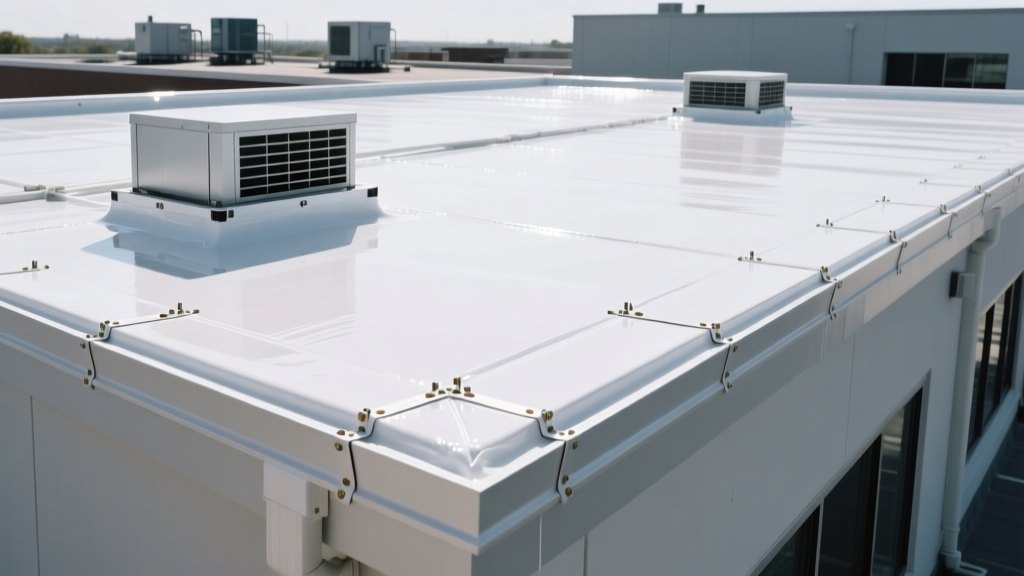
Liquid-Applied vs. Single-Ply Membranes: A Financial Decision Framework
Choosing between a liquid-applied waterproof roofing material (like silicone or polyurethane) and a single-ply sheet membrane (TPO/PVC) should be dictated by roof topology, not just base material costs. Use the following framework to determine the most financially viable system for your specific structure.
When to Choose Liquid-Applied Silicone or Polyurethane
- High Penetration Density: If the roof has more than 8-10 penetrations (HVAC curbs, pipes, skylights) per 1,000 square feet, liquid systems become significantly cheaper. Single-ply membranes require labor-intensive flashing, inside/outside corners, and termination bar installations for every penetration. Liquid membranes are simply rolled or sprayed over these details, reducing flashing labor by up to 60%.
- Complex Geometries: Domes, barrel vaults, and roofs with severe pitch transitions are prohibitively expensive to flash with sheet goods. Liquid systems conform seamlessly to any geometry.
- Weight Restrictions: Liquid coatings add less than 0.5 lbs per square foot, making them ideal for older structures where adding a tear-off dumpster load or heavy insulation layers exceeds structural load limits.
When to Choose Single-Ply (TPO / PVC / EPDM)
- New Construction or Full Tear-Off: Liquid systems require an existing, stable substrate to adhere to. For new construction, single-ply membranes mechanically fastened to the deck are the standard, most warrantable approach.
- High Foot Traffic: If the roof will serve as a terrace or require frequent maintenance access, reinforced PVC or heavy-mil TPO (60-mil or 80-mil) provides superior puncture resistance compared to liquid coatings, which can be easily gouged by dropped tools.
- Reflectivity Mandates: While white silicone is highly reflective, it attracts dirt and loses solar reflectance over time unless cleaned. TPO and PVC maintain high Solar Reflectance Index (SRI) values with minimal maintenance, ensuring compliance with energy codes like California's Title 24 or ASHRAE 90.1. For more on reflectivity standards, refer to the EPA Heat Islands Cool Roofs guidelines.
Lifecycle Cost Analysis and 20-Year ROI
Initial installation cost is only one variable in the total cost of ownership. A 20-year lifecycle analysis reveals that the cheapest waterproof roofing material upfront often costs more over time due to maintenance, seam degradation, and energy inefficiency.
| System Type | Expected Lifespan | 20-Year Maintenance Cost (per sq. ft.) | Energy Savings Potential | End-of-Life Recyclability |
|---|---|---|---|---|
| 60-mil TPO | 15 - 20 Years | $1.50 - $2.50 | High (White reflective) | Moderate (Thermoplastic) |
| 50-mil PVC | 20 - 25 Years | $1.00 - $2.00 | High (White reflective) | High (Established recycling) |
| 60-mil EPDM (Black) | 20 - 30 Years | $2.00 - $3.50 | Low (Absorbs heat) | Low (Thermoset rubber) |
| Silicone Coating | 10 - 15 Years (before recoat) | $3.00 - $4.50 | High (Initial), degrades | None (Cannot be recycled) |
EPDM boasts the longest raw material lifespan, but black EPDM significantly increases cooling loads in warm climates, negating material savings through higher HVAC costs. White TPO and PVC reflect up to 80% of solar radiation. According to building envelope studies, upgrading from a black roof to a highly reflective white membrane can reduce peak cooling demand by 10% to 15%, yielding substantial utility savings that offset the higher initial cost of PVC or reinforced TPO within 5 to 7 years.
Critical Installation Failures That Void Warranties
The performance of any waterproof roofing material is entirely dependent on installation precision. Manufacturers will void 20-year or 30-year No Dollar Limit (NDL) warranties if specific installation parameters are violated. Understanding these edge cases protects your financial investment.
Hot-Air Welding Temperature Deviations (TPO/PVC)
Single-ply thermoplastic membranes rely on hot-air welding to fuse seams. The welding equipment must be calibrated daily based on ambient temperature and humidity. In 2026, automated robotic welders are standard for field seams, but hand-welding is still required for details and penetrations. If the air temperature is too low (below 1,000°F), the seam will experience a 'cold weld' and peel apart under wind uplift. If too high (above 1,150°F), the polymer will scorch, creating micro-fractures. Contractors must perform destructive peel tests every 1,000 linear feet of seam to verify weld integrity.
Improper Fall Protection and Deck Damage
Safety compliance is a hidden cost that impacts the bottom line. Roofing crews must adhere to strict safety protocols, which can slow down installation and increase labor bids. Failure to utilize proper anchor points or guardrails not only risks severe penalties from regulatory bodies like OSHA Fall Protection standards, but improper placement of temporary safety anchors can puncture the vapor retarder or insulation layer, creating hidden moisture pathways before the membrane is even laid.
Flashing and Termination Bar Failures
Over 85% of roof leaks occur at the perimeter or at penetrations, not in the field of the membrane. When terminating the membrane at a parapet wall, contractors must use heavy-duty aluminum termination bars fastened into masonry or concrete with screws spaced no more than 8 inches apart. The joint must then be sealed with a high-grade polyurethane sealant and covered with a metal counter-flashing. Relying solely on adhesive or mastic at the termination edge is a guaranteed failure point within 3 to 5 years due to thermal expansion and contraction of the building envelope.
By accurately budgeting for substrate realities, selecting the membrane chemistry that matches your roof's topology, and enforcing strict installation quality control, you can ensure your waterproof roofing material investment delivers reliable, leak-free performance for decades.
Written by
Sarah WhitfieldSarah Whitfield is a chartered quantity surveyor (MRICS) and construction cost analyst with 15 years of experience in material pricing, procurement strategy, and project budgeting. She earned her degree in Construction Management from the University of Reading (UK) and has worked on projects ranging from $2M custom homes to $180M mixed-use developments across North America and Europe. Sarah currently leads cost estimating for BuildMat Insight, maintaining a proprietary database of 4,000+ material price points updated quarterly. She is a frequent contributor to RSMeans cost data panels and has presented at the International Cost Engineering Council (ICEC) congress. Based in Denver, CO, Sarah is an avid trail runner and volunteer mentor for Women in Construction.
More from Sarah Whitfield
View all
Wood & Lumber
What Are the Different Types of Wood? A Builder's Guide
Compare structural softwoods, finish hardwoods, and engineered lumber. Analyze Janka ratings, MOE values, and 2026 pricing for construction.
Aug 4, 2026

Walls & Panels
Steel Framing vs Wood Framing: Corrosion and Moisture Defense
Compare steel framing vs wood framing for moisture resistance. Learn about galvanized coatings, condensation risks, and corrosion protection strategies.
Jul 21, 2026

Stone & Masonry
How to Cut Stone Veneer: Wet Saw vs Grinder Comparison
Compare the best tools for cutting stone veneer. We review wet saws, angle grinders, and chop saws to help you achieve clean, chip-free cuts.
Jul 21, 2026