Cost Estimator Guide: Waterproof Jackets for Pipe Insulation Systems
Calculate material and labor costs for waterproof jackets on pipe insulation. Includes current pricing for PVC, aluminum, and silicone fiberglass.
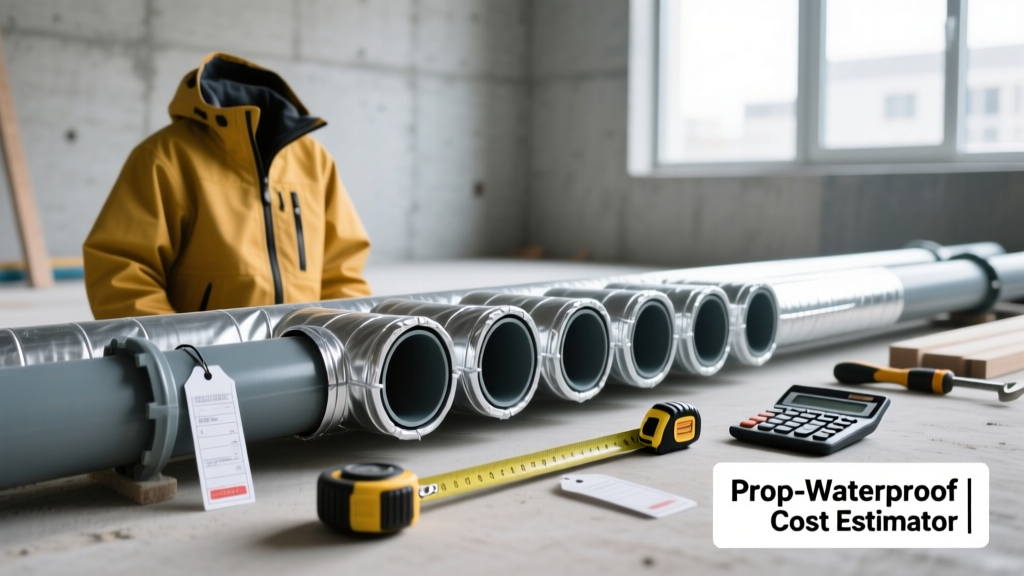
Defining Waterproof Jackets in Mechanical Construction
When commercial estimators and mechanical contractors search for waterproof jackets, they are not looking for apparel; they are referring to the critical outer cladding applied over thermal pipe and equipment insulation. In commercial and industrial construction, the insulation itself (whether fiberglass, mineral wool, or closed-cell elastomeric) is highly susceptible to moisture ingress. Once insulation becomes wet, its thermal resistance (R-value) collapses, and the trapped moisture accelerates Corrosion Under Insulation (CUI) on the carbon steel piping beneath.
Waterproof jackets act as the primary vapor and weather barrier. According to the U.S. Department of Energy's Steam Systems guidelines, damaged or improperly sealed insulation jacketing can increase system heat loss by up to 15% while simultaneously destroying the underlying pipe through localized galvanic and chloride-induced corrosion. Accurately estimating the material quantities and labor for these jackets is a specialized skill that requires moving beyond simple linear-foot takeoffs.
Material Cost Matrix: Selecting the Right Jacketing
The cost of waterproof jackets varies drastically based on the operating temperature of the pipe, the environment (indoor vs. outdoor UV exposure), and the required fire-rating. Below is the current pricing matrix for the three most common jacketing materials used in mechanical rooms and exterior pipe racks.
| Material Type | Standard Thickness | Cost per Sq. Ft. (Material Only) | Best Application | Limitations |
|---|---|---|---|---|
| PVC (Polyvinyl Chloride) | 20 to 30 mil | $1.25 - $2.10 | Indoor chilled water, domestic plumbing, low-temp HVAC. | Brittle under UV exposure; melts above 150°F (65°C). |
| Aluminum (Smooth/Corrugated) | 0.016" to 0.024" | $2.80 - $4.50 | Outdoor steam, hot water, and process piping. Excellent UV and physical abuse resistance. | Prone to galvanic corrosion if in direct contact with certain wet alkaline insulation without a separator. |
| Silicone-Coated Fiberglass | 17 oz to 32 oz | $6.50 - $11.50 | High-temperature steam lines, turbine exhausts, and complex removable valve covers. | High material cost; requires specialized heavy-duty thread and sealing tape for seams. |
| Stainless Steel (304/316) | 0.010" to 0.016" | $8.00 - $14.00 | Food/beverage processing, marine environments, and highly corrosive chemical plants. | Extremely high cost; difficult to fabricate on-site without specialized shears and brakes. |
Note: Prices reflect bulk commercial purchasing (pallet quantities) and exclude specialized fasteners, sealants, and banding.
The Quantity Calculator Framework
Estimating waterproof jackets requires calculating the outer surface area of the insulation, not the pipe itself. A common error among junior estimators is using the nominal pipe size (NPS) rather than the insulated outer diameter (OD).
Step 1: Calculate the Insulated Outer Diameter (OD)
Use the following formula to determine the diameter of the insulated pipe:Insulated OD = Pipe OD + (2 × Insulation Thickness)
For example, a 4-inch nominal steel pipe (actual OD 4.50") wrapped in 2.5 inches of fiberglass insulation will have an insulated OD of 9.50 inches.
Step 2: Calculate Base Surface Area
Convert the insulated OD to feet, then calculate the square footage per linear foot (LF):Sq. Ft. per LF = (Insulated OD in inches × π) / 12
Using the 9.50" OD example: (9.50 × 3.1416) / 12 = 2.48 sq. ft. per linear foot.
Step 3: Apply the Overlap and Waste Multiplier
Waterproof jackets are never installed butt-joint to butt-joint. Longitudinal seams require a minimum 1.5-inch to 2-inch overlap to prevent capillary water draw, and circumferential joints require a 2-inch overlap. Furthermore, material is lost during cutting and fabrication.
Labor Rates and Productivity Benchmarks
Material costs are only half of the equation. Installing waterproof jackets—particularly rigid metal jacketing—requires skilled insulation mechanics. According to data tracked by the North American Insulation Manufacturers Association (NAIMA), proper installation is critical to maintaining the vapor retarder integrity of the system.
Current labor benchmarks for commercial mechanical insulation jacketing include:
- Journeyman Insulator Rate: $65 to $95 per hour (fully burdened, including taxes, insurance, and union benefits where applicable).
- Apprentice/Helper Rate: $40 to $55 per hour.
- Productivity (Straight Horizontal Runs): A two-person crew (one journeyman, one helper) can typically measure, cut, and secure 120 to 160 linear feet of aluminum jacketing per 8-hour shift.
- Productivity (Complex Manifolds/Valves): Production drops precipitously to 25 to 40 linear feet equivalent per shift when fabricating custom mitered elbows, flange covers, and valve boxes.
Edge Cases: Estimating for Valves, Flanges, and Expansion Joints
The most severe budget overruns in mechanical insulation occur at the fittings. Valves, flanges, and strainers must remain accessible for maintenance, meaning they cannot be permanently encapsulated in rigid aluminum or PVC. Instead, estimators must specify removable waterproof jackets (often called removable insulation covers or thermal blankets).
When calculating costs for these components, abandon the square-footage method and use a per-unit piece cost:
| Fitting Type | Estimation Method | Average Installed Cost (Material + Labor) |
|---|---|---|
| Standard Flange Cover (up to 6") | Per Unit | $180 - $260 |
| Globe/Ball Valve Cover (up to 4") | Per Unit | $250 - $400 |
| Complex Control Valve (with actuator) | Custom Field Measure | $600 - $1,200+ |
| 90-Degree Elbow (Field-mitered metal) | Add 1.5 LF to straight run | Calculated via labor time (approx. 1.5 hours) |
Removable silicone-coated fiberglass valve jackets are typically fabricated off-site by specialized subcontractors based on field templates or 3D scans. Estimators must include a line item for "Field Templating and Template Return Logistics," which usually adds $500 to $1,000 per project phase.
Avoiding the 'Straight-Run Only' Estimation Trap
Warning: Relying solely on automated takeoff software that calculates linear piping length will result in a 20% to 30% underestimation of waterproof jacketing costs. Software often ignores the surface area added by the insulation thickness on fittings, the required metal bands (strapping), and the specialized butyl sealants required at every termination point. Always manually audit your automated takeoffs for fitting density.
To ensure a highly accurate bid, cross-reference your piping and instrumentation diagrams (P&IDs) to count every valve, strainer, and flange. For every 100 linear feet of pipe in a dense commercial mechanical room, expect to encounter 8 to 12 fittings that require specialized waterproofing treatments. By combining precise geometric surface area calculations with realistic labor productivity rates and fitting multipliers, estimators can protect their margins while delivering a fully sealed, CUI-resistant mechanical system.
For further reading on system design and vapor retarder requirements, consult the Whole Building Design Guide (WBDG) thermal insulation resources, which provides comprehensive federal standards for moisture control in building envelopes and mechanical systems.