Best Material Waterproofing Spray Options Compared for 2026
Compare top material waterproofing spray options for 2026. We analyze acrylic, rubber, and silicone formulas for durability, cost, and application.

The Chemistry of Material Waterproofing Sprays
When selecting a material waterproofing spray, understanding the underlying chemistry is critical to preventing catastrophic moisture intrusion. Sprays generally fall into two distinct categories: film-forming membranes and penetrating sealers. Film-forming sprays, such as synthetic rubbers and acrylic elastomerics, build a physical, continuous barrier on the substrate surface, typically achieving a Dry Film Thickness (DFT) of 20 to 60 mils. These are designed to bridge cracks and resist hydrostatic pressure.
Conversely, penetrating sprays utilize silane or siloxane molecules that are small enough to enter the capillary pores of masonry and concrete. Once inside, they react with the silica and alkaline environment to form a hydrophobic resin network beneath the surface. According to the Environmental Protection Agency (EPA) moisture control guidelines, managing bulk water and vapor transmission requires matching the coating's permeability (perm rating) to the substrate's natural drying potential. Applying a low-perm film-forming spray to a damp masonry wall will trap moisture, leading to spalling and efflorescence.
Head-to-Head Material Waterproofing Spray Comparison Matrix
| Formulation Type | Dry Film Thickness (DFT) | Permeability (Perms) | UV Resistance | Avg Cost per Sq Ft (2026) |
|---|---|---|---|---|
| Synthetic Rubber / Asphalt | 40 - 60 mils | < 0.05 (Vapor Barrier) | Poor (Requires topcoat) | $0.90 - $1.30 |
| Silane / Siloxane Penetrating | 0 mils (Sub-surface) | > 5.0 (Highly Breathable) | Excellent | $0.20 - $0.40 |
| Polyurethane Elastomeric | 20 - 30 mils | < 1.0 (Semi-Impermeable) | Good | $1.10 - $1.60 |
| Acrylic Emulsion | 10 - 15 mils | 2.0 - 4.0 (Breathable) | Excellent | $0.35 - $0.60 |
Deep Dive: Top Formulations & Specific Product Benchmarks
1. Synthetic Rubber & Rubberized Asphalt
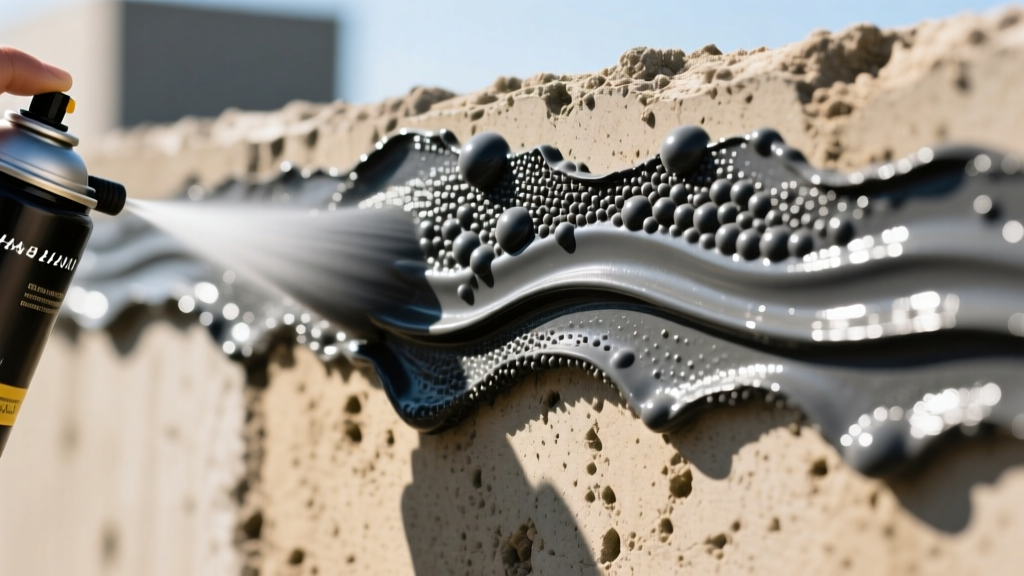
Products like Liquid Rubber Foundation Sealant and aerosolized Flex Seal represent the synthetic rubber category. These sprays are heavily favored for below-grade foundation walls, planter boxes, and metal roofing seams. The high elasticity (often exceeding 1000% elongation per ASTM D412 testing) allows the membrane to bridge dynamic hairline cracks that expand and contract with seasonal freeze-thaw cycles.
Application Metric: To achieve the warranted 40-mil DFT, you must apply roughly 80 to 100 mils of wet coating, as the water or solvent carrier evaporates during curing. In a 2026 market analysis, professional-grade spray-applied rubberized membranes cost approximately $1.15 per square foot, including surface prep.
2. Penetrating Silane/Siloxane Sealers
For above-grade porous substrates like split-face CMU (concrete masonry units), brick, and porous limestone, penetrating sealers are the undisputed standard. Prosoco Siloxa-Seal 400 and Thompson's WaterSeal Advanced utilize siloxane molecules that penetrate up to 3/8 of an inch into the substrate. Because they do not form a surface film, they are completely immune to UV degradation and physical abrasion from foot traffic.
Following the Department of Energy's building science moisture protocols, maintaining the breathability of above-grade masonry is essential to prevent trapped interior humidity from causing structural rot. Siloxanes boast a perm rating of 5.0 or higher, allowing water vapor to escape while repelling bulk liquid water.
3. Polyurethane & Acrylic Elastomerics
Aerosol polyurethane sprays, such as Rust-Oleum LeakSeal, are highly effective for spot repairs, flashing details, and HVAC curb sealing. They offer a faster tack-free time (often under 30 minutes) compared to rubberized asphalt. However, they are not recommended for large-scale foundation waterproofing due to their higher cost per square foot and lower elongation properties under severe structural movement.
Critical Failure Modes: Why Sprays Peel and Degrade
Even the most advanced material waterproofing spray will fail if applied outside its engineered parameters. The three most common failure modes observed in field inspections include:
- Efflorescence Breakthrough: If masonry is not treated with an acidic cleaner to remove existing salt deposits (efflorescence) before spraying, the crystalline salts will grow beneath the film-forming membrane, creating blisters and breaking the adhesive bond.
- Hydrostatic Delamination: As noted, applying low-tensile acrylic or rubber sprays on interior basement walls results in delamination when the water table rises. The adhesive shear strength of most sprays (typically 15-25 psi) cannot withstand the lateral force of saturated soil.
- Improper Mil Thickness: Applicators frequently spray a single, thin pass that dries to only 8-10 mils. This results in pinholes and micro-tears. A wet mil gauge must be used during application to verify the coating is hitting the 80+ wet mil target.
Decision Framework: Selecting the Right Spray for Your Substrate
Use this step-by-step logic tree to specify the correct material waterproofing spray for your 2026 project:
- Is the substrate below-grade and exposed to soil moisture?
Yes → Use a Synthetic Rubber or Rubberized Asphalt spray on the exterior (positive) side. Ensure a minimum 40-mil DFT.
No → Proceed to step 2. - Is the substrate above-grade masonry, brick, or concrete?
Yes → Use a Penetrating Silane/Siloxane spray. Do not use film-forming products, as they will trap vapor and alter the facade's aesthetic.
No → Proceed to step 3. - Are you sealing metal flashing, roofing seams, or HVAC penetrations?
Yes → Use a Polyurethane Elastomeric spray for its high adhesion to non-porous metals and rapid cure time.
Application Metrics & Industry Standards
When reviewing technical data sheets (TDS) for any material waterproofing spray, verify compliance with specific ASTM standards. Look for ASTM D6153 (Standard Specification for Waterproofing and Dampproofing Materials) to ensure the product has been tested for long-term hydrostatic resistance. For elongation and tensile strength, ASTM D412 is the benchmark. A high-quality synthetic rubber spray should demonstrate a minimum tensile strength of 250 psi and an elongation at break of 800% or greater.
Furthermore, VOC (Volatile Organic Compound) regulations have tightened significantly. In 2026, ensure your selected spray complies with regional air quality management district limits, typically requiring architectural waterproofing coatings to contain less than 100 g/L of VOCs for interior applications and under 250 g/L for exterior applications. Always cross-reference the manufacturer's safety data sheet (SDS) to confirm compliance before specifying the material for enclosed or occupied spaces.
Written by
Elena RodriguezElena Rodriguez is a civil engineer and technical writer specializing in concrete technology, masonry systems, and ASTM/ACI compliance. She earned her B.S. in Civil Engineering from Texas A&M University and spent a decade at a materials testing laboratory, performing over 2,000 concrete compressive strength tests and masonry prism evaluations. Elena is an ACI-certified Field Testing Technician (Grade I) and a member of ASTM Committee C12 on Natural Building Stone. She currently consults on forensic engineering cases involving concrete failures and moisture intrusion. Based in San Antonio, TX, Elena is a proud member of the Society of Women Engineers (SWE) and coaches her daughter's FIRST Robotics team.
More from Elena Rodriguez
View all
Walls & Panels
Cost Analysis: Light Gauge Steel Framing Advantages and Disadvantages
Evaluate light gauge steel framing advantages and disadvantages through a strict cost analysis lens, comparing material, labor, and lifecycle expenses.
Aug 4, 2026

Walls & Panels
Gypsum Board Types: Exact Specifications, Thickness & Dimensions
Compare standard, Type X, and moisture-resistant gypsum board types. Get exact specifications, thicknesses, dimensions, and ASTM standards for your project.
Aug 4, 2026

Fire Resistance
Best Fire-Resistant Outdoor Decking Materials: 2026 Buyer Guide
Discover the best fire-resistant outdoor decking materials for 2026. Compare Class A PVC, aluminum, and hardwood options for WUI compliance and safety.
Aug 4, 2026