Husky 15-Inch Water-Resistant Tool Bag: Performance & Material Specs
Analyze the material specs, hydrostatic ratings, and job-site performance of the Husky 15-inch contractor's multi-purpose water-resistant tool bag.
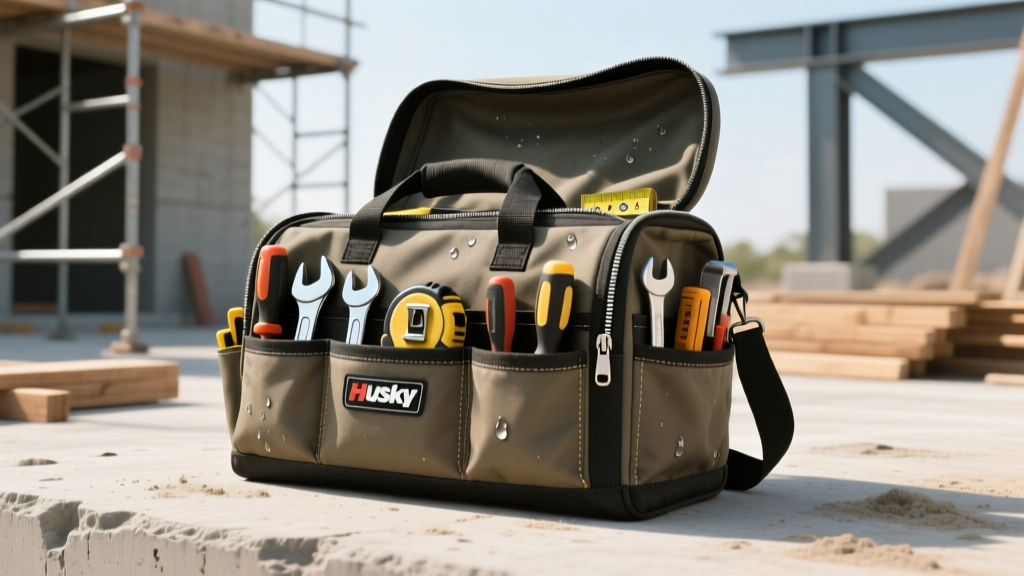
Material Composition and Fabric Technology
When executing below-grade waterproofing or applying liquid-applied membranes in damp environments, protecting sensitive diagnostic equipment—such as thermal imaging cameras and pin-type moisture meters—is non-negotiable. The husky 15 inch contractor's multi-purpose water-resistant tool bag is engineered specifically to bridge the gap between standard canvas carriers and hard-shell waterproof cases. To understand its actual job-site viability in 2026, we must deconstruct its material specifications, hydrostatic limitations, and failure points under continuous moisture exposure.
The primary chassis of the bag is constructed from 1680-denier (1680D) polyester. In textile engineering, denier refers to the linear mass density of the fibers; a 1680D yarn is exceptionally thick, originally developed for military luggage and heavy-duty tarps. However, the weave alone does not provide water resistance. The critical moisture barrier is a polyurethane (PU) backing applied to the interior face of the fabric. According to the British Plastics Federation, PU coatings offer excellent hydrolytic stability and flexibility, preventing the fabric from becoming brittle when exposed to freezing job-site temperatures.
The PU backing on this specific class of contractor bags typically yields a hydrostatic head rating between 1,500mm and 2,000mm. This means the fabric can withstand a 1.5 to 2-meter column of water pressure before moisture begins to penetrate the membrane. While this easily repels heavy rain, hydrostatic splash, and accidental spills from water-based primers, it is not rated for submersion.
Core Specification Snapshot
- Dimensions: 15 in. L x 7 in. W x 10.5 in. H
- Base Material: 1680D Polyester with PU backing
- Hydrostatic Head: ~1,500mm (Splash & Rain Resistant)
- Hardware: Rust-resistant coated steel D-rings and POM plastic buckles
- Empty Weight: 3.1 lbs (1.4 kg)
- Base Construction: Injection-molded polypropylene skid plate
The DWR Finish and Alkaline Degradation on Job Sites
The exterior of the bag is treated with a Durable Water Repellent (DWR) finish. This microscopic coating lowers the surface tension of the fabric, causing water to bead up and roll off rather than wetting the outer fibers. As of 2026, industry shifts have moved toward PFC-free (perfluorocarbon-free) DWR formulations to comply with environmental regulations. While safer, PFC-free DWRs require more frequent maintenance to maintain their beading effect.
The most critical, yet frequently overlooked, failure mode for water-resistant tool bags in the waterproofing and masonry trades is alkaline degradation. Concrete dust, Portland cement, and alkaline-based waterproofing primers (like those used before applying bentonite or liquid membranes) have a high pH. When these alkaline particulates embed themselves in the fabric weave, they chemically break down the DWR coating and can eventually degrade the PU backing. Once the DWR fails, the outer 1680D polyester absorbs water, causing the bag to become waterlogged and excessively heavy, even if the inner PU layer is still preventing water from reaching the tools.
Testing protocols, such as those outlined by the American Association of Textile Chemists and Colorists (AATCC), measure water repellency using a spray test (AATCC 22). A brand-new bag will score a 100 (no water absorption). After three months of exposure to concrete dust without cleaning, that score can drop below 50, indicating severe wet-out. To mitigate this, contractors must neutralize and rinse the bag regularly, a maintenance protocol detailed later in this guide.
Hardware, Seams, and Moisture Ingress Points
A fabric's hydrostatic rating is irrelevant if the seams and hardware compromise the envelope. The Husky 15-inch model utilizes bound seams with heavy-duty nylon thread. The needle holes created during sewing act as microscopic capillaries that can wick water into the bag's interior if left untreated. To counter this, high-stress bottom seams are reinforced with PVC binding tape, which physically blocks the needle holes from direct water exposure.
The primary zipper is a standard #8 coil zipper, covered by a 1.5-inch PU storm flap. It is vital to understand that this is not an AquaGuard or waterproof zipper. If the bag is laid on its side in a half-inch puddle of water, capillary action will eventually draw moisture through the zipper teeth. The rust-resistant zinc-alloy D-rings and polyoxymethylene (POM) plastic buckles ensure that the hardware itself will not corrode or stain the fabric when left in damp crawlspaces or humid basements over long periods.
Comparative Moisture Protection Matrix
| Feature | Husky 15' Water-Resistant | Standard 16oz Canvas Bag | Hard-Shell Waterproof Case |
|---|---|---|---|
| Material Base | 1680D Polyester + PU | Cotton/Poly Canvas | Injection-Molded Resin |
| Water Resistance Level | High (Repels heavy rain/spills) | Low (Absorbs water quickly) | Absolute (Submersible/IP67) |
| Weight (Empty) | ~3.1 lbs | ~2.5 lbs | ~8.0+ lbs |
| Flexibility & Storage | High (Folds when empty) | High (Collapsible) | None (Fixed volume) |
| Ideal Use Case | Damp basements, roof decks, rain | Dry interior framing, finish work | Flood zones, marine, submersion |
Job Site Performance in Waterproofing Applications
For contractors specializing in building envelope waterproofing, the bag's 15-inch footprint is optimized for carrying specific material samples and diagnostic tools. The interior features a rigid, injection-molded polypropylene base. This skid plate serves two purposes: it prevents the bag from sagging when loaded with heavy items like moisture meters and core samples, and it provides a non-porous barrier against ground moisture when the bag is set down on wet concrete or damp soil.
When transporting liquid-applied membrane samples (e.g., polyurethane or asphalt-modified emulsions), the interior PU coating resists chemical staining and degradation from accidental spills, provided they are wiped down before the solvents evaporate. Furthermore, maintaining dry diagnostic tools is critical for accurate building envelope assessments. As noted by the Environmental Protection Agency (EPA) in their moisture control guidelines, improper moisture readings due to compromised equipment can lead to catastrophic mold growth and structural decay. Keeping infrared cameras and Tramex meters in a high-denier, water-resistant environment ensures sensor calibration is not thrown off by ambient humidity or direct water contact.
Maintenance and Re-Proofing Protocols
To maintain the hydrostatic integrity of the 1680D polyester and the DWR finish, contractors must implement a strict cleaning regimen, particularly after working with alkaline materials like cementitious waterproofing slurries.
- Dry Brushing: Use a stiff-bristle brush to remove all dried concrete dust, mud, and membrane overspray from the exterior weave. Do not use compressed air, as it forces particulates deeper into the needle holes.
- Neutralization and Washing: Wipe the exterior with a damp microfiber cloth and a pH-neutral technical fabric cleaner. Avoid standard laundry detergents, which leave behind hydrophilic (water-attracting) residues that destroy DWR performance.
- DWR Re-Activation: If the bag's exterior no longer beads water, apply a spray-on, wash-in PFC-free DWR reproofer (such as Nikwax Tech Wash and TX.Direct). Allow the bag to air dry completely in a well-ventilated area; avoid high-heat dryers which can delaminate the interior PU backing.
- Zipper Lubrication: Apply a silicone-based zipper lubricant every six months to ensure the storm flap seals tightly and the coil zipper does not bind when clogged with fine silica dust.
Frequently Asked Questions
Can this bag be fully submerged in water?
No. The 1,500mm hydrostatic rating and standard coil zippers mean the bag will leak if submerged. It is designed for heavy rain, hydrostatic splash, and damp environments, not marine or flood-extraction use.
Will liquid waterproofing membranes stain the interior?
The interior PU coating is highly resistant to water-based acrylic and polyurethane membranes. However, solvent-based primers can degrade the PU layer if left to pool. Wipe spills immediately with a mineral spirit-dampened rag.
Does the rigid base crack in freezing temperatures?
The injection-molded polypropylene base is rated for impact resistance down to -20°F (-29°C), making it suitable for winter exterior waterproofing and snow-melt system installations without risk of shattering.