Best Waterproof Clothing Material for Site Workwear 2026
Discover the best waterproof clothing material for construction PPE in 2026. We review ePTFE, PU-coated, and PVC fabrics for maximum site durability.

The Hydrostatic Head vs. MVTR Trade-off
Water infiltration on a construction site is not merely a comfort issue; it is a severe safety and productivity hazard. According to the NIOSH Cold Stress Guide, wet clothing accelerates body heat loss by up to 25 times compared to dry clothing, rapidly leading to hypothermia and impaired motor function. When specifying personal protective equipment (PPE) for roofing, concrete pouring, or heavy civil projects, site managers must navigate the fundamental trade-off in textile engineering: waterproofness versus breathability.
To evaluate the best waterproof clothing material for industrial workwear, we rely on two standardized metrics defined by AATCC Test Methods:
Hydrostatic Head (mm): Measures water pressure resistance. A fabric must withstand at least 10,000mm of water pressure to be considered highly waterproof for heavy rain. Industrial-grade materials often exceed 20,000mm.
Moisture Vapor Transmission Rate (MVTR - g/m²/24h): Measures breathability. High-exertion tasks require an MVTR of 10,000+ to prevent sweat accumulation inside the garment, which causes the same chilling effect as external rain.
Material 1: ePTFE Membranes (Gore-Tex Pro & eVent)
Expanded polytetrafluoroethylene (ePTFE) represents the pinnacle of waterproof-breathable technology. The membrane contains approximately 9 billion microscopic pores per square inch. Each pore is 20,000 times smaller than a water droplet, blocking liquid ingress, yet 700 times larger than a water vapor molecule, allowing sweat to escape.
Performance Profile & Real-World Application
Gore-Tex Pro 3-Layer and eVent Professional are the premier ePTFE membranes utilized in high-end construction workwear. They offer a hydrostatic head exceeding 28,000mm and an MVTR of 25,000 g/m²/24h.
- Best For: Site supervisors, surveyors, and heavy equipment operators who experience fluctuating exertion levels and require all-day comfort without overheating.
- Durability: The 3-layer construction bonds the membrane between a rugged outer face fabric (often 70-denier nylon) and an inner scrim, protecting the delicate ePTFE from body oils and abrasion.
- Cost: $350 to $550 per jacket. This high capital expenditure is justified for personnel who need uncompromising mobility and climate regulation.
Site Hazard Warning: ePTFE membranes are highly susceptible to contamination from alkaline substances. Wet concrete dust and curing compounds can permanently clog the microscopic pores, destroying the MVTR and causing the garment to 'wet out.' Reserve ePTFE gear for supervisory roles away from direct concrete handling.
Material 2: Polyurethane (PU) Coated Polyesters
Polyurethane coatings offer a mid-tier solution that balances robust water resistance with moderate breathability and significantly lower costs. Unlike ePTFE, which is a physical membrane, PU is applied as a continuous monolithic or microporous coating to the back of a polyester or nylon face fabric.
The Workhorse: Carhartt Storm Defender & Helly Tech
Brands like Carhartt (Storm Defender) and Helly Hansen Workwear (Helly Tech Performance) dominate this category. These garments typically achieve a hydrostatic head of 10,000mm to 15,000mm and an MVTR between 5,000 and 8,000 g/m²/24h.
- Best For: General laborers, framers, and siding installers who need reliable rain protection during high-mobility tasks but do not require the extreme breathability of ePTFE.
- Durability: PU coatings are highly resistant to UV degradation and chemical exposure compared to raw membranes. They handle the abrasive environment of lumber yards and scaffolding exceptionally well.
- Cost: $120 to $180 per jacket. This price point makes it economically viable to outfit entire crews and replace garments annually as part of standard PPE budgets.
Material 3: PVC-Coated Polyester (The Heavy-Duty Slicker)
When breathability is irrelevant and absolute liquid impermeability is mandatory, Polyvinyl Chloride (PVC) coated polyester is the undisputed champion. This material consists of a heavy-duty polyester scrim completely encapsulated in thick PVC.
Impenetrable Protection for Extreme Conditions
Manufacturers like Grundéns and Helly Hansen (Protex line) utilize PVC coatings that yield a hydrostatic head well over 35,000mm. The MVTR is effectively zero; these garments do not breathe. However, they are entirely impervious to liquid water, mud, and harsh chemicals.
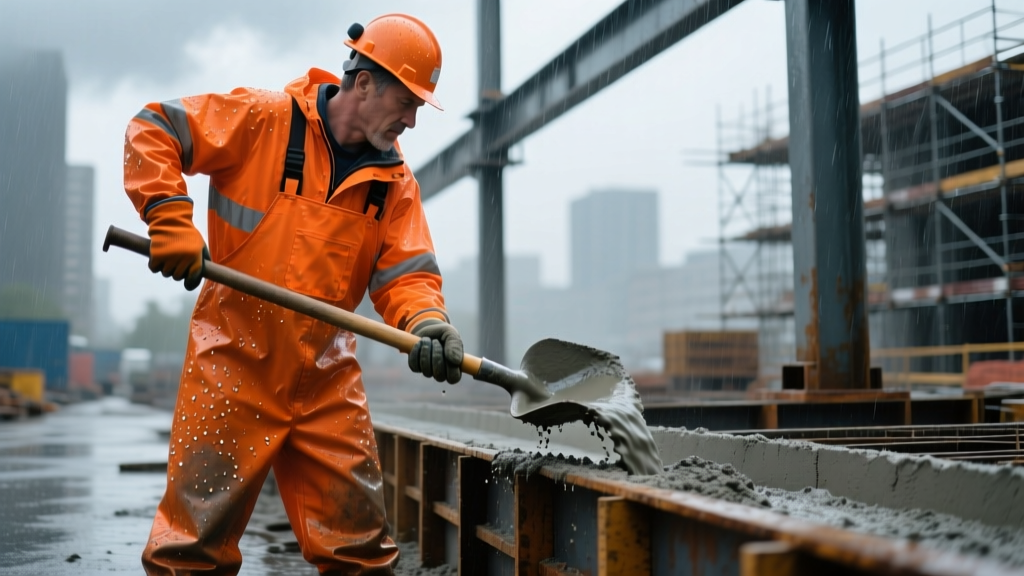
- Best For: Concrete pouring crews, trenching operators, rebar tiers, and marine construction workers who are exposed to standing water, wet mud, and alkaline slurry.
- Durability: PVC coatings are virtually indestructible in standard construction environments. They resist snags from exposed rebar, repel wet concrete, and can be power-washed or wiped clean with solvents at the end of a shift.
- Cost: $60 to $130 per jacket or bib. The low cost and extreme longevity make this the most economical choice for high-abuse, wet-environment tasks.
Procurement Tip: Because PVC garments trap 100% of perspiration, specify models with mechanical ventilation features, such as underarm grommets, vented back yokes, or loose-fitting bib designs that allow air circulation from the bottom hem.
Head-to-Head Comparison Matrix
| Material Type | Hydrostatic Head | MVTR (Breathability) | Avg. Jacket Cost | Primary Site Application |
|---|---|---|---|---|
| ePTFE (Gore-Tex Pro) | > 28,000 mm | ~ 25,000 g/m²/24h | $350 - $550 | Supervisors, Surveyors, High-Exertion |
| PU-Coated Polyester | 10,000 - 15,000 mm | 5,000 - 8,000 g/m²/24h | $120 - $180 | Framers, General Labor, Roofing |
| PVC-Coated Polyester | > 35,000 mm | 0 g/m²/24h (None) | $60 - $130 | Concrete, Trenching, Marine, Mud |
Failure Modes: Why Waterproof Gear Fails on Site
Even the best waterproof clothing material will fail if the specific failure modes of a construction site are not accounted for. Based on OSHA PPE Standards regarding environmental protection, site managers must monitor for the following degradation factors:
1. DWR Degradation from Alkaline Dust
All breathable waterproof garments rely on a Durable Water Repellent (DWR) finish on the outer face fabric to cause water to bead and roll off. Portland cement dust, drywall compound, and masonry mortar are highly alkaline. When these dusts mix with rain on a worker's jacket, they create a caustic solution that strips the DWR finish within weeks. Once the DWR fails, the face fabric 'wets out,' trapping sweat and making the wearer feel wet, even if the inner membrane is still technically blocking liquid water.
2. Seam Tape Delamination
Waterproof membranes are only as strong as their seams. Factory-applied polyurethane seam tape degrades when exposed to prolonged UV radiation and the mechanical stress of carrying heavy tool belts or lumber. PU-coated and ePTFE garments require annual inspections for peeling seam tape, particularly around the shoulders and gussets.
3. Abrasion from Fall Protection Harnesses
Workers operating at heights must wear OSHA-compliant fall protection harnesses. The constant friction of nylon harness webbing against the shoulders and chest of a waterproof jacket will quickly abrade the face fabric and compromise the waterproof membrane beneath. For roofers and steel erectors, specify jackets with reinforced Kevlar or Cordura shoulder patches.
Procurement Framework for Site Managers
Selecting the right waterproof material requires matching the textile to the specific trade and task, rather than issuing a uniform garment to the entire crew. Implement this decision framework for your next PPE procurement cycle:
- Identify the Moisture Source: Is the primary threat falling rain (requires high MVTR for active workers) or standing water/mud/slurry (requires PVC impermeability)?
- Assess Chemical Exposure: If workers handle wet concrete, epoxy, or asphalt sealants, bypass ePTFE and PU materials entirely. PVC is the only material that can be easily decontaminated without permanent damage.
- Calculate Cost-Per-Wear: A $400 Gore-Tex jacket is a poor investment for a concrete finisher who will destroy the DWR in a month. However, for a site superintendent who wears the garment daily for three years, the cost-per-wear justifies the premium ePTFE material.
- Mandate Proper Layering: Waterproof shells only manage liquid water. They do not provide insulation. Ensure workers are supplied with moisture-wicking synthetic or merino wool base layers to transport sweat away from the skin to the garment's interior, allowing the MVTR to function correctly.
By aligning the specific material properties of ePTFE, PU, and PVC with the exact environmental hazards of your job site, you eliminate weather-related downtime, ensure OSHA compliance, and protect your workforce from cold-stress injuries.
Written by
Sarah WhitfieldSarah Whitfield is a chartered quantity surveyor (MRICS) and construction cost analyst with 15 years of experience in material pricing, procurement strategy, and project budgeting. She earned her degree in Construction Management from the University of Reading (UK) and has worked on projects ranging from $2M custom homes to $180M mixed-use developments across North America and Europe. Sarah currently leads cost estimating for BuildMat Insight, maintaining a proprietary database of 4,000+ material price points updated quarterly. She is a frequent contributor to RSMeans cost data panels and has presented at the International Cost Engineering Council (ICEC) congress. Based in Denver, CO, Sarah is an avid trail runner and volunteer mentor for Women in Construction.
More from Sarah Whitfield
View all
Wood & Lumber
What Are the Different Types of Wood? A Builder's Guide
Compare structural softwoods, finish hardwoods, and engineered lumber. Analyze Janka ratings, MOE values, and 2026 pricing for construction.
Aug 4, 2026

Walls & Panels
Steel Framing vs Wood Framing: Corrosion and Moisture Defense
Compare steel framing vs wood framing for moisture resistance. Learn about galvanized coatings, condensation risks, and corrosion protection strategies.
Jul 21, 2026

Stone & Masonry
How to Cut Stone Veneer: Wet Saw vs Grinder Comparison
Compare the best tools for cutting stone veneer. We review wet saws, angle grinders, and chop saws to help you achieve clean, chip-free cuts.
Jul 21, 2026