Crawlspace Vapor Barrier Deep Dive: Stego Wrap vs. VaporGuard
Compare Stego Wrap and Raven VaporGuard crawlspace vapor barriers. Explore mil thickness, ASTM E1745 compliance, pricing, and real-world failure modes.
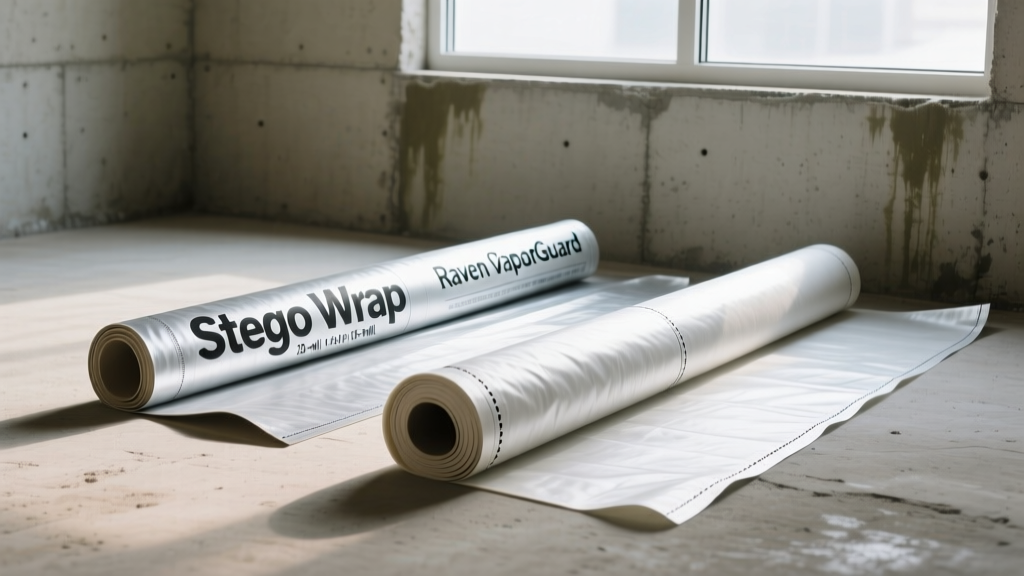
The Anatomy of a High-Performance Crawlspace Vapor Barrier
When sealing an unvented crawlspace, the ground cover is the primary defense against soil moisture, radon gas, and structural decay. According to the Building America Solution Center, a true vapor barrier must meet ASTM E1745 Class A requirements, meaning it exhibits a water vapor permeance of less than 0.1 perms. However, not all Class A barriers perform equally under the physical stress of construction traffic, sharp aggregate, and long-term hydrostatic pressure.
This deep dive evaluates the two dominant product lines in the professional encapsulation market: Stego Industries (Stego Wrap) and Raven Industries (VaporGuard). We will break down their material science, real-world pricing, and specific failure modes to help you specify the right membrane for your project.
Stego Wrap Product Line: Virgin Resin Durability
Stego Industries built its reputation on utilizing 100% virgin polyethylene resins. Unlike recycled-content liners that suffer from inconsistent thickness and weak spots, Stego Wrap offers uniform extrusion. This uniformity is critical for passing the ASTM D4833 puncture resistance test, which measures the force (in pounds-force, lbf) required to push a blunt probe through the membrane.
Stego Wrap 10 Mil vs. 15 Mil vs. 20 Mil
- Stego Wrap 10 Mil: Puncture resistance of roughly 22 lbf. Suitable only for light-duty, low-traffic crawlspaces with smooth, sifted soil beds. Priced around $0.14–$0.18 per square foot.
- Stego Wrap 15 Mil: The industry workhorse. Boasts a puncture resistance of approximately 38 lbf. Handles standard construction foot traffic and minor aggregate. Priced at $0.22–$0.28 per square foot.
- Stego Wrap 20 Mil: Engineered for active radon mitigation systems and heavy commercial use. Puncture resistance exceeds 50 lbf. Priced at $0.30–$0.36 per square foot.
Raven Industries VaporGuard: Woven Reinforcement
Raven Industries takes a different engineering approach with its VaporGuard line. Instead of relying solely on thick, solid extrusions, VaporGuard integrates a high-density polyethylene (HDPE) woven scrim between layers of polyethylene film. This cross-lamination dramatically increases tensile strength and tear resistance.
VaporGuard 15 and 20 Mil Specifications
The woven core gives VaporGuard an exceptional tear resistance rating. While a solid 15-mil film might tear easily once a small nick occurs, the woven fibers in VaporGuard 15 act as a rip-stop, containing the damage. This makes it highly favorable in crawlspaces where heavy HVAC equipment, dehumidifiers, or storage items are dragged across the floor.
- VaporGuard 15: Features a woven scrim with a total thickness of 15 mils. Tensile strength exceeds 150 lbf/inch. Priced at $0.25–$0.32 per square foot.
- VaporGuard 20: Adds thicker outer film layers for enhanced puncture resistance while maintaining the rip-stop core. Ideal for irregular, rocky subgrades. Priced at $0.34–$0.42 per square foot.
Head-to-Head Comparison Matrix
| Feature | Stego Wrap 15 Mil | Raven VaporGuard 15 |
|---|---|---|
| Material Composition | Solid Virgin Polyethylene | Cross-Laminated Woven HDPE |
| ASTM E1745 Class | Class A (<0.1 perms) | Class A (<0.1 perms) |
| Puncture Resistance (ASTM D4833) | ~38 lbf | ~32 lbf (but higher tear resistance) |
| Tear Resistance | Moderate | Exceptional (Rip-stop woven core) |
| Seaming Method | Stego Tape 4" (Acrylic/Butyl) | Double-sided Butyl Tape |
| Avg. Cost (per sq. ft.) | $0.22 – $0.28 | $0.25 – $0.32 |
Real-World Failure Modes and Edge Cases
Specifying the right material is only half the battle. The EPA's guidelines on mold and moisture emphasize that continuous, unbroken seals are mandatory for preventing microbial growth. Here are the most common field failures encountered with both product lines:
1. Seam Tape Delamination in High Humidity
Applying tape to a dusty or damp membrane guarantees failure. Stego Wrap requires the surface to be wiped clean; its proprietary Stego Tape uses an aggressive acrylic-butyl hybrid that bonds well to virgin poly. Raven VaporGuard's woven texture can sometimes trap dust in the weave, making single-sided tape application tricky. Fix: For Raven products, always use a high-quality double-sided butyl tape (like Protecto Wrap Butyl) placed directly between the overlapping layers, rather than taping the top surface.
2. Termite Bait Station Penetrations
In regions with subterranean termites, pest control companies install monitoring stations directly into the crawlspace soil. Cutting a hole in the vapor barrier to accommodate these stations creates a direct pathway for soil moisture and radon. Fix: Use a specialized vapor barrier sealant mastic or a pre-manufactured pipe boot. Apply a bead of polyurethane sealant around the station collar, then secure a 6-inch patch of the same barrier material over the cut using double-sided tape and a hose clamp.
If the property is in an EPA Zone 1 or Zone 2 radon area, a standard 10 or 15-mil barrier is insufficient for active soil depressurization systems. The vacuum pressure can pull radon through micro-tears. You must specify a 20-mil or thicker membrane (such as Stego Wrap 20 or a dedicated radon barrier) and seal all penetrations with radon-rated acoustic sealant.
3. Wall Termination and Capillary Action
Running the vapor barrier up the foundation wall is critical. If the barrier is terminated exactly at the soil grade line, capillary action can draw moisture up the concrete block and over the top edge of the liner. Both Stego and Raven recommend extending the membrane up the wall to match the exterior grade level (typically 6 to 12 inches above the dirt floor). Secure it using a mechanical termination bar sealed with a continuous bead of acoustical sealant or compatible mastic.
Installation Nuances: Fasteners and Overlaps
The physical attachment of the barrier to the ground dictates its longevity. Never use standard cap staples. The thin wire of a staple will rust and slice through the polyethylene over time due to galvanic corrosion and thermal expansion.
- Use Cap Nails: Deploy 1.5-inch galvanized or polymer cap nails with a minimum 1-inch diameter plastic cap. The wide cap distributes the holding force and prevents the membrane from tearing under tension.
- Overlap Distances: While ASTM standards allow for a 6-inch overlap, professional encapsulators should mandate a 12-inch overlap for all field seams. This provides a wider bonding surface for the tape, accommodating minor subgrade shifts and settling over the first 24 months.
- Pillar Wrapping: When wrapping structural piers, do not rely solely on tape. Use mechanical fasteners (like stainless steel banding or specialized vapor barrier clips) to secure the membrane tightly against the concrete pier, preventing air channels that could lead to condensation.
Final Verdict: Which Brand Fits Your Project?
The choice between Stego Wrap and Raven VaporGuard depends entirely on the physical conditions of the crawlspace and the project's performance requirements.
Choose Stego Wrap (15 or 20 Mil) when:
- The subgrade is smooth, clean, and free of sharp rocks.
- You require maximum puncture resistance for heavy construction traffic during the framing and drywall phases.
- The project involves an active radon mitigation system (specify 20 Mil).
- You prefer a single-sided, highly aggressive surface tape for seaming.
Choose Raven VaporGuard (15 or 20 Mil) when:
- The crawlspace floor is irregular, rocky, or contains exposed tree roots that threaten to tear standard films.
- The encapsulated space will be used for active storage, requiring high tear resistance against dragging boxes and equipment.
- You are retrofitting an older home with uneven, crumbling foundation walls where the membrane will experience high tensile stress during termination.
By matching the material science of the membrane to the specific mechanical and environmental stressors of the site, contractors can eliminate callback failures and ensure a permanently dry, code-compliant crawlspace environment.