Maintenance Playbook: Cleaning Water Resistant Coatings & Sealers
Master the maintenance of water resistant coatings and sealers. Learn exact pH levels, PSI limits, and cleaning protocols to prevent hydrophobic failure.
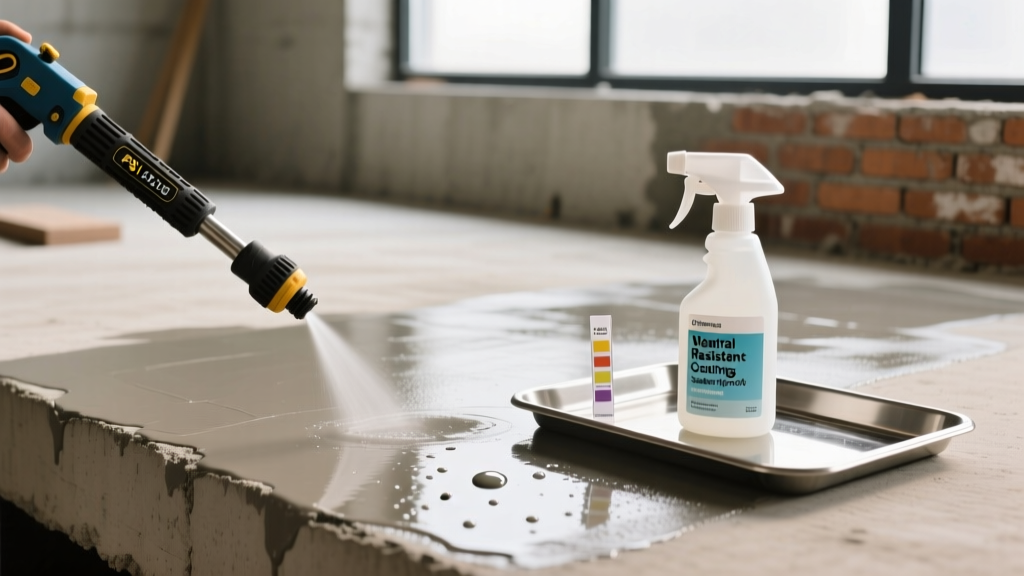
The Physics of Hydrophobic Failure
Water resistant building materials—ranging from penetrating silane/siloxane concrete sealers to film-forming elastomeric acrylics and treated gypsum facings—rely on specific surface chemistry to shed liquid moisture. However, facility managers frequently confuse "water resistant" with "maintenance-free." When environmental contaminants like diesel soot, biological growth (algae and mildew), and airborne surfactants accumulate on these surfaces, they drastically alter the material's contact angle.
A clean siloxane-treated concrete surface maintains a water contact angle of roughly 110 to 120 degrees, causing water to bead and roll off. When dirt and organic matter build up, they act as a physical bridge that breaks surface tension. Water stops beading, begins to sheet, and eventually penetrates the microscopic pores the sealer was designed to protect. According to guidelines published by the Whole Building Design Guide (WBDG), failure to maintain the surface tension of water-resistive barriers (WRBs) and exterior coatings is the leading cause of premature moisture intrusion in commercial envelopes.
Material-Specific Cleaning Matrix
Using the wrong cleaning agent can chemically degrade water resistant properties. High-alkaline cleaners can cause saponification in acrylic coatings, turning them water-soluble, while acidic cleaners can etch masonry and destroy the silica bonds of penetrating sealers. Use the following matrix to select the correct chemical and mechanical parameters for your specific substrate.
| Material Type | Common Examples | Approved Cleaner Chemistry | Max Pressure (PSI) | Rinse Requirement |
|---|---|---|---|---|
| Penetrating Siloxane/Silane | Prosoco SiloxanePD, Euclid Chem EverSeal | pH-Neutral (6.5 - 7.5) Bio-wash | 1,200 PSI | Heavy flood rinse to clear pores |
| Elastomeric Acrylic Coatings | Sherwin-Williams Sherlastic, Tnemec 114 | Mild TSP Substitute (1 oz/gal) | 1,500 PSI | Thorough rinse to prevent surfactant leaching |
| Water-Resistant Gypsum (Facing) | Purple Board, DensArmor Plus | Non-abrasive, non-ammoniated detergent | N/A (Soft cloth only) | Damp wipe; do not saturate |
| Polyurethane Deck Coatings | Polyaspartic/Polyurea topcoats | Enzyme-based deck cleaner | 800 PSI (Fan tip only) | Standard rinse; avoid pooling |
The 4-Step Siloxane & Elastomeric Maintenance Playbook
For exterior masonry and stucco protected by water resistant coatings, follow this standardized four-step protocol to restore hydrophobicity without damaging the substrate.
- Dry Pre-Sweeping and Inspection: Before introducing moisture, use a soft-bristle push broom to remove loose abrasive particulates (sand, grit). Inspect for micro-cracking. If elastomeric coatings show cracks wider than 1/16-inch, patch with a high-build elastomeric caulk before washing to prevent driving water behind the film.
- Low-Pressure Chemical Application: Apply the approved pH-neutral or mild alkaline cleaner using a garden sprayer or a pressure washer equipped with a downstream injector. Set the pressure below 500 PSI during application. Allow a dwell time of 10 to 15 minutes. Crucial: Do not let the cleaner dry on the surface, as this will leave a hydrophilic salt residue.
- Controlled Agitation: For stubborn biological staining, use a medium-nylon bristle brush on a telescoping pole. Never use wire brushes or stiff poly-bristles on water resistant coatings, as they will mechanically abrade the top microscopic layer where the hydrophobic resins are concentrated.
- The Flood Rinse: Switch to a 15-degree or 25-degree pressure washer tip. Maintain a strict maximum of 1,200 PSI for siloxane and 1,500 PSI for elastomeric films. Keep the wand at least 18 inches from the surface. Rinse from top to bottom, ensuring all surfactant residues are flushed away.
Many maintenance crews default to 3,000+ PSI gas-powered washers to save time. Pressures exceeding 1,500 PSI on masonry will mechanically blow out the siloxane pore-linings, instantly destroying the water resistant treatment. Furthermore, high-pressure water can be forced through microscopic laps in WRBs, causing interior water damage. Always use a pressure regulator and test on an inconspicuous 2x2 foot area first.
Diagnostic Testing: When to Clean vs. When to Re-coat
How do you know if a surface just needs a wash, or if the water resistant chemistry has entirely failed? Building Science Corporation recommends two simple field diagnostics before authorizing expensive re-coating projects.
- The Rill Test (For Penetrating Sealers): Pour a continuous stream of water from a gallon jug onto a 12-inch section of the wall. If the water forms distinct, tight beads that roll off without leaving a dark wet trail, the siloxane is intact and only requires cleaning. If the water sheets and leaves a dark, absorbing "rill" or trail, the sealer has degraded past the point of cleaning and requires re-application.
- The Tape Pull and Chalk Test (For Elastomeric Coatings): Rub your hand across the dry coating. If excessive white chalk transfers to your skin, the binder is degrading (chalking). Next, apply a piece of standard duct tape to the surface and pull it off at a 45-degree angle. If the coating flakes off onto the tape, adhesion has failed. Cleaning will not fix adhesion failure; the coating must be scraped, primed, and re-applied.
Financial Impact: Maintenance vs. Replacement Costs
Deferring the cleaning of water resistant surfaces results in exponential lifecycle cost increases. Based on commercial facility management data and ASTM International building standards for envelope maintenance, here is the financial reality of preventative care versus reactive replacement as of early 2026.
Cost Comparison (Per Square Foot)
Preventative Bi-Annual Cleaning: $0.15 – $0.28 / sq. ft.
Includes labor, pH-neutral chemicals, and low-pressure equipment.
Reactive Re-Coating (Siloxane Penetrating): $1.25 – $2.10 / sq. ft.
Includes surface profiling, two coats of silane/siloxane, and masking.
Reactive Re-Coating (Elastomeric Film): $3.50 – $5.80 / sq. ft.
Includes pressure washing, scraping, masonry patching, primer, and two topcoats.
Insight: A $5,000 annual cleaning budget for a 25,000 sq. ft. facade prevents a $112,500 elastomeric re-coating project, extending the coating's viable lifespan by an average of 4 to 6 years.
Maintaining water resistant materials is not merely an aesthetic exercise; it is a critical structural defense protocol. By strictly adhering to material-specific pH limits, respecting mechanical PSI thresholds, and utilizing diagnostic field testing, facility managers can preserve the hydrophobic integrity of their building envelopes and avoid catastrophic moisture intrusion.