Outdoor Material Waterproof Systems: 2026 Selection Guide
Compare the best outdoor material waterproof systems for 2026. Expert analysis of polyurethane, acrylic, and siloxane coatings with real pricing.

The Core Challenge: Hydrokinetic vs. Hydrostatic Water Management
Selecting the correct outdoor material waterproof system requires understanding the specific physics of the water threat. Most coating failures occur because contractors treat all moisture identically. In reality, exterior structures face two distinct forces:
- Hydrokinetic Pressure: Surface runoff from rain or snowmelt. This is a low-pressure threat managed by surface barriers and proper sloping (minimum 1/4 inch per foot).
- Hydrostatic Pressure: Water pushing from beneath or within the substrate (e.g., ground moisture migrating up through a concrete slab). This high-pressure force will easily blister and delaminate standard surface films.
According to the Whole Building Design Guide (WBDG), misidentifying hydrostatic pressure as mere surface runoff is the leading cause of premature membrane failure in below-grade and slab-on-grade outdoor applications. This guide breaks down the top three chemical categories for exterior waterproofing, providing exact product specifications, failure modes, and 2026 market pricing.
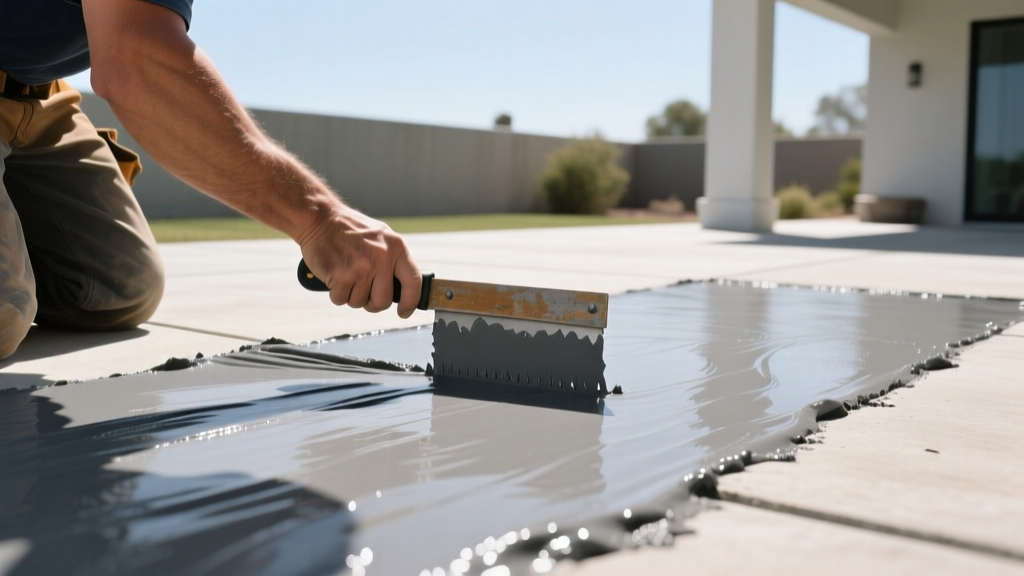
Decision Matrix: Matching the Coating to the Substrate
Use this framework to select the appropriate chemistry based on your specific substrate and environmental exposure.
| Substrate Type | Primary Threat | Recommended Chemistry | Required Mil Thickness | Breathability Needed? |
|---|---|---|---|---|
| Poured Concrete (Above Grade) | UV, Surface Runoff, Freeze-Thaw | Silane/Siloxane Penetrant | N/A (Penetrates 1/4 inch) | Yes (High) |
| Wood Decks / Plywood Subfloors | Hydrokinetic, Substrate Movement | Aliphatic Polyurethane | 60 Dry Mils | No |
| Stucco / EIFS Exterior Walls | Wind-Driven Rain, Hairline Cracks | Elastomeric Acrylic | 20-30 Dry Mils | Yes (Moderate) |
| Concrete Planters (Interior Lined) | Hydrostatic, Constant Immersion | PMMA (Polymethyl Methacrylate) | 80-100 Dry Mils | No |
System 1: Aliphatic Polyurethane Liquid Membranes
For high-traffic outdoor surfaces like pedestrian decks, balconies, and rooftop patios, aliphatic polyurethanes are the industry standard. Unlike aromatic polyurethanes, which degrade and chalk under UV exposure, aliphatic formulations retain their color and flexibility indefinitely when exposed to sunlight.
Product Spotlight: Sika Sikalastic 621 TC
This traffic-grade, moisture-triggered polyurethane is a benchmark in the industry. It requires a strict application protocol:
- Primer: Must be applied over a CSP 3-4 (Concrete Surface Profile) prepared substrate. Use Sikalastic Primer on porous surfaces.
- Base Coat: Applied at 22 wet mils using a 1/4-inch nap roller.
- Reinforcement: Embed Sika Reemat Premium fiberglass mat into the wet base coat at all joints, cracks, and penetrations.
- Top Coat: Apply at 18 wet mils to achieve a total system thickness of 60 dry mils.
System 2: Elastomeric Acrylic Coatings
Elastomeric acrylics are water-based, high-build coatings designed primarily for vertical surfaces and low-slope roofs. Their primary advantage is elongation; premium 100% acrylic formulas can stretch up to 600% without tearing, allowing them to bridge dynamic hairline cracks (up to 1/16 inch wide) that open and close with thermal expansion.
Product Spotlight: Ames Research Laboratories Super Elasto-Barrier
Ames formulates this product with a high solids content, allowing it to build thickness rapidly. However, acrylics are fundamentally breathable, meaning they allow water vapor to escape the substrate but can be overwhelmed by liquid hydrostatic pressure. They should never be used on the negative side of a retaining wall or inside a planter box. For exterior stucco or CMU (concrete masonry unit) walls, apply two coats at a rate of 2 gallons per 100 square feet to achieve the necessary 20 dry mils.
System 3: Silane/Siloxane Penetrating Sealers
When the goal is to waterproof outdoor masonry, natural stone, or exposed aggregate concrete without altering the aesthetic (no glossy film), penetrating sealers are mandatory. These systems do not form a surface film; instead, they react chemically with the free lime and alkalis in the substrate to form a hydrophobic resin network within the pores.
Product Spotlight: PROSOCO Siloxane WB
This water-based, silane/siloxane blend penetrates up to 1/4 inch into standard concrete. Because it leaves the surface pores open, it allows 100% of water vapor to transmit outward, completely eliminating the risk of blistering. It is the definitive choice for protecting outdoor concrete from freeze-thaw spalling and chloride ingress (de-icing salts). Apply via low-pressure HVLP sprayer until the surface is completely flooded, then back-roll to eliminate puddles.
Critical Failure Modes & How to Avoid Them
Even the best outdoor material waterproof products will fail if installed incorrectly. Recognize these three common failure modes:
Cause: Applying a non-breathable film over a damp substrate. Water vapor tries to escape, gets trapped, and creates localized pressure blisters.
Fix: Mandate ASTM D4259 shot-blasting to open pores, followed by a 48-hour dry-out period and strict moisture testing before priming.
Cause: Water-soluble salts migrate to the surface of the concrete, crystallizing under the coating and breaking the mechanical bond.
Fix: Acid-etch or mechanically abrade the surface to remove existing salts, and apply a silicate-based densifier to lock up free calcium before coating.
Cause: Using an aromatic polyurethane (often sold as a cheaper 'deck coating') in direct sunlight. The UV rays break down the polymer chains.
Fix: Always specify 'aliphatic' polyurethanes for topcoats in exterior, UV-exposed environments.
Step-by-Step Surface Prep Protocol for Concrete
According to building science experts at Building Science Corporation, surface preparation accounts for 80% of a coating system's lifespan. Follow this exact sequence for exterior concrete slabs:
- Diamond Grinding / Shot Blasting: Achieve a CSP 3 or CSP 4 profile. Acid etching is no longer considered an acceptable prep method for high-performance membranes due to inconsistent profiling and residual salt contamination.
- Vacuuming: Use a HEPA-filtered commercial vacuum to remove all micro-dust. Dust acts as a bond-breaker.
- Solvent Wipe: Wipe the surface with denatured alcohol or a manufacturer-approved solvent to remove invisible form-release oils or biological growth.
- Moisture Testing: Perform both a quantitative calcium chloride test (ASTM F1869) and a relative humidity probe test (ASTM F2170) to establish a baseline.
- Primer Application: Apply the specified primer within 24 hours of prep to prevent surface oxidation and recontamination.
2026 Pricing & Coverage Calculator
Budgeting for outdoor waterproofing requires looking beyond the cost per gallon. The true metric is the installed cost per square foot, factoring in prep, primer, and required mil thickness.
| System Type | Material Cost (per Gallon) | Coverage Rate | Installed Cost (per Sq Ft) | Expected Lifespan |
|---|---|---|---|---|
| Aliphatic Polyurethane (Traffic Grade) | $180 - $240 | 40 sq ft / gallon | $5.50 - $8.00 | 10 - 15 Years |
| Elastomeric Acrylic (Vertical/Low Slope) | $90 - $130 | 50 sq ft / gallon | $2.50 - $4.00 | 5 - 8 Years |
| Silane/Siloxane Penetrant | $150 - $200 | 150 sq ft / gallon | $1.20 - $2.00 | 7 - 10 Years |
| PMMA (Rapid Cure / Immersion) | $350 - $450 | 30 sq ft / gallon | $12.00 - $16.00 | 20+ Years |
Expert Verdict: Making the Final Selection
There is no universal 'best' outdoor material waterproof product; there is only the correct chemistry for your specific substrate and exposure profile. If you are waterproofing a high-traffic wooden or concrete balcony exposed to direct sun, invest in an aliphatic polyurethane system like Sikalastic. For vertical stucco walls prone to thermal cracking, an elastomeric acrylic provides the necessary bridge. Finally, for driveways, patios, and natural stone where maintaining the original texture is paramount, a siloxane penetrant is the only viable choice. Always prioritize rigorous surface preparation and strict moisture testing over upgrading to a more expensive chemical formula.
Written by
Priya KapoorPriya Kapoor is a real estate market analyst and construction economics researcher with expertise in housing affordability, development feasibility, and infrastructure investment. She holds a Master of Regional Planning from Cornell University and previously worked as a senior analyst at CBRE's Investment Properties group, where she modeled returns for $4B in mixed-use development pipelines. Priya now runs an independent research practice advising developers, municipalities, and REITs on construction cost forecasting and market timing. She publishes the quarterly "BuildMat Market Pulse" report tracking material price indices across 12 commodity categories. Based in Austin, TX, Priya serves on the board of Habitat for Humanity Austin and is a marathon runner.
More from Priya Kapoor
View all
Construction Cost
Cost to Build a 1600 Sq Ft Home in 2026: Full Breakdown
Accurate 2026 cost to build a 1600 sq ft home—material, labor, and regional pricing breakdowns included. Plan your budget with real-time estimates.
Aug 11, 2026

Wood & Lumber
Name the Types of Wood for Pressure Treatment and Preservation
Learn how to name the types of wood best suited for pressure treatment. Compare species treatability, chemical retention levels, and 2026 preservation costs.
Aug 4, 2026

Stone & Masonry
Stone Veneer Suppliers Lindenhurst: 2026 Cost Analysis
Analyze 2026 stone veneer costs in Lindenhurst, NY. Compare local supplier pricing, delivery fees, and Suffolk County installation labor rates.
Aug 4, 2026