Best Basement Waterproofing Materials: 2026 Buyer Guide
Compare top basement waterproofing materials for 2026. Explore interior sealers, exterior membranes, and drainage systems with real costs and specs.

The Physics of Below-Grade Moisture and IRC R406
Water does not merely leak into basements; it is driven through concrete pores by hydrostatic pressure. A water table sitting just 10 feet above a basement floor exerts approximately 624 pounds of pressure per square foot against the foundation wall. Standard Portland cement concrete is inherently porous, featuring a network of microscopic capillaries that readily wick moisture inward. To combat this, the International Residential Code (IRC) Section R406 mandates specific below-grade moisture protection, distinguishing between basic dampproofing (bituminous coatings that resist soil moisture) and true waterproofing (membranes and systems designed to withstand hydrostatic pressure).
Selecting the correct basement waterproofing materials requires matching the material's tensile strength, elongation properties, and chemical resistance to the specific soil profile and water table dynamics of the site. According to the University of Minnesota Extension, managing exterior bulk water via grading and drainage is the mandatory first step before any chemical or membrane barrier will perform to its engineered specifications.
Quick Decision Framework: Interior vs. Exterior
Choose Exterior Membranes If: You are in new construction or excavating an existing foundation. This is the only method that stops water before it degrades the concrete and protects the structural rebar from chloride-induced corrosion.
Choose Interior Crystalline/Sealers If: You are retrofitting an existing home where exterior excavation is cost-prohibitive or physically impossible due to property lines. Interior systems manage and redirect water rather than stopping it at the source.
Deep Dive: Interior Sealers and Crystalline Systems
Interior basement waterproofing materials function by either densifying the concrete matrix or creating an impermeable surface film. They are applied to the negative side (the dry side) of the wall, which subjects the coating to tensile stress rather than compressive stress.
Silicate Densifiers and Capillary Blockers
Sodium and lithium silicate solutions, such as RadonSeal 1250, penetrate up to 4 inches into the concrete substrate. They react with free lime and alkali to form a calcium silicate hydrate (C-S-H) gel, effectively expanding within the capillaries and permanently blocking them. Unlike surface films, silicate densifiers cannot peel or blister because they become an integral part of the concrete. They are ideal for addressing minor seepage and efflorescence but will not bridge active structural cracks wider than 1/32 of an inch.
Crystalline Waterproofing
Products like Xypex Concentrate utilize a proprietary blend of Portland cement, graded quartz sand, and active chemicals. When applied as a slurry to a damp concrete wall, the chemicals catalyze a reaction that forms insoluble, needle-like crystalline structures deep within the concrete's capillary tracts. A critical advantage of crystalline systems is their self-sealing capability; if a new hairline crack forms years later and moisture enters, the dormant chemicals reactivate to seal the new void.
Acrylic and Latex Hybrid Coatings
For active hydrostatic pressure on the interior, elastomeric masonry waterproofer paints like Drylok Extreme provide a thick, flexible barrier. Formulated to withstand up to 15 PSI of hydrostatic pressure (equivalent to a 33-foot head of water), these coatings rely on mechanical adhesion. The substrate must be entirely free of efflorescence and previous paint, typically requiring aggressive wire-brushing or acid etching prior to application.
Exterior Foundation Membranes and Drainage Matrices
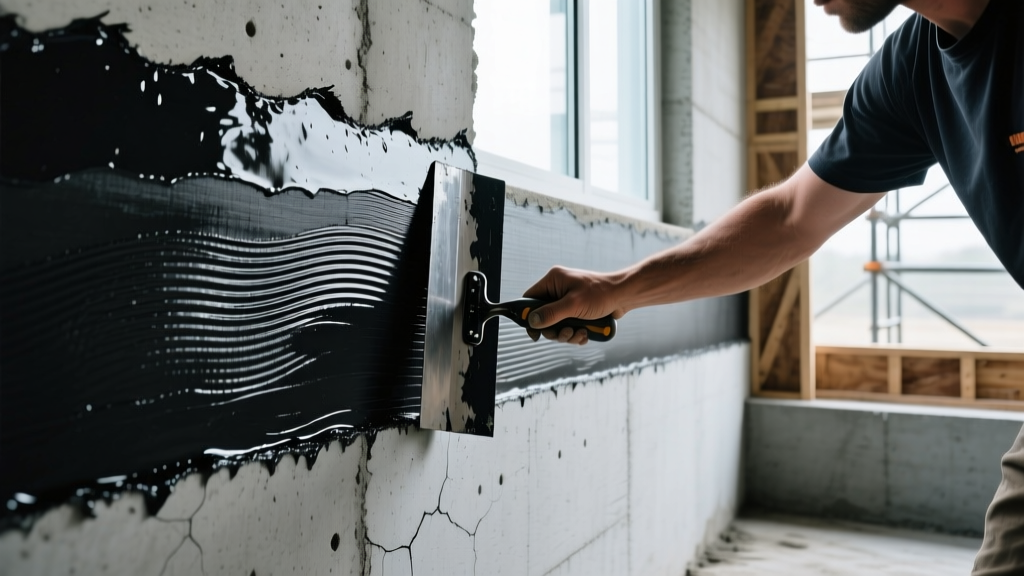
Exterior systems are applied to the positive side (the wet side) of the foundation. Here, hydrostatic pressure pushes the membrane tighter against the concrete, utilizing compressive force to enhance the seal.
SBS-Modified Asphalt Peel-and-Stick Membranes
Sheet membranes like Polyguard 650 XTreme or Tremco Paraseal consist of rubberized asphalt laminated to a high-density polyethylene (HDPE) cross-laminated film. These materials offer exceptional elongation (often exceeding 1,000%), allowing them to bridge structural shrinkage cracks that inevitably develop as concrete cures. The rubberized asphalt component provides self-sealing properties around form-tie holes and mechanical fasteners.
HDPE Dimple Drainage Boards
A waterproofing membrane alone is insufficient without pressure relief. Dimpled drainage mats, such as Carlisle MiraDRAIN or Tremco Platon, are installed directly over the primary membrane. The 5/16-inch to 1/2-inch HDPE dimples create an air gap that channels bulk water downward to the footing drain, completely eliminating hydrostatic pressure buildup against the membrane itself. In 2026, integrating a filter fabric facing on the dimple board remains the industry standard to prevent fine soil particles from clogging the drainage channels over the structure's lifespan.
2026 Material Cost and Specification Matrix
Pricing for basement waterproofing materials varies significantly based on the chemical complexity and application method. The following matrix outlines current material-only costs and technical thresholds for professional-grade products.
| Material Category | Industry Standard Product | Material Cost (per sq ft) | Hydrostatic PSI Rating | Primary Application |
|---|---|---|---|---|
| Penetrating Silicate | RadonSeal 1250 | $0.35 - $0.45 | N/A (Capillary block) | Interior dampness & radon mitigation |
| Crystalline Slurry | Xypex Concentrate | $0.80 - $1.20 | Up to 20 PSI | Interior/exterior positive & negative side |
| Elastomeric Acrylic | Drylok Extreme | $0.40 - $0.60 | 15 PSI | Interior finished walls & floors |
| Peel-and-Stick SBS | Polyguard 650 XTreme | $1.50 - $2.25 | Continuous (Elongation >1000%) | Exterior below-grade positive side |
| HDPE Dimple Board | Carlisle MiraDRAIN | $1.80 - $2.50 | Pressure Relief (Drainage) | Exterior protection & hydrostatic relief |
Critical Failure Modes in Below-Grade Applications
Even premium basement waterproofing materials will fail if installation protocols ignore concrete chemistry and site physics. The most common failure modes include:
- Efflorescence Blistering: Applying interior acrylic or latex coatings over concrete that has not been properly etched or neutralized. Water-soluble salts migrate to the surface, crystallize behind the coating, and generate enough expansive force to blister and delaminate the waterproofing film.
- Cold Joint Bypass: The joint where the basement wall meets the footing is the most vulnerable point in any foundation. Failing to install a hydrophilic waterstop (such as Bentonite Waterstop RX) or a continuous membrane overlap at this joint guarantees water intrusion, regardless of the wall membrane used.
- UV and Backfill Degradation: Exterior liquid-applied polyurethane and SBS-modified membranes degrade rapidly when exposed to ultraviolet light. If left exposed for more than 30 days before backfilling, the material loses its elasticity. Furthermore, backfilling with heavy, uncompacted clay or debris without a protective rigid insulation board or dimple mat will puncture the membrane.
Pro-Tip for Retrofit Excavations: When excavating existing foundations for exterior membrane application, never use heavy machinery to compact backfill soil directly against the wall. The lateral earth pressure can crack the foundation inward. Instead, use flowable fill (controlled low-strength material or CLSM) or compact in strict 6-inch lifts using hand tampers within 3 feet of the foundation wall.
Industry Standards and Moisture Management
Effective waterproofing extends beyond the application of chemical barriers. The EPA's Moisture Control Guidance for Building Design emphasizes that bulk water management via properly sloped grading (minimum 6 inches of fall over the first 10 feet) and functional gutter downspout extensions (discharging at least 5 feet from the foundation) reduces the hydrostatic load on waterproofing materials by up to 80%.
When specifying materials, always verify compliance with relevant ASTM standards. For interior masonry coatings, look for products tested under ASTM D7088 (Standard Practice for Evaluation of Water Resistance of Interior Masonry Water Repellent Coatings). For exterior sheet membranes, ensure the product meets ASTM C1512 for cold-applied adhesive tapes or ASTM D1970 for self-adhering polymer-modified bituminous sheet materials. By aligning material selection with verified testing standards and rigorous site preparation, structural integrity and interior air quality are preserved for the lifespan of the building.
Written by
Elena RodriguezElena Rodriguez is a civil engineer and technical writer specializing in concrete technology, masonry systems, and ASTM/ACI compliance. She earned her B.S. in Civil Engineering from Texas A&M University and spent a decade at a materials testing laboratory, performing over 2,000 concrete compressive strength tests and masonry prism evaluations. Elena is an ACI-certified Field Testing Technician (Grade I) and a member of ASTM Committee C12 on Natural Building Stone. She currently consults on forensic engineering cases involving concrete failures and moisture intrusion. Based in San Antonio, TX, Elena is a proud member of the Society of Women Engineers (SWE) and coaches her daughter's FIRST Robotics team.
More from Elena Rodriguez
View all
Walls & Panels
Cost Analysis: Light Gauge Steel Framing Advantages and Disadvantages
Evaluate light gauge steel framing advantages and disadvantages through a strict cost analysis lens, comparing material, labor, and lifecycle expenses.
Aug 4, 2026

Walls & Panels
Gypsum Board Types: Exact Specifications, Thickness & Dimensions
Compare standard, Type X, and moisture-resistant gypsum board types. Get exact specifications, thicknesses, dimensions, and ASTM standards for your project.
Aug 4, 2026

Fire Resistance
Best Fire-Resistant Outdoor Decking Materials: 2026 Buyer Guide
Discover the best fire-resistant outdoor decking materials for 2026. Compare Class A PVC, aluminum, and hardwood options for WUI compliance and safety.
Aug 4, 2026