Vapor Barrier Crawl Space Insulation: Material Types & Selection
Compare vapor barrier crawl space insulation materials. Expert taxonomy of poly liners, spray foam, and rigid boards for encapsulation projects.
The Physics of Crawl Space Moisture & Insulation
When addressing the composite challenge of vapor barrier crawl space insulation, it is critical to understand that moisture moves through building assemblies via four distinct mechanisms: bulk water, capillary action, air transport, and vapor diffusion. Traditional building codes historically focused on vapor diffusion, mandating thin plastic sheets to block molecular water vapor. However, modern building science dictates that air transport carries up to 100 times more moisture than vapor diffusion alone.
Therefore, selecting materials for a crawl space is not merely about picking a product with a low perm rating. It requires a holistic taxonomy where ground vapor retarders, wall insulation, and air-sealing membranes work in tandem. According to extensive field research by Building Science Corporation, unvented, fully encapsulated crawl spaces outperform vented ones in almost all North American climate zones, provided the correct material classes are deployed.
Material Taxonomy: Classifying Vapor Barriers & Insulation
The market offers a fragmented array of products. To make precise specifications, we must categorize them by their primary function and physical properties.
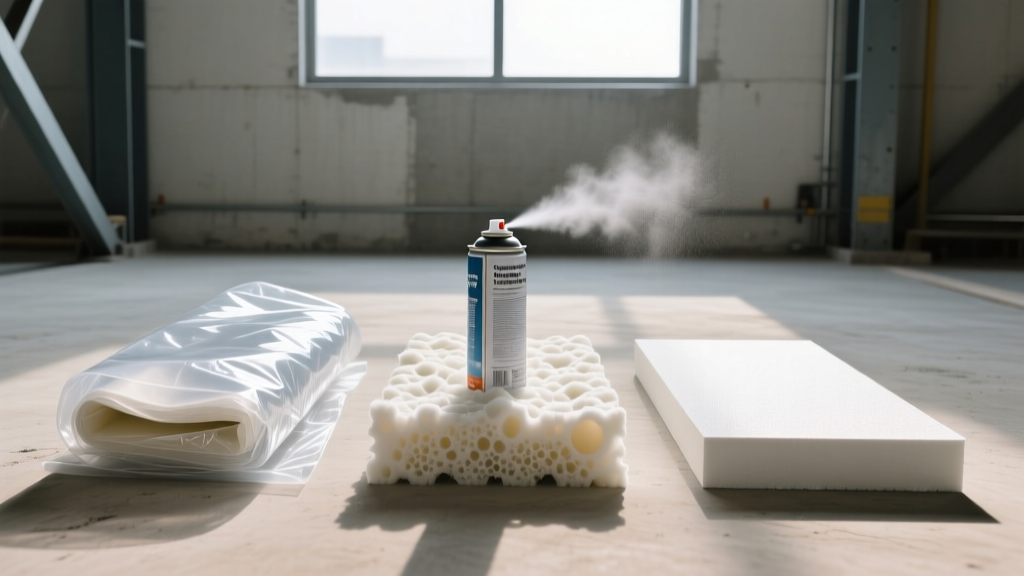
Class I Vapor Retarders (Polyethylene Liners)
Polyethylene (PE) sheeting is the foundational material for ground moisture control. While the International Residential Code (IRC) mandates a minimum 6-mil (0.006-inch) Class I vapor retarder, this thickness is highly susceptible to tearing during installation and routine maintenance.
- 6-Mil to 10-Mil PE: Suitable only for temporary construction moisture control or low-traffic storage crawl spaces. High puncture rate.
- 12-Mil to 20-Mil Reinforced PE: The professional standard for full encapsulation. Products like the Raven Industries VaporBlock 20 feature string-reinforced cross-lamination, providing high tensile strength and puncture resistance. Perm rating is effectively zero (<0.01 perms).
Closed-Cell Spray Polyurethane Foam (ccSPF)
Closed-cell spray foam serves as a dual-purpose hybrid, functioning as both high-R-value insulation and a Class II (or Class I, depending on thickness) vapor retarder. At a density of 2.0 lbs/ft³, ccSPF achieves an R-value of R-6.5 to R-7.0 per inch.
Rigid Foam Board Insulation (XPS, EPS, Polyiso)
Rigid boards are mechanically fastened or adhered to the interior of the foundation walls. They do not act as ground vapor barriers but are essential for insulating the conditioned crawl space envelope.
- Extruded Polystyrene (XPS):strong> High compressive strength (25-40 psi) and low water absorption. Ideal for below-grade or dirt-contact applications. Typical R-value: R-5 per inch.
- Expanded Polystyrene (EPS):strong> More cost-effective but features a higher moisture absorption rate. Must be protected from direct ground contact.
- Foil-Faced Polyisocyanurate: Offers the highest R-value (R-6.5 per inch) and the foil facer acts as an exceptional Class I vapor barrier. However, the facers are easily compromised by tearing or moisture wicking at the cut edges.
Comparative Selection Matrix
The following matrix contrasts the primary materials used in modern crawl space encapsulation and insulation assemblies.
| Material Type | Perm Rating | R-Value / Inch | Primary Application | Vulnerability |
|---|---|---|---|---|
| 20-Mil Reinforced PE | < 0.01 | N/A | Ground vapor barrier & encapsulation | Seam tape failure, UV degradation |
| 2.0 lb ccSPF | < 1.0 (at 1.5 in) | R-6.8 | Foundation wall insulation & air seal | Off-ratio mixing, termite concealment |
| 2-inch XPS Board | 1.1 - 1.5 | R-5.0 | Foundation wall insulation | Capillary wicking at joints |
| Foil-Faced Polyiso | < 0.05 | R-6.5 | Above-grade wall insulation | Facer delamination in high humidity |
Climate Zone Decision Framework
Material selection must align with the IECC climate zone. The U.S. Department of Energy emphasizes that vapor retarder placement is strictly dictated by the predominant moisture drive (warm-in-winter vs. warm-in-summer).
Zone 1-3 (Hot/Humid & Mixed-Humid)
The primary moisture drive is inward from the humid exterior. The ground vapor barrier (20-mil PE) is the most critical component to prevent soil evaporation from condensing on cold air-conditioned floor joists. Wall insulation should utilize XPS or ccSPF to prevent exterior humidity from penetrating the foundation block.
Zone 4-8 (Cold & Marine)
The primary moisture drive is outward during winter. Interior warm, moist air will condense on the cold foundation walls. Here, continuous interior rigid insulation (XPS or Polyiso) is mandatory to raise the interior surface temperature of the foundation wall above the dew point. The ground liner remains necessary, but wall air-sealing becomes the primary defense against interstitial condensation.
Critical Failure Modes & Edge Cases
Even premium materials fail when installation ignores building physics. Anticipate these specific edge cases:
1. The Termite Visual Inspection Gap
In regions prone to subterranean termites, building codes require a 3-inch to 4-inch visual inspection strip on the foundation wall, just below the sill plate. Never spray closed-cell foam or install rigid foam over this gap. If foam bridges this gap, termites can build shelter tubes concealed behind the insulation, leading to catastrophic, uninsurable structural damage. Use specialized termite mesh or leave the gap exposed and monitor it annually.
2. Capillary Action at Rigid Foam Joints
When installing XPS boards against a concrete foundation, water can wick through the microscopic gap between the foam and the concrete via capillary action. To prevent this, apply a continuous bead of closed-cell spray foam or a compatible elastomeric sealant at the bottom edge of the rigid board where it meets the concrete footing, effectively creating a capillary break.
3. HVAC Ductwork Sweating
If you install a ground vapor barrier but fail to insulate the foundation walls or seal the crawl space vents, the space remains semi-vented. In summer, warm, humid air enters the vents and contacts cold HVAC supply ducts, causing severe condensation that drips onto the vapor barrier and rots adjacent wooden joists. Encapsulation requires insulating the perimeter walls and sealing all exterior vents to create a conditioned space.
2026 Cost Breakdown & Material Sourcing
Budgeting for a professional-grade crawl space encapsulation requires separating material costs from labor. The following ranges reflect 2026 market pricing for materials sourced through commercial building supply distributors.
| Material Component | Specification | Estimated Material Cost (per sq. ft.) |
|---|---|---|
| Ground Vapor Barrier | 20-Mil String-Reinforced PE | $0.45 - $0.65 |
| Seam Tape | 4-inch Butyl / Acrylic Hybrid | $0.15 - $0.25 (linear foot) |
| Foundation Wall Insulation | 2-inch XPS (R-10) | $1.60 - $2.10 |
| Foundation Wall Insulation | 2-inch Closed-Cell SPF (R-13.6) | $2.80 - $3.50 (board foot equiv.) |
| Fasteners & Adhesive | Powder-actuated pins & mastic | $0.20 - $0.35 |
Selecting the correct vapor barrier crawl space insulation is an exercise in managing thermodynamics and hydrodynamics. By prioritizing 20-mil reinforced ground liners, utilizing closed-cell foam or XPS for perimeter walls, and respecting termite inspection gaps, builders can create durable, code-compliant, and energy-efficient crawl space assemblies that protect the structural integrity of the home for decades.