How to Apply Waterproof Material for Bags: Trade & Industrial Guide
Master application techniques for waterproof material for bags. Learn heat welding, TPU lamination, and seam sealing for heavy-duty industrial use.

Industrial Waterproofing: Beyond Basic DWR Sprays
Manufacturing heavy-duty bags for construction, trade, and industrial use requires precise application of waterproof materials. Whether producing FIBC (Flexible Intermediate Bulk Container) liners, heavy-duty debris containment bags, or tradesperson dry bags, the application technique dictates the hydrostatic head rating and ultimate lifespan. While consumer bags rely on superficial Durable Water Repellent (DWR) sprays, industrial applications demand integrated membranes, welded seams, and liquid polyurethane coatings that withstand high hydrostatic pressure and mechanical abrasion.
As of 2026, the shift toward C0 (fluorocarbon-free) finishes and advanced Thermoplastic Polyurethane (TPU) laminates has changed how manufacturers approach waterproof material for bags. This guide details the exact application techniques, thermal parameters, and quality control metrics required for professional-grade bag manufacturing.
Material Selection Matrix for Heavy-Duty Bags
Choosing the correct waterproof material for bags depends on the required hydrostatic head (water pressure resistance), flexibility in sub-zero temperatures, and welding compatibility. Below is a technical comparison of the three primary industrial membranes.
| Material Type | Base Fabric | Hydrostatic Head | Primary Welding Method | Approx. Cost (per Sq Yard) |
|---|---|---|---|---|
| Ether-based TPU Laminate | 500D - 1000D Nylon/Poly | 10,000mm - 20,000mm | Hot Air / Hot Wedge | $3.50 - $5.50 |
| PVC Coated Polyester | 1000D - 1500D Polyester | 5,000mm - 8,000mm | RF (Radio Frequency) | $2.00 - $3.20 |
| Silicone-Impregnated Ripstop | 210D - 420D Nylon | 3,000mm - 5,000mm | Sewn + Liquid Seam Sealer | $4.00 - $6.50 |
When sourcing TPU as a waterproof material for bags intended for prolonged wet environments (e.g., concrete curing blankets or marine construction bags), you must specify ether-based TPU. Ester-based TPU is 20-30% cheaper but is highly susceptible to hydrolysis—a chemical breakdown caused by prolonged moisture exposure that turns the membrane brittle and opaque within 12 to 18 months.
Technique 1: Thermal and RF Welding Parameters
Sewing creates needle holes that compromise the waterproof membrane. For TPU and PVC materials, thermal welding melts the coating layers together, creating a monolithic, watertight bond that is often stronger than the base fabric itself.
Hot Wedge and Hot Air Welding (For TPU)
Hot wedge welding is the standard for long, straight seams on FIBC liners and large debris bags. A heated metal wedge is inserted between the two layers of TPU-coated fabric, followed by pressure rollers.
- Temperature: 350°F to 380°F (177°C - 193°C) for standard 85A Shore hardness TPU. Increase to 400°F (204°C) for 95A hardness.
- Speed: 12 to 15 feet per minute (FPM). Speeds exceeding 18 FPM risk cold-weld delamination.
- Pressure: Roller pressure must be calibrated to 30-40 PSI. Excessive pressure causes 'squeeze-out', thinning the weld and creating a failure point.
For complex geometries, baffles, or curved dry-bag closures, hot air welding is required. A focused nozzle blows 450°F air onto the seam interface immediately before the pressure roller compresses the layers.
Radio Frequency (RF) Welding (For PVC)
PVC coated polyester cannot be hot-wedge welded effectively due to the fabric's thermal mass and the PVC's tendency to scorch before melting. Instead, manufacturers use RF welding at 27.12 MHz. The high-frequency electromagnetic field excites the polar molecules in the PVC, melting it from the inside out.
- Dwell Time: 3 to 5 seconds, depending on material thickness (typically 18 oz to 22 oz PVC).
- Dielectric Buffering: A Teflon or fishpaper buffer (0.010 inches thick) must be used between the brass welding die and the material to prevent electrical arcing, which will burn holes through the waterproof material for bags.
Technique 2: Liquid Polyurethane Coating Application
For bags with complex 3D shapes, gussets, or multi-layer folds where thermal welding is impossible, liquid polyurethane (PU) coating is applied post-assembly. This is common in heavy-duty tactical bags and specialized tool containment bags.
Dip Coating vs. Spray Application
Dip Coating: The assembled bag is inverted and submerged in a vat of two-part aliphatic liquid PU. This ensures 100% coverage of internal seams. The target viscosity for the liquid PU bath is 3,000 to 5,000 centipoise (cP). After a 30-second submersion, the bag is extracted at a rate of 2 inches per second to ensure an even 0.5mm film thickness, then hung to cure.
Airless Spray: For localized waterproofing or reinforcing high-stress areas (like the base of a construction debris bag), plural-component airless sprayers are used. The resin and isocyanate hardener mix at the spray tip at a 1:1 ratio. Application requires a minimum ambient temperature of 60°F (15°C) and relative humidity below 70% to prevent CO2 entrapment, which causes micro-blisters in the cured coating.
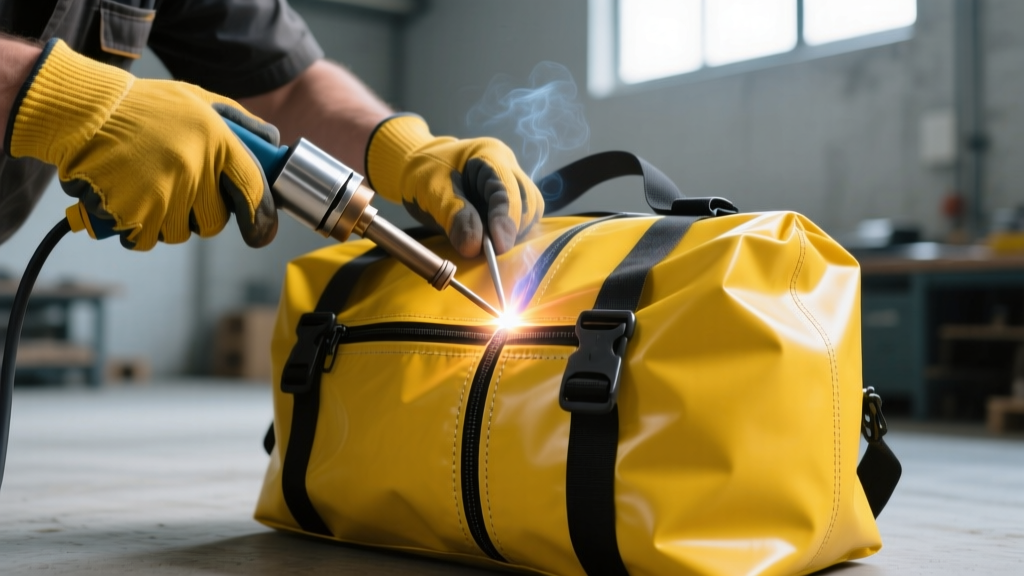
Seam Sealing: The Critical Failure Point
When sewing is unavoidable—such as when attaching heavy-duty nylon webbing handles or D-rings to silicone-impregnated fabrics—the needle perforations must be sealed. According to testing protocols outlined in the Gear Aid seam sealing technical guidelines, the choice of sealer must chemically match the fabric coating.
Tape vs. Liquid Sealers
- PU Seam Tape (e.g., Bemis ST604): Applied over sewn seams on TPU and PVC fabrics using a hot air taping machine. The 20mm or 22mm wide tape is fed at 3 meters/minute with an air temperature of 300°C. The tape's heat-activated adhesive flows into the needle holes, creating a permanent seal.
- Liquid Silicone Sealers (e.g., SilNet): PU tapes will not adhere to silicone-impregnated nylon. For silicone bags, a liquid silicone elastomer must be brushed over the seam. It requires a 24-hour cure time at room temperature and must be applied in a bead no wider than 1/4 inch to maintain fabric flexibility.
Before committing to a full production run of any welded or taped seam, manufacturers must perform a cross-hatch adhesion test. Following the ASTM D3359 Standard Test Methods for Rating Adhesion by Tape Test, a lattice pattern is cut into the seam, and specialized pressure-sensitive tape is applied and ripped off. A rating of 4B or 5B (less than 5% flaking) is mandatory for industrial bag applications.
Quality Control: Hydrostatic Head Testing
Visual inspection is insufficient for verifying the integrity of waterproof material for bags. Manufacturers must perform hydrostatic pressure testing to simulate the stress of a fully loaded, submerged, or heavily compressed bag.
The industry standard is ISO 811:2018 (Textiles — Determination of resistance to water penetration — Hydrostatic pressure test). A 100 cm² sample of the welded seam or coated fabric is clamped over a water column. Water pressure is increased at a constant rate of 60 cm per minute. The test concludes when three distinct drops of water penetrate the fabric.
Passing Metrics for Industrial Bags
- Light Trade Dry Bags: Minimum 3,000mm hydrostatic head.
- Construction Debris Containment: Minimum 5,000mm (accounts for sharp aggregate pressing against the membrane under load).
- FIBC Liquid Liners / Hazardous Material Containment: Minimum 10,000mm to 15,000mm, with 100% of seams undergoing non-destructive spark testing or vacuum decay testing prior to shipment.
Mastering these application techniques ensures that the waterproof material for bags performs reliably in demanding environments, preventing costly material loss, environmental contamination, and equipment damage on the job site.
Written by
James ThorntonJames Thornton is a construction industry veteran with 25 years of hands-on experience in wood framing, lumber grading, and residential building codes. He started as a framing carpenter in rural Oregon, earned his ICC Residential Building Inspector certification, and eventually became a senior plan reviewer for the City of Portland Bureau of Development Services. James holds a B.S. in Wood Science & Technology from Oregon State University and is a certified lumber grader through the West Coast Lumber Inspection Bureau (WCLIB). He has inspected over 3,000 residential construction sites and authored the city's internal guide on advanced framing techniques (2x6 at 24" O.C.). James lives in Bend, OR, where he builds custom timber-frame cabins and competes in lumberjack sports.
More from James Thornton
View all
Insulation
Best Home Insulation Materials: Complete 2026 Guide
Compare top home insulation materials for 2026. Find R-values, installed costs per square foot, and best uses for fiberglass, spray foam, and mineral wool.
Aug 4, 2026

Sustainable Building
Certify Your Green Building Material for LEED and WELL
Step-by-step guide to certifying a green building material for LEED v5 and WELL v2. Master EPDs, HPDs, and VOC limits for 2026 project specifications.
Aug 4, 2026

Stone & Masonry
Veneer Stacked Stone Panels: Interior Design & Style Showcase
Discover how veneer stacked stone panels transform interiors. Explore modern design profiles, material pairings, and technical installation specs.
Aug 4, 2026