Vapor Barrier Crawl Space Durability: Lifespan by Mil Thickness
Compare 6mil to 20mil vapor barrier crawl space liners. Analyze lifespan, puncture resistance, and long-term ROI for encapsulation projects.
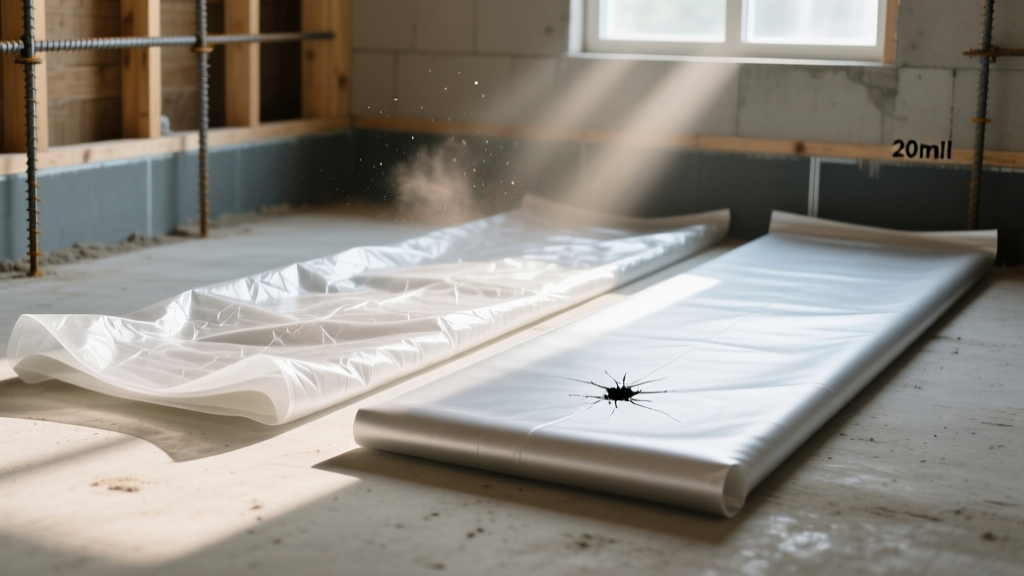
The Reality of Crawl Space Liner Degradation
Not all polyethylene sheeting survives the subterranean environment. When evaluating a vapor barrier crawl space installation, the primary enemy of longevity is not just moisture, but mechanical stress, soil gas acidity, and UV exposure during the curing phase of new construction. A liner's lifespan is dictated by its polymer formulation—specifically whether it utilizes virgin polyethylene resin or regrind (recycled) material. Regrind poly contains inconsistent polymer chains and microscopic impurities that accelerate oxidative degradation, often causing brittle failure within 36 months. For permanent encapsulation, specifying 100% virgin polyethylene with UV stabilizers is non-negotiable.
Mil Thickness vs. Expected Lifespan Matrix
The term 'mil' refers to one-thousandth of an inch (0.001 inches). However, thickness alone does not guarantee durability; the manufacturing process (extrusion vs. cross-lamination) plays an equally critical role in puncture resistance. The following matrix outlines the real-world lifespan expectations based on material grade and structural composition.
| Material Grade | Thickness | Composition Type | ASTM D1004 Tear Resistance | Expected Lifespan |
|---|---|---|---|---|
| Builder-Grade | 6-Mil | Extruded Regrind Poly | Low (2-4 lbs) | 1 to 3 Years |
| Contractor-Standard | 10-Mil | String-Scrim Reinforced | Medium (8-12 lbs) | 7 to 10 Years |
| Encapsulation-Grade | 12-Mil to 15-Mil | Cross-Laminated Virgin Poly | High (15-25 lbs) | 15 to 20 Years |
| Heavy-Duty Commercial | 20-Mil | Multi-Layer Nylon Scrim | Very High (30+ lbs) | 25+ Years (Lifetime) |
The 6-Mil Builder-Grade Trap
Six-mil polyethylene is the default material used by production homebuilders to meet minimum International Residential Code (IRC) requirements. While it technically blocks vapor diffusion on day one, it lacks the tensile strength to withstand HVAC technicians, pest control inspectors, or plumbing repairs. Under the ASTM D1709 Elmendorf impact test, 6-mil liners routinely fail at less than 100 grams of force. Once punctured, the tear propagates rapidly across the extruded grain, compromising the entire encapsulation envelope.
12-Mil to 15-Mil Cross-Laminated: The Permanent Standard
Products like Raven Industries VaporBlock or Poly-Ace 15-mil utilize cross-lamination technology. By fusing multiple layers of high-density polyethylene (HDPE) at alternating angles, manufacturers create a composite membrane that stops tear propagation dead in its tracks. If a sharp rock punctures a 15-mil cross-laminated liner, the tear is contained within a 1-inch radius rather than splitting the sheet down the middle. This structural integrity is what allows these membranes to achieve a 20-year functional lifespan in active crawl spaces.
Many 10-mil liners are marketed as 'reinforced' because they contain a polyester string scrim. While this increases tensile pull strength, it does little to improve puncture resistance. Furthermore, if the outer poly layers are breached, moisture wicks into the exposed string scrim, leading to internal delamination and mold growth within the liner itself. Always specify cross-laminated or solid virgin poly over string-scrim for encapsulation.
Primary Failure Modes That Cut Lifespan in Half
Even a 20-mil premium liner will fail prematurely if subjected to specific environmental and mechanical stressors. Understanding these failure modes is critical for specifying the correct auxiliary materials.
- Sub-Membrane Hydrostatic Blistering: When groundwater rises beneath the vapor barrier without a drainage mat or sump pump to relieve pressure, the liner floats and stretches. This hydrostatic pressure pulls the liner away from the foundation walls, snapping mechanical fasteners and tearing the material at the seams.
- Acrylic Tape Delamination: Standard acrylic seam tapes rely on surface moisture to activate and degrade rapidly in high-humidity, high-temperature crawl spaces. Within 24 months, the adhesive turns brittle and flakes off, leaving seams wide open to soil gas intrusion.
- Sub-Floor Debris Puncture: Failing to remove sharp rocks, concrete chunks, and exposed tree roots before rolling out the liner guarantees immediate micro-punctures. Over time, foot traffic expands these micro-punctures into major breaches.
- Termite Bait Station Interference: Pest control professionals often cut massive, unsealed flaps into vapor barriers to access termite monitoring stations. These unsealed penetrations negate the vapor diffusion metrics of the entire system.
Installation Variables That Dictate Longevity
The material science of the liner is only half the equation; the chemistry of the seams and the physics of the wall terminations determine whether the system lasts 5 years or 25 years.
Seaming Chemistry: Butyl vs. Acrylic Tapes
For overlaps and wall terminations, butyl rubber tape (such as Protecto Wrap Butyl or Tyvek Straight Flash) is the only acceptable adhesive for permanent encapsulation. Butyl rubber does not cure or dry out; it remains permanently pliable and maintains its tackiness even when submerged in water or exposed to 140°F crawl space summer temperatures. Apply a minimum 4-inch overlap on all field seams, and use a heavy J-roller to apply 50+ lbs of pressure, forcing the butyl into the microscopic texture of the polyethylene to create a monolithic bond.
Mechanical Fastening to Foundation Walls
Adhesive alone will eventually succumb to gravity and hydrostatic pressure on vertical foundation walls. The liner must be mechanically terminated at the top edge, typically 6 to 12 inches below the sill plate to allow for termite inspection zones.
While many contractors use wooden 1x2 batten strips nailed into the block with concrete nails, wood will eventually rot or warp in a damp environment, pulling away from the wall and dropping the liner. Instead, use PVC or aluminum termination bars (Z-flashing profiles) anchored with 1.5-inch Tapcon masonry screws spaced every 16 inches. This provides a permanent, rot-proof mechanical lock.
Cost-to-Lifespan ROI Matrix
When budgeting a vapor barrier crawl space project, analyzing the upfront material cost without factoring in the replacement cycle leads to poor financial decisions. The following breakdown illustrates the true cost of ownership based on 2026 material pricing averages.
| Liner Specification | Material Cost (per sq. ft.) | Expected Service Life | Amortized Annual Cost | Replacement Disruption |
|---|---|---|---|---|
| 6-Mil Regrind Poly | $0.15 - $0.20 | 2 Years | $0.075 - $0.100 | High (Requires full tear-out) |
| 10-Mil String Scrim | $0.35 - $0.45 | 8 Years | $0.043 - $0.056 | Medium (Seams usually fail first) |
| 15-Mil Cross-Laminated | $0.60 - $0.75 | 20 Years | $0.030 - $0.037 | None (Lifetime installation) |
| 20-Mil Nylon Scrim | $0.85 - $1.10 | 25+ Years | $0.034 - $0.044 | None (Commercial grade) |
As the data demonstrates, the 15-mil cross-laminated option offers the lowest amortized annual cost while eliminating the massive labor expense and disruption of a mid-life replacement. Upgrading from 6-mil to 15-mil adds roughly $0.50 per square foot in material costs, but saves thousands in future remediation labor.
Sourcing Authoritative Standards
Proper encapsulation requires adherence to building science principles regarding moisture management and indoor air quality. The Environmental Protection Agency (EPA) explicitly outlines the risks of unsealed crawl spaces, noting that up to 50% of the air in a home's living space originates from the crawlspace via the stack effect. Furthermore, the Department of Energy (Energy Saver) mandates that when insulating and encapsulating these zones, the ground must be covered with a continuous vapor retarder to prevent moisture migration into the structural framing.
When specifying materials, always request the manufacturer's technical data sheet (TDS) to verify ASTM D1709 (Impact Resistance) and ASTM D1004 (Tear Resistance) metrics. Do not rely on marketing terms like 'heavy-duty' or 'contractor grade.' By demanding verified test data, specifying virgin cross-laminated resins, and executing mechanical terminations with butyl chemistry, you ensure the vapor barrier crawl space system performs flawlessly for the life of the structure.