Decoding Waterproof Flooring Specs: WPC, SPC & Wear Layers
Compare WPC and SPC waterproof flooring specs. Learn wear layer metrics, AC ratings, ASTM F3261 standards, and real-world failure thresholds.
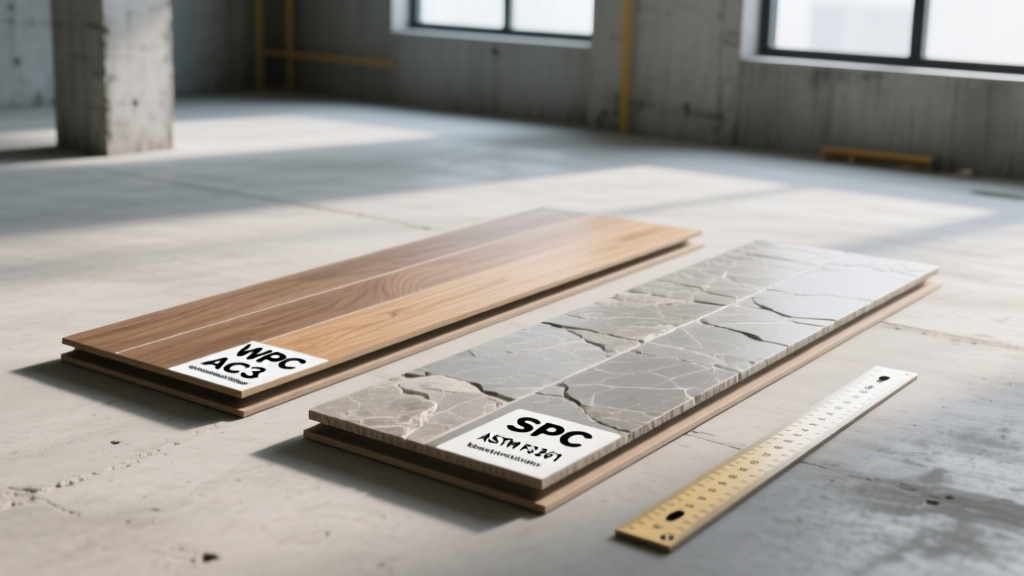
The Core Composition Matrix: SPC vs. WPC Specifications
Marketing teams frequently label all rigid core luxury vinyl as 100% waterproof, but building scientists and flooring contractors know that moisture management is dictated by material density, dimensional stability, and chemical composition. When specifying waterproof flooring for commercial or high-moisture residential environments, the distinction between Stone Plastic Composite (SPC) and Wood Plastic Composite (WPC) is the primary performance differentiator.
SPC cores are engineered with a high ratio of calcium carbonate (limestone powder) to polyvinyl chloride (PVC) resin, typically ranging from 60:40 to 70:30. This creates an ultra-dense, rigid structure. WPC, conversely, utilizes a foaming agent that expands the core, integrating wood-like plasticizers that yield a softer, more acoustically absorbent plank but with significantly lower dimensional stability under thermal stress.
| Specification Metric | SPC (Stone Plastic Composite) | WPC (Wood Plastic Composite) |
|---|---|---|
| Core Density | 1.9 - 2.1 g/cm³ | 0.8 - 1.0 g/cm³ |
| Dimensional Stability (Shrinkage) | < 0.05% (per ASTM F3261) | 0.10% - 0.15% |
| Impact Resistance (DIN 53454) | High (Resists heavy point loads) | Moderate (Prone to denting) |
| Thermal Expansion Coefficient | Low (Ideal for sunrooms/solariums) | High (Requires strict expansion gaps) |
| Subfloor Telegraphing Risk | Low (Rigid core bridges minor flaws) | Moderate (Softer core conforms to dips) |
As of 2026, manufacturing tolerances for SPC have tightened, allowing for thinner plank profiles (down to 4.0mm total thickness) without sacrificing structural integrity. However, the high limestone content makes SPC more brittle during installation; if the click-lock mechanism is forced at an improper angle, the milled lip can micro-fracture, creating a direct pathway for moisture to bypass the waterproof core and reach the subfloor.
Demystifying the Wear Layer: Mil, MM, and the AC Rating System
The waterproof core protects the structural integrity of the plank, but the wear layer dictates the floor's survivability against surface moisture, abrasion, and chemical degradation. A critical specification trap in the flooring industry is the conflation of mils and millimeters. A mil is one-thousandth of an inch (0.001"). Therefore, a 20-mil wear layer is exactly 0.508mm thick. Unscrupulous manufacturers occasionally market a "20mm wear layer" by mistake or design, which would be nearly an inch thick and physically impossible for residential plank.
Beyond thickness, the chemical composition of the wear layer determines its hydrophobic properties and stain resistance. Standard urethane coatings will eventually degrade under prolonged exposure to alkaline moisture (such as pet urine or harsh cleaning agents). Specify wear layers treated with ceramic bead or aluminum oxide additives. These microscopic particulates are suspended in the UV-cured urethane, increasing the surface tension and creating a micro-texture that prevents liquid pooling and accelerates evaporation.
To verify surface durability independently of marketing claims, reference the EN 13329 Abrasion Class (AC) rating system:
- AC3 (Class 31): Suitable for residential bedrooms and living rooms. Fails prematurely in high-moisture entryways.
- AC4 (Class 32): The baseline for residential kitchens, bathrooms, and light commercial spaces. Features enhanced scratch and moisture-stain resistance.
- AC5 (Class 33): Mandatory for heavy commercial environments. The wear layer is heavily fortified to resist micro-abrasions that can compromise the hydrophobic topcoat over time.
Waterproof vs. Water-Resistant: The Locking Mechanism Vulnerability
A pervasive misconception in architectural specifications is that a "100% waterproof core" equates to a waterproof installation. The core material itself will not swell, warp, or degrade when submerged. However, the mechanical click-lock joints—typically an angle-angle or drop-lock system—are the critical failure points in moisture management.
⚠️ Hydrostatic Pressure Warning
Waterproof flooring is designed to resist top-down moisture (spills, mopping, flooding). It is not designed to act as a vapor barrier against bottom-up hydrostatic pressure. If moisture vapor from a concrete slab pushes upward through the locking seams, it will trap moisture against the subfloor, leading to mold proliferation and adhesive failure (if glue-down methods are used at the perimeter).
Furthermore, micro-bevel edges—popular for mimicking the shadow lines of authentic hardwood—create physical troughs along the plank seams. In wet environments like commercial restrooms or residential mudrooms, surface water pools in these bevels, increasing the dwell time of moisture against the joint. For high-wet environments, specify square-edge (micro-bevel-free) SPC planks to ensure water sheets off the surface rather than channeling into the seams.
Subfloor Moisture Protocols and Testing Standards
Because waterproof flooring traps moisture, rigorous subfloor testing is non-negotiable before installation. Installing an impermeable SPC or WPC floor over a damp concrete slab guarantees subfloor degradation. The industry relies on two primary testing methodologies to quantify moisture vapor emission rates (MVER):
- Calcium Chloride Test (ASTM F1869): Measures the pounds of moisture emitted per 1,000 square feet over 24 hours. Standard SPC/WPC specifications require an MVER of less than 5 lbs. Specialized commercial SPC products with integrated vapor-barrier underlayments may tolerate up to 8-10 lbs, but this must be explicitly verified in the manufacturer's technical data sheet.
- In-Situ Relative Humidity Probe Testing (ASTM F2170): The more accurate, modern standard. Probes are inserted into holes drilled to 40% of the slab's depth. The acceptable threshold for most rigid core waterproof flooring is an RH reading of 75% to 80%, depending on the specific adhesive or underlayment used.
For comprehensive guidance on managing moisture in building envelopes and preventing mold growth beneath impermeable floor coverings, refer to the EPA's Moisture and Mold Prevention guidelines. Additionally, ensuring the flooring meets strict indoor air quality standards when exposed to heat and moisture is critical; verify that the product carries a FloorScore certification to guarantee low VOC emissions even in high-humidity environments.
Acoustic Ratings and Underlayment Integration
The performance specifications of waterproof flooring extend beyond moisture resistance to acoustic mitigation, particularly in multi-family residential and commercial high-rises. The attached underlayment (usually IXPE or EVA foam) serves a dual purpose: it absorbs impact sound and acts as a secondary moisture buffer.
When reviewing specifications, look for the Impact Insulation Class (IIC) and Sound Transmission Class (STC) ratings. An IIC rating of 50 is the minimum code requirement for many multi-story buildings, but premium SPC products with high-density IXPE underlayments achieve IIC ratings of 65 to 72. Crucially, if the environment requires a separate 6-mil polyethylene vapor barrier due to high slab moisture, you must specify a waterproof flooring product with no attached pad. Installing a floor with an attached foam pad over a separate poly-film creates a slip plane, leading to joint separation, clicking noises, and eventual lock failure under foot traffic.
Verifying Compliance: The ASTM F3261 Standard
To ensure the waterproof flooring you specify meets rigorous engineering thresholds, mandate compliance with ASTM F3261, the Standard Specification for Resilient Flooring in Plank or Tile Format with Rigid Core. This standard dictates the exact testing parameters for dimensional stability, residual indentation, and locking mechanism shear strength. By explicitly writing "Must comply with ASTM F3261-21 (or current revision)" into your project specifications, you legally filter out substandard, off-brand imports that rely on deceptive "waterproof" marketing while lacking the structural density to survive real-world thermal and moisture cycling.