Finding the Best Waterproof Material for Outdoor Structures
Discover the best waterproof material for outdoor structures. Compare membranes, coatings, and polymers with 2026 pricing, specs, and installation tips.

The Physics of Exterior Moisture Exposure
Selecting the right waterproof material for outdoor applications requires understanding that exterior structures face a multi-vector moisture assault. Unlike interior environments, outdoor materials must withstand hydrostatic pressure from pooling water, capillary action drawing moisture through porous substrates, and severe ultraviolet (UV) photodegradation. According to the Portland Cement Association, unsealed concrete can wick water vertically up to 6 inches per hour through capillary action, leading to freeze-thaw spalling in colder climates.
Furthermore, thermal expansion and contraction continuously test the tensile strength of waterproofing layers. A material that performs flawlessly in a static indoor test will often delaminate outdoors if it lacks sufficient elastomeric elongation. The ideal exterior waterproofing system must combine high tensile strength, UV stability, and a vapor permeability profile that matches the substrate to prevent trapped moisture.
Comprehensive Material Comparison Matrix
The market offers dozens of exterior waterproofing solutions, but they are not interchangeable. Below is a technical comparison of the top-performing material categories for 2026 outdoor construction projects.
| Material Category | Best Application | Avg. Cost (per sq. ft.) | Expected Lifespan | Elongation / Movement |
|---|---|---|---|---|
| Pure Polyurea Coatings | Pool decks, high-traffic patios | $6.50 - $9.00 | 20+ years | 400% - 600% |
| Reinforced PVC Membranes | Elevated balconies, rooftop decks | $4.50 - $7.00 | 25 - 30 years | 200% (heat-welded seams) |
| Marine-Grade HDPE Polymers | Outdoor kitchens, cabinetry | $8.00 - $14.00 (material) | Lifetime (50+ years) | Rigid (thermal expansion only) |
| Silane/Siloxane Penetrants | Vertical concrete, retaining walls | $1.20 - $2.50 | 5 - 10 years | N/A (pore-lining, not film) |
| EPDM Rubber Sheets | Low-slope exterior roofs, planters | $1.80 - $3.00 | 15 - 20 years | 300% |
Scenario-Based Selection Guide
Choosing the correct waterproof material for outdoor projects depends entirely on the structural geometry and load requirements of the specific application.
Grade-Level Patios and Pool Decks
For high-traffic, grade-level concrete surfaces exposed to constant moisture and pool chemicals, pure polyurea coatings (such as VersaFlex FLS m-78 or Line-X 585) are the industry standard. Unlike epoxy, which becomes brittle and yellows under UV exposure, pure polyurea is 100% solids, emits zero VOCs, and cures in under 15 seconds. It must be applied at a minimum of 60 mils wet thickness (yielding roughly 40 mils dry) over a properly profiled concrete substrate (CSP 3 or 4 via diamond grinding). Polyurea's 400% elongation allows it to bridge hairline cracks up to 1/16 inch without tearing.
Elevated Balconies and Rooftop Decks
Liquid coatings often fail on elevated wooden or concrete balconies due to structural deflection and ponding water. Here, reinforced PVC heat-welded membranes (like Sika Sarnafil S 327) are superior. These 60-mil thick sheets feature an internal polyester scrim that prevents puncture from patio furniture. The critical advantage of PVC over EPDM or TPO in pedestrian areas is the heat-welded seam, which fuses the overlapping sheets into a single, monolithic piece of material, eliminating the primary failure point of adhesively taped seams.
Outdoor Kitchens and Built-In Cabinetry
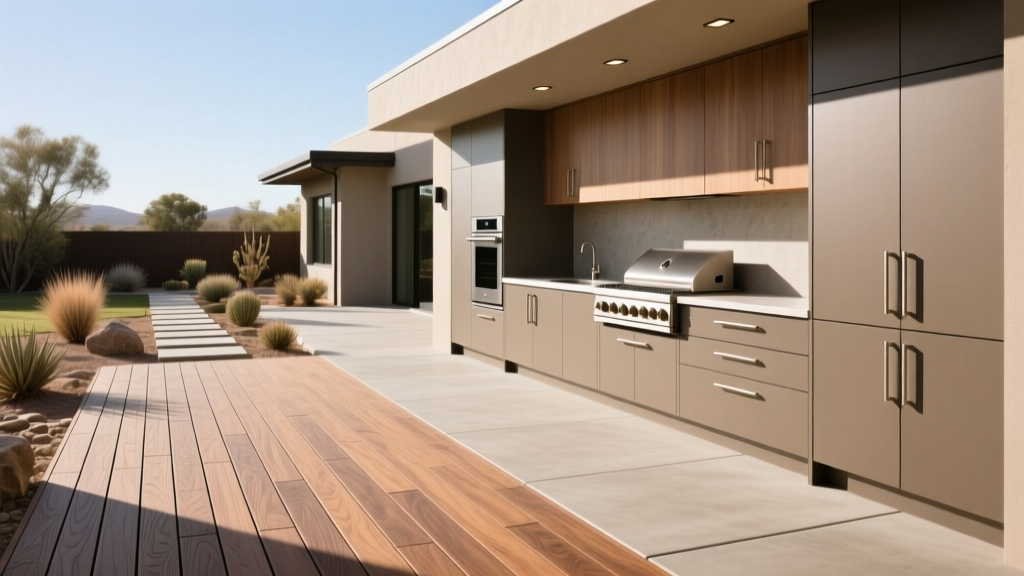
Wood and standard MDF will rapidly delaminate and rot in outdoor kitchens due to ambient humidity and direct splash zones. The optimal waterproof material for outdoor cabinetry framing is marine-grade HDPE polymer board (such as King StarBoard or Tangent Marine Board). This high-density polyethylene material has a water absorption rate of exactly 0.00%. It will not rot, swell, or harbor mold, and it can be routed and fastened using standard woodworking tools. For countertop substrates and tile backing, extruded polystyrene (XPS) foam boards with waterproof facings (like Schlüter Kerdi-Board) provide a lightweight, completely impervious base that eliminates the need for heavy cement backer boards.
Never apply a non-breathable, film-forming waterproof coating (like urethane or epoxy) to the exterior side of a below-grade retaining wall or a wooden deck that has not been fully dried. According to research on Equilibrium Moisture Content by Building Science Corporation, trapping moisture inside a substrate creates immense vapor pressure when heated by the sun. This pressure will blister and delaminate the coating from the inside out. Always use breathable penetrating sealers (silane/siloxane) for vertical masonry, or ensure substrates are tested with a calcium chloride moisture test before applying impermeable membranes.
Installation Tolerances and Critical Measurements
Even the most expensive waterproof material for outdoor use will fail if installed outside of strict engineering tolerances. Adhere to these critical measurements during installation:
- Minimum Slope: All horizontal surfaces, including balcony decks and patio slabs, must have a minimum slope of 1/4 inch per foot (2%) away from the structure to prevent ponding water. Ponding water accelerates UV degradation and promotes biological growth.
- Flashing Heights: Waterproof membranes must flash up vertical walls a minimum of 8 inches above the finished deck surface to prevent capillary wicking behind the membrane during heavy wind-driven rain.
- Thermal Expansion Gaps: When installing rigid waterproof materials like composite decking or HDPE polymer boards, maintain a strict 3/16 inch gap between board ends and a 1/8 inch side gap for every 40°F temperature differential expected in your climate zone.
- Sealant Joint Depths: For perimeter expansion joints, use a 2:1 width-to-depth ratio for polyurethane sealants (e.g., Tremco Dymonic FC). A 1/2 inch wide joint must be exactly 1/4 inch deep, backed by a closed-cell backer rod to ensure two-sided adhesion and allow for 25% joint movement.
Real-World Failure Modes and Prevention
Understanding how exterior waterproofing systems fail in the field allows contractors and homeowners to preemptively engineer solutions.
| Failure Mode | Primary Cause | Engineered Prevention Strategy |
|---|---|---|
| Coating Blistering | Outgassing of moisture or air from porous concrete substrates during the heat of the day. | Apply coatings during falling temperatures (late afternoon/evening) and use a moisture-mitigating epoxy primer before the polyurea topcoat. |
| Membrane Punctures | Concentrated point loads from heavy outdoor kitchen islands or sharp-edged patio furniture. | Install a 1/4 inch thick protective rubber mat or a geotextile separation fabric over the PVC/EPDM membrane before placing heavy loads. |
| Wood Substrate Rot | Water infiltrating through fastener holes in decking, bypassing the surface membrane. | Use hidden fastener systems or apply butyl flashing tape over all joists before laying the decking boards to protect the structural framing. |
Long-Term Maintenance and Lifecycle Costs
When evaluating the best waterproof material for outdoor structures, initial installation costs must be weighed against lifecycle maintenance. Penetrating silane/siloxane sealers are highly cost-effective upfront ($1.20 to $2.50 per square foot) but require reapplication every 5 to 10 years as the active chemicals degrade under UV exposure. The USDA Forest Products Laboratory notes that repeated wetting and drying cycles eventually break down the hydrophobic barrier in wood and masonry, necessitating this maintenance cycle.
Conversely, reinforced PVC membranes and pure polyurea coatings represent a higher initial capital expenditure ($4.50 to $9.00+ per square foot) but require virtually zero chemical reapplication. Maintenance for these systems is limited to annual clearing of drainage scuppers and inspecting heat-welded seams or perimeter flashings for physical damage. For commercial outdoor spaces or high-end residential builds, the 25-year lifecycle of a monolithic membrane system yields a significantly lower total cost of ownership compared to cyclical re-sealing of penetrating treatments.
Written by
Elena RodriguezElena Rodriguez is a civil engineer and technical writer specializing in concrete technology, masonry systems, and ASTM/ACI compliance. She earned her B.S. in Civil Engineering from Texas A&M University and spent a decade at a materials testing laboratory, performing over 2,000 concrete compressive strength tests and masonry prism evaluations. Elena is an ACI-certified Field Testing Technician (Grade I) and a member of ASTM Committee C12 on Natural Building Stone. She currently consults on forensic engineering cases involving concrete failures and moisture intrusion. Based in San Antonio, TX, Elena is a proud member of the Society of Women Engineers (SWE) and coaches her daughter's FIRST Robotics team.
More from Elena Rodriguez
View all
Walls & Panels
Cost Analysis: Light Gauge Steel Framing Advantages and Disadvantages
Evaluate light gauge steel framing advantages and disadvantages through a strict cost analysis lens, comparing material, labor, and lifecycle expenses.
Aug 4, 2026

Walls & Panels
Gypsum Board Types: Exact Specifications, Thickness & Dimensions
Compare standard, Type X, and moisture-resistant gypsum board types. Get exact specifications, thicknesses, dimensions, and ASTM standards for your project.
Aug 4, 2026

Fire Resistance
Best Fire-Resistant Outdoor Decking Materials: 2026 Buyer Guide
Discover the best fire-resistant outdoor decking materials for 2026. Compare Class A PVC, aluminum, and hardwood options for WUI compliance and safety.
Aug 4, 2026