Best Vapor Barrier for Crawl Space: 2026 Brand & Product Deep-Dive
Compare top vapor barrier for crawl space brands like Crawlspace Depot and VaporGuard. Get 2026 pricing, mil thickness specs, and installation tips.
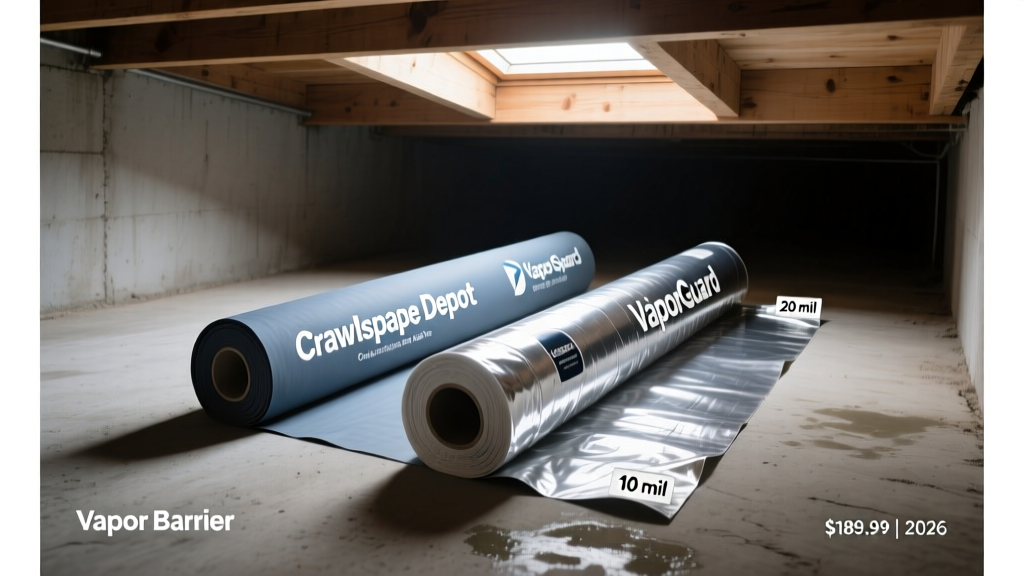
The Science of Crawl Space Moisture and ASTM E1745
Selecting the correct vapor barrier for crawl space encapsulation is not merely about laying down plastic; it is about engineering a continuous, puncture-resistant membrane that alters the hygrothermal dynamics of the structure. According to the U.S. Environmental Protection Agency, unsealed dirt crawl spaces can introduce up to 12 gallons of water vapor into a home daily, driving up HVAC loads and accelerating structural decay.
Industry professionals evaluate these membranes using ASTM E1745, the standard specification for plastic water vapor retarders used in contact with soil. This standard categorizes barriers into Class A (highest puncture and tensile strength), Class B, and Class C. For a fully encapsulated, conditioned crawl space where the floor will be used for storage or accessed for maintenance, a Class A, 20-mil reinforced barrier is the baseline requirement. Thinner 6-mil or 10-mil unreinforced polyethylene sheets, often sold at big-box hardware stores, fail to meet the tensile requirements for long-term crawl space traffic and are prone to micro-tearing when dragged over sharp aggregate.
Brand Deep-Dive: Crawlspace Depot Pro Series
Crawlspace Depot has positioned its Pro Series as the premium choice for professional remediation contractors. Their flagship product, the Pro 20 Woven, utilizes a high-density polyethylene (HDPE) woven scrim laminated between two layers of virgin low-density polyethylene (LDPE).
Pros and Cons of Crawlspace Depot Pro 20
- Pro: Exceptional puncture resistance (2,200 grams per ASTM D1709).
- Pro: Bright white surface reflects light, significantly improving visibility for technicians working under the house.
- Con: At approximately $0.68 per square foot in 2026, it sits at the top tier of the pricing spectrum.
- Con: The heavy weight (approx. 1.2 lbs per sq ft) makes maneuvering 100-foot rolls in tight, low-clearance crawl spaces physically demanding for a two-person crew.
Brand Deep-Dive: Raven Industries VaporGuard
Raven Industries approaches the vapor barrier for crawl space market with engineered agricultural and construction films. Their VaporGuard 15 X-Frame utilizes a cross-laminated technology rather than a traditional woven scrim. By laminating multiple layers of polyethylene at opposing angles, Raven creates a 15-mil barrier that performs like a 20-mil woven product in tear-resistance tests.
The X-Frame series is particularly noted for its flexibility in cold weather. While standard HDPE scrims become stiff and difficult to fold around concrete piers when crawl space temperatures drop below 50°F, Raven's cross-laminated structure retains high pliability. This allows for tighter, cleaner terminations around irregular foundation elements without requiring excessive heat-gun manipulation.
Application Specifics
Raven recommends pairing their membrane with their proprietary double-sided butyl seam tape. Unlike standard acrylic tapes which can degrade in high-humidity, high-alkalinity environments (common when the barrier wraps up concrete block walls), butyl tape maintains a permanent, non-hardening seal. The 15-mil X-Frame retails for roughly $0.58 per square foot, making it a highly competitive mid-tier option for contractors balancing performance with material costs.
Brand Deep-Dive: PolyGuard by Insulation Solutions
PolyGuard targets the budget-conscious encapsulation market without dropping below the critical 10-mil threshold. Their PolyGuard 12 String-Reinforced embeds nylon strings in a grid pattern within the extrusion. While it lacks the dense HDPE woven core of the Crawlspace Depot Pro series, the nylon string provides a reliable tear-stop mechanism.
At $0.42 per square foot, PolyGuard 12 is the go-to choice for 'light encapsulations'—projects where the crawl space is sealed to meet building code vapor retarder requirements, but the space will not be conditioned, heavily trafficked, or used for storage. It is not recommended for full, unvented, conditioned crawl spaces where dehumidifiers and HVAC ducting require regular service access, as repeated knee traffic will eventually wear through the LDPE outer layers, exposing the nylon string to soil moisture.
Head-to-Head Comparison Matrix
| Brand & Model | Thickness | Reinforcement Type | Puncture Resistance | 2026 Avg. Price/Sq Ft |
|---|---|---|---|---|
| Crawlspace Depot Pro 20 | 20-mil | HDPE Woven Scrim | 2,200g (Class A) | $0.68 |
| Raven VaporGuard 15 X-Frame | 15-mil | Cross-Laminated | 1,950g (Class A) | $0.58 |
| PolyGuard 12 String | 12-mil | Nylon String Grid | 1,100g (Class B) | $0.42 |
Seaming and Fastening: Where Installations Fail
The most robust vapor barrier for crawl space applications will fail if the seaming and termination details are executed poorly. Field data shows that over 80% of encapsulation callbacks are due to seam delamination or wall-termination detachment, not membrane punctures.
The Seam Tape Hierarchy
- Butyl Tape (Best): A rubberized, non-curing adhesive that remains tacky and flexible for decades. It conforms to minor dust and moisture on the membrane surface. Essential for overlapping seams on the dirt floor.
- Double-Sided Acrylic Tape (Good): Provides a strong initial bond and is easier to apply cleanly than butyl. However, it requires perfectly dry, dust-free surfaces to achieve maximum adhesion. Best used for vertical wall overlaps.
- Single-Sided Duct/Poly Tape (Avoid): Standard construction tapes will dry out, shrink, and peel within 18 to 24 months in a humid crawl space environment. Never use these for primary encapsulation seams.
Termination at Foundation Walls and Piers
Running the barrier up the foundation wall by 6 to 12 inches is standard practice, but securing it requires mechanical fastening. Relying solely on spray adhesive or mastic to hold the heavy 20-mil membrane to a porous concrete block wall is a guaranteed failure point. The correct protocol involves applying a continuous bead of polyurethane construction adhesive (like Loctite PL Premium) to the wall, pressing the membrane into the bead, and then securing it with a PVC batten strip fastened using concrete tap screws or powder-actuated pins every 16 inches. According to the U.S. Department of Energy, proper air-sealing at these perimeters is critical to preventing soil gases, including radon, from bypassing the vapor retarder.
Cost Breakdown and Material ROI
When budgeting for a 1,500-square-foot crawl space encapsulation in 2026, material costs extend beyond the roll price of the barrier itself. A complete material bill of materials (BOM) typically includes:
- Primary Membrane (1,650 sq ft including 10% overlap/waste): $690 (Raven 15-mil) to $1,122 (Crawlspace Depot 20-mil).
- Seam Tape (Butyl, 12 rolls at 45ft each): ~$280.
- Termination Batten Strips and Fasteners (150 linear feet): ~$145.
- Pier Wraps and Collars (for 15 support piers): ~$120.
While upgrading from a 6-mil builder-grade poly sheet to a 20-mil woven barrier adds roughly $800 to the material cost of an average project, it eliminates the risk of membrane degradation, prevents costly callback repairs, and is a mandatory requirement for homeowners seeking to convert their crawl space into a conditioned, semi-habitable utility zone. Investing in a Class A, string or scrim-reinforced barrier is non-negotiable for long-term structural preservation and indoor air quality management.