Waterproof Cast Material: Polyurethane vs Polyurea vs Concrete
Compare waterproof cast materials for below-grade and plaza decks. We analyze cast polyurethane, polyurea, and crystalline concrete costs and durability.

The Mechanics of In-Situ Cast Waterproofing
When designing below-grade foundations, plaza decks, or podiums, architects and engineers must choose between pre-formed sheet membranes and in-situ cast systems. A waterproof cast material refers to any liquid or fluid-applied system that cures in place to form a continuous, monolithic barrier without seams. Unlike self-adhered modified bitumen or PVC sheets, cast materials conform perfectly to complex geometries, penetrations, and irregular substrates. However, the term encompasses vastly different chemical technologies, each with distinct curing mechanisms, structural elongation properties, and failure modes.
Selecting the correct cast-in-place waterproofing system requires matching the material's chemical profile to the substrate's moisture content, the project's traffic demands, and the anticipated structural movement. This guide compares the three dominant waterproof cast materials used in modern commercial construction: cast polyurethane liquid membranes, pure cast polyurea elastomers, and integral cast-in-place crystalline concrete.
Quick Decision Framework
- Choose Cast Polyurethane for pedestrian plaza decks, green roofs, and applications requiring high elongation (400%+) over moving substrates where hot-work or heavy spray equipment is prohibited.
- Choose Cast Polyurea for heavy vehicular traffic decks, water treatment facilities, and secondary containment where rapid return-to-service (under 2 hours) and extreme chemical resistance are mandatory.
- Choose Integral Crystalline Concrete for below-grade foundation walls, water tanks, and tunnels where external membrane application is physically impossible or where self-sealing of micro-cracks is the primary design requirement.
Cast Polyurethane Liquid Membranes
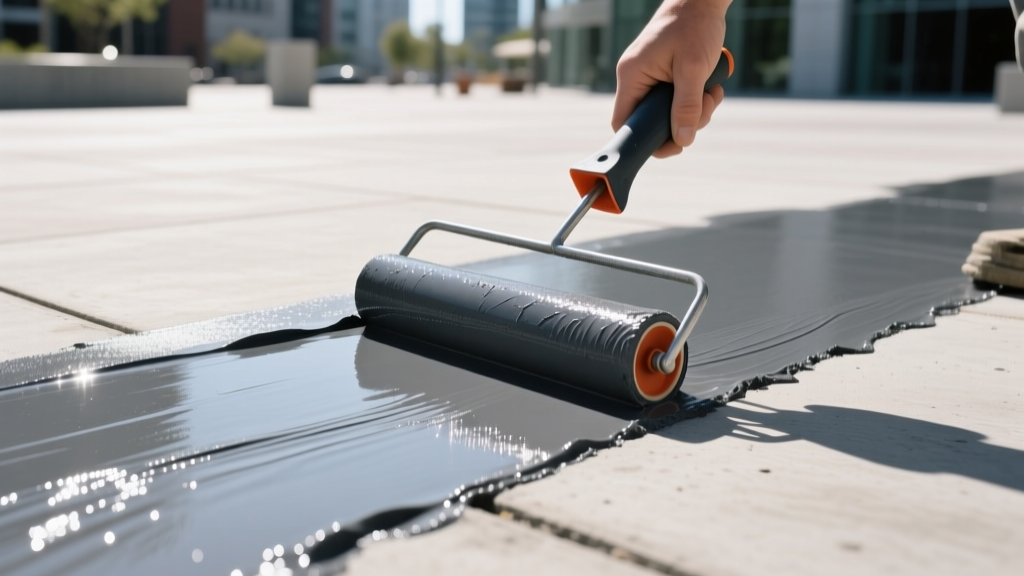
Cast polyurethane systems are typically applied via roller, squeegee, or airless sprayer. They are available in single-component (moisture-cured) and two-component (chemical-cured) formulations. For high-performance plaza decks, two-component aromatic or aliphatic polyurethanes are the industry standard, often applied in multiple coats to achieve a minimum dry film thickness (DFT) of 60 to 90 mils.
Technical Specifications and Application Realities
Polyurethanes offer exceptional tensile strength (typically 400 to 800 psi) and high elongation, allowing them to bridge dynamic cracks up to 1/16 inch without tearing. According to testing standards outlined by the International Concrete Repair Institute, polyurethane membranes excel in freeze-thaw cycling and UV resistance when formulated with aliphatic topcoats.
However, the primary vulnerability of moisture-cured polyurethanes is osmotic blistering. If applied over a concrete substrate with a moisture vapor emission rate (MVER) exceeding 3 lbs per 1,000 square feet per 24 hours (per ASTM F1869), the trapped vapor reacts with the isocyanates during the curing process, generating carbon dioxide gas that forms permanent blisters. Mitigation requires the application of a vapor-blocking epoxy primer prior to casting the polyurethane.
Pure Cast Polyurea Elastomers
Polyurea represents the high-performance, rapid-cure evolution of cast elastomeric membranes. Pure polyurea is a 100% solids, two-component system that requires a plural-component spray reactor heated to 150°F–160°F at pressures exceeding 2,000 psi. Upon mixing at the spray gun, the material gels in 5 to 15 seconds and cures to full physical properties within minutes.
Performance Metrics and Substrate Demands
The mechanical properties of pure polyurea are formidable: tensile strengths often exceed 3,000 psi, with elongation ranging from 250% to 450%. It is entirely moisture-insensitive during the curing phase, meaning it will not blister or foam when applied to damp concrete. This makes it the premier waterproof cast material for water containment and municipal infrastructure.
The critical edge case for polyurea is surface preparation. Because it cures almost instantly, it does not have time to wet out and penetrate the substrate pores like slower-curing polyurethanes. The concrete must be shot-blasted to a Concrete Surface Profile (CSP) of 3 to 5, and a dedicated polyurea-compatible primer must be applied to prevent delamination. Furthermore, the capital cost for plural-component spray equipment is substantial, restricting application to specialized, certified contractors.
Cast-in-Place Integral Crystalline Concrete
Rather than applying a membrane to the surface of the concrete, integral crystalline technology transforms the concrete matrix itself into the waterproof cast material. Chemical admixtures (typically a blend of Portland cement, very fine silica sand, and proprietary active chemicals) are added to the concrete batch at the ready-mix plant at a dosage rate of 2% to 3% by weight of cementitious material.
Self-Sealing Mechanics and Limitations
When water penetrates the concrete, the dormant chemicals activate and react with the calcium hydroxide and free lime in the cement paste, forming insoluble needle-like crystalline structures. These crystals block the capillary tracts and micro-cracks, effectively self-sealing the concrete. The American Concrete Institute recognizes these admixtures under ACI 212.3R as permeability-reducing admixtures for hydrostatic conditions.
The major limitation of crystalline concrete is its inability to bridge moving structural cracks or construction joints that exceed 0.4 mm in width. While it excels at sealing static shrinkage cracks, dynamic joints still require supplementary waterstops or injectable grout systems. Additionally, the concrete must remain continuously moist-cured for at least 3 to 7 days post-pour to allow the initial crystallization network to establish.
Head-to-Head Material Comparison Matrix
| Feature | Cast Polyurethane | Pure Cast Polyurea | Integral Crystalline |
|---|---|---|---|
| Dry Film Thickness / Dosage | 60 - 90 mils | 60 - 125 mils | 2% - 3% by cement weight |
| Cure to Traffic Time | 24 - 48 hours | 1 - 2 hours | 7 - 14 days (structural cure) |
| Tensile Strength (ASTM D412) | 400 - 800 psi | 2,500 - 3,500 psi | N/A (Inherent to concrete) |
| Elongation at Break | 400% - 600% | 250% - 450% | 0% (Rigid matrix) |
| Moisture Sensitivity During Cure | High (Requires primer) | None (Moisture insensitive) | Requires continuous wet-curing |
| Estimated 2026 Installed Cost | $5.50 - $8.50 / sq ft | $9.00 - $15.00 / sq ft | Adds $0.80 - $1.25 / sq ft |
Expert Troubleshooting: Common Cast Material Failures
Even the most advanced waterproof cast materials will fail if the environmental and substrate variables are mismanaged. Below are the most frequent field failures and their technical remedies.
1. Osmotic Blistering in Polyurethane Systems
The Symptom: Dome-shaped blisters ranging from 1/4 inch to 2 inches in diameter appear 48 to 72 hours after casting the polyurethane membrane.
The Root Cause: Applying moisture-cured polyurethane over concrete with high internal relative humidity (RH > 75% per ASTM F2170). The isocyanate reacts with water vapor instead of the polyol resin, releasing CO2 gas.
The Fix: Blisters must be cut out, the substrate dried, and a moisture-mitigating epoxy primer (such as a 100% solids, high-build vapor barrier) must be applied before re-casting the membrane.
2. Pinholes and Outgassing in Polyurea
The Symptom: Tiny craters or pinholes dot the surface of the cured polyurea, compromising the monolithic seal.
The Root Cause: Concrete is naturally porous and contains trapped air. When the hot polyurea (160°F) hits the cool concrete, the air inside the pores expands rapidly and escapes through the gelling membrane.
The Fix: Apply a high-solids, solvent-free epoxy primer to seal the pores. Broadcast a fine aggregate (like 20-30 mesh silica sand) into the wet primer to provide mechanical tooth for the polyurea to grip.
3. Efflorescence and Crystalline Inhibition
The Symptom: Heavy white mineral deposits (efflorescence) push through the concrete surface, and water continues to leak through micro-cracks despite the crystalline admixture.
The Root Cause: The concrete was not wet-cured adequately, or the admixture dosage was diluted by high fly-ash or slag replacement levels (exceeding 40%), which reduces the available calcium hydroxide needed for the crystalline reaction.
The Fix: For active leaks, apply a topical crystalline slurry coat to the negative side. Ensure future mix designs limit supplementary cementitious materials (SCMs) to 30% when utilizing integral crystalline technology.
Sourcing and Quality Assurance Standards
When specifying waterproof cast materials, rely on standardized testing rather than manufacturer marketing claims. Ensure that polyurethane and polyurea membranes are tested for hydrostatic resistance per ASTM D5385 or equivalent modified standards, and verify that the concrete admixtures comply with the performance requirements outlined by the National Institute of Building Sciences for below-grade waterproofing. Always require the contractor to provide a mock-up test patch, including adhesion pull-off testing (ASTM D4541) to verify substrate preparation and primer compatibility before full-scale casting begins.
Written by
Elena RodriguezElena Rodriguez is a civil engineer and technical writer specializing in concrete technology, masonry systems, and ASTM/ACI compliance. She earned her B.S. in Civil Engineering from Texas A&M University and spent a decade at a materials testing laboratory, performing over 2,000 concrete compressive strength tests and masonry prism evaluations. Elena is an ACI-certified Field Testing Technician (Grade I) and a member of ASTM Committee C12 on Natural Building Stone. She currently consults on forensic engineering cases involving concrete failures and moisture intrusion. Based in San Antonio, TX, Elena is a proud member of the Society of Women Engineers (SWE) and coaches her daughter's FIRST Robotics team.
More from Elena Rodriguez
View all
Walls & Panels
Cost Analysis: Light Gauge Steel Framing Advantages and Disadvantages
Evaluate light gauge steel framing advantages and disadvantages through a strict cost analysis lens, comparing material, labor, and lifecycle expenses.
Aug 4, 2026

Walls & Panels
Gypsum Board Types: Exact Specifications, Thickness & Dimensions
Compare standard, Type X, and moisture-resistant gypsum board types. Get exact specifications, thicknesses, dimensions, and ASTM standards for your project.
Aug 4, 2026

Fire Resistance
Best Fire-Resistant Outdoor Decking Materials: 2026 Buyer Guide
Discover the best fire-resistant outdoor decking materials for 2026. Compare Class A PVC, aluminum, and hardwood options for WUI compliance and safety.
Aug 4, 2026