Timing Liquid Membrane Cures: Using a Waterproof Watch for Flawless Application
Learn why commercial waterproofing applicators rely on a rugged waterproof watch to time critical PMMA and polyurethane liquid membrane curing windows.
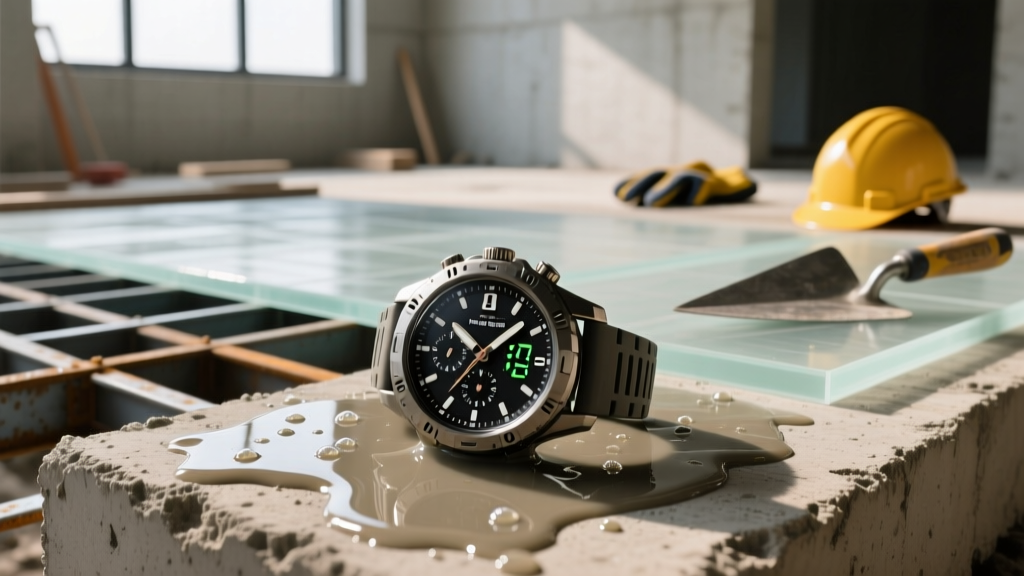
The Hidden PPE: Why Liquid Membrane Applicators Rely on a Waterproof Watch
In the high-stakes environment of commercial plaza deck and podium waterproofing, timing is not just a metric—it is the primary determinant of inter-coat adhesion and system warranty validity. While architects and engineers specify liquid-applied membranes like Polymethyl Methacrylate (PMMA), Polyurea, and Polyurethane for their seamless, monolithic protection, the burden of executing the chemical cure falls entirely on the applicator. Modern smartphones are useless in this environment: capacitive touchscreens do not respond through chemical-resistant nitrile or butyl gloves, and a single splash of Methyl Ethyl Ketone (MEK) or Xylene will permanently destroy a phone's oleophobic coating and internal seals.
Enter the rugged waterproof watch. Far from a mere accessory, a chemical-resistant, high-bar waterproof watch is an essential piece of Personal Protective Equipment (PPE) and application tooling. It serves as the definitive timer for tracking pot life, tack-free phases, and the critical recoat windows that dictate whether a multi-layer waterproofing system will perform for decades or fail within the first freeze-thaw cycle.
The Financial Cost of Missing the Recoat Window
Liquid-applied membranes rely on chemical cross-linking. If an applicator fails to apply the subsequent topcoat or aggregate broadcast within the manufacturer's specified recoat window, the initial layer achieves full chemical cure. At this point, the surface becomes inert. Applying a new layer over a fully cured membrane results in a mechanical bond rather than a chemical bond, leading to delamination, blistering, and catastrophic water ingress.
If a 5,000 sq. ft. plaza deck exceeds the recoat window on a PMMA base coat, the contractor must mechanically abrade (shot-blast or diamond grind) the entire surface to re-open the pores and restore a chemical profile. At an average remediation cost of $1.50 to $2.50 per square foot, a missed timer window results in a $7,500 to $12,500 rework penalty before a single new drop of resin is poured.
Critical Timing Matrix: PMMA, Polyurea, and Polyurethane
Different membrane chemistries demand entirely different timing disciplines. A waterproof watch with multiple independent chronograph timers is required to manage overlapping pours on large commercial decks. Below is the standard timing matrix for ambient conditions (70°F / 21°C and 50% Relative Humidity).
| Membrane Chemistry | Pot Life | Tack-Free Time | Recoat Window | Primary Solvent Risk |
|---|---|---|---|---|
| PMMA (MMA Resin) | 12–15 Minutes | 30–45 Minutes | 1 Hour – 72 Hours | High (MEK / Acetone) |
| Polyurea (Hot Spray) | 5–10 Seconds | 10–15 Seconds | N/A (Requires Primer) | Low (No active solvents) |
| Polyurethane (Single-Component) | 2–4 Hours | 4–6 Hours | 12 – 48 Hours | Moderate (Xylene) |
As detailed in the ASTM D6947 Standard Specification for Liquid Applied Single-Component Urethane Elastomeric Waterproofing Membranes, environmental variables such as substrate temperature and ambient humidity drastically alter these baselines. Applicators must use their watch timers to log exact intervals from the moment the catalyst is introduced to the resin.
Specifying the Right Waterproof Watch for Chemical Environments
Not every watch marketed as 'waterproof' can survive a waterproofing job site. The term 'waterproof' in horology is governed by ISO 22810, which dictates water pressure resistance. However, chemical resistance is an entirely different engineering challenge. When selecting a waterproof watch for membrane application, contractors must enforce the following specifications:
1. Pressure Rating: 10 BAR (100 Meters) Minimum
While applicators are not diving, a 10 BAR rating ensures the watch case can withstand high-pressure job site washdowns, accidental submersion in primer buckets, and the aggressive use of pressurized solvent sprayers during tool cleanup.
2. Band Material: Fluoroelastomer or High-Density Polyurethane Resin
Never wear a standard silicone, leather, or nylon watch band on a liquid membrane site. MEK and Xylene will cause standard silicone to rapidly swell, degrade, and melt onto the wrist. Nylon bands trap flammable solvent vapors, creating a severe flash-fire hazard when working near hot-air welding guns or open-flame primer torches. Specify Casio G-Shock Mudmaster (resin) or Garmin Instinct (fiber-reinforced polymer) models.
3. Tactile, Oversized Pushers
Applicators wear 8-mil to 14-mil nitrile or butyl rubber gloves. Touchscreens are obsolete in this scenario. The watch must feature physical, oversized, knurled buttons that can be actuated through thick chemical gloves to start, stop, and reset lap timers without removing hand protection.
Standard Operating Procedure: Integrating the Watch into the Pour
To maximize inter-coat adhesion and minimize material waste, site foremen should integrate the waterproof watch into the standard mixing and broadcasting procedure.
- T-Minus 0 (The Mix): The moment the B-Component (catalyst) is poured into the A-Component (resin) bucket, the foreman hits the primary chronograph on the watch. This tracks the absolute pot life.
- T-Plus 3 Minutes (Agitation): After mechanical mixing, the secondary timer is started to track the 'induction time' (sweat time) required for certain polyurethanes to off-gas before application.
- T-Plus 15 Minutes (The Pour & Broadcast): For PMMA systems, the material must be poured and the quartz aggregate broadcast before the tack-free window closes. The watch's lap function is used to track section-by-section pour rates across the plaza deck grid.
- The Recoat Alarm: Upon completing the base coat, the foreman sets a countdown alarm on the watch for the absolute minimum recoat time (e.g., 60 minutes for PMMA). This prevents the crew from returning to the deck too early and stepping into uncured, tacky material, which compromises the membrane thickness and introduces organic contaminants.
Post-Application Decontamination
At the end of the shift, the waterproof watch must be decontaminated. Do not use MEK or acetone to clean the watch casing, as these aggressive solvents can cloud mineral crystals and degrade polyurethane gaskets over time. Instead, wipe the watch casing and resin band with a lint-free cloth dampened with isopropyl alcohol (IPA) or a mild, non-caustic soap and water solution. Inspect the crown seals and pusher gaskets annually; if the tactile 'click' of the button feels spongy, the internal O-rings have been compromised by solvent vapor and the watch must be serviced or replaced to maintain its ISO 22810 integrity.
Jobsite Troubleshooting FAQ
Q: Can I use a smartwatch with physical buttons if I wear a nitrile glove over the screen?
A: No. Solvent vapors permeate standard nitrile gloves and will pool between the glove and the smartwatch screen, permanently destroying the digitizer and voiding the warranty. Stick to dedicated digital/analog resin watches.
Q: Does temperature affect my watch's timer accuracy?
A: Quartz movements are generally accurate to +/- 15 seconds a month. However, extreme cold (below 40°F) can temporarily slow the LCD screen refresh rate on digital watches. In winter waterproofing applications, rely on the audible alarm functions rather than visual LCD readouts.
Q: What is the best strap replacement for chemical environments?
A: If your OEM resin strap degrades, replace it with a Fluoroelastomer (FKM) strap. FKM is the same material used in high-end chemical processing O-rings and offers near-total immunity to Xylene, Toluene, and MEK.