Application Techniques for Bag Waterproof Material on Concrete
Learn precise application techniques for bag waterproof material on concrete. Discover mixing ratios, surface prep, and troweling methods to prevent failure.

Bag waterproof material—specifically dry-pack cementitious and crystalline compounds—represents a cornerstone of below-grade and structural concrete waterproofing. Unlike liquid-applied membranes or sheet goods, bagged cementitious materials rely on chemical integration with the concrete substrate to block water migration. However, the efficacy of these systems is entirely dependent on rigorous application techniques. A failure in surface preparation, mixing ratios, or moisture management during curing will result in delamination, blistering, or capillary tracking. This guide details the exact protocols for applying bag waterproof material to ensure a permanent, impermeable barrier.
Material Classification: Crystalline vs. Polymer-Modified
Before initiating application, it is critical to identify the specific chemistry of the bag waterproof material you are using, as this dictates the mixing and curing protocols. According to the Portland Cement Association, cementitious waterproofing generally falls into two categories:
- Crystalline Compounds (e.g., Xypex Concentrate, Kryton Krystol): These contain proprietary catalytic chemicals that react with free lime and moisture in the concrete to form insoluble dendritic crystals. They require a continuous moisture source to propagate and can self-seal micro-cracks up to 0.4mm.
- Polymer-Modified Cementitious Coatings (e.g., SikaTop Seal 107, BASF MasterSeal 583): These are two-component systems (a liquid polymer additive and a dry bag powder) or single-component bags that require an acrylic additive. They cure to form a flexible, breathable, yet impermeable physical barrier, ideal for structures subject to slight deflection or hydrostatic pressure.
Substrate Preparation: Achieving CSP-3 and SSD
The most common cause of bag waterproof material failure is inadequate substrate preparation. The concrete must be structurally sound, free of laitance, dust, and form release agents.
Profiling the Concrete
The substrate must be mechanically profiled to an International Concrete Repair Institute (ICRI) Concrete Surface Profile (CSP) of 3 to 5. As detailed in industry surface preparation guidelines, a CSP-3 resembles coarse sandpaper and is typically achieved via dry or wet shot blasting. Acid etching is strictly prohibited for modern cementitious waterproofing, as it leaves residual salts that disrupt the chemical bond.
Achieving Saturated Surface Dry (SSD) Condition
Cementitious bag waterproof material requires the substrate to be in a Saturated Surface Dry (SSD) state at the time of application.
To achieve SSD, soak the concrete with clean water 12 hours prior to application. Just before mixing the material, use a stiff bristle broom or compressed air to remove all pooled surface water.
Precision Mixing Protocols
Mixing bag waterproof material is not like mixing standard concrete; it requires strict adherence to water-to-powder ratios and shear limits. Entraining air into the mix will create microscopic pinholes that compromise hydrostatic resistance.
| Material Type | Water/Powder Ratio (by vol.) | Drill Speed (RPM) | Pot Life (at 70°F) |
|---|---|---|---|
| Crystalline (Single Bag) | 1 part water : 2 parts powder | 300 - 450 RPM | 20 - 30 minutes |
| Polymer-Modified (2-Part) | Pre-measured liquid additive | 300 - 450 RPM | 45 - 60 minutes |
| Hydraulic Cement (Rapid) | 1 part water : 3 parts powder | Hand mix only | 3 - 5 minutes |
Mixing Execution: Always add the powder to the water (or liquid polymer), never the reverse. Use a low-speed, high-torque drill equipped with a spiral mixing paddle. Mix for exactly 3 to 5 minutes until a lump-free, peanut-butter-like consistency is achieved. Let the mix slake (rest) for 2 minutes, then remix briefly without adding water.
Application Techniques: Troweling vs. Spraying
The application method depends on the project scale and the specific product formulation. Most crystalline and polymer-modified bag materials require a minimum two-coat application to achieve the specified mil thickness (typically 1/16' to 1/8' per coat).
Hand Troweling for Detail and Small Areas
For foundations, retaining walls, and detail work (pipe penetrations, cold joints), a flat steel trowel or a stiff nylon brush is required.
- First Coat (Bond Coat): Apply the material using a stiff masonry brush, working it aggressively into the pores and bug holes of the concrete. This ensures maximum mechanical and chemical adhesion.
- Second Coat (Build Coat): Once the first coat is firm to the touch but still damp (usually 2 to 4 hours), apply the second coat using a flat steel trowel. Do not use a notched trowel, as the ridges will trap air and create voids.
- Thickness Control: Maintain a uniform thickness. For negative-side waterproofing (applying to the inside of a basement wall to hold back exterior hydrostatic pressure), total thickness must not exceed 1/8' to prevent shrinkage cracking.
Hopper Spraying for Large Expanses
For large plaza decks, water treatment tanks, or extensive below-grade foundations, a continuous mix hopper sprayer significantly reduces labor costs.
- Use a stator and rotor pump capable of handling high-viscosity cementitious slurries.
- Maintain a spray distance of 18 to 24 inches from the substrate.
- Apply in a cross-hatch pattern (first coat horizontally, second coat vertically) to ensure uniform coverage and eliminate holidays (missed spots).
- Back-trowel the sprayed material immediately with a steel trowel to consolidate the membrane and eliminate air pockets.
Curing Mechanics and Moisture Management
Unlike solvent-based membranes that cure by evaporation, bag waterproof material cures through cement hydration, which requires continuous moisture. If the material dries too quickly, it will craze-crack and lose its waterproofing properties.
Do not cover newly applied cementitious waterproofing with plastic sheeting. Plastic traps heat and prevents the concrete from breathing, which can lead to condensation under the sheet and subsequent blistering of the membrane. Use damp burlap or continuous fine misting instead.
Begin mist curing 24 hours after the final application. Apply a fine water mist 3 times a day for a minimum of 48 to 72 hours. In high-wind or high-temperature environments (above 85°F), increase misting frequency to prevent flash drying.
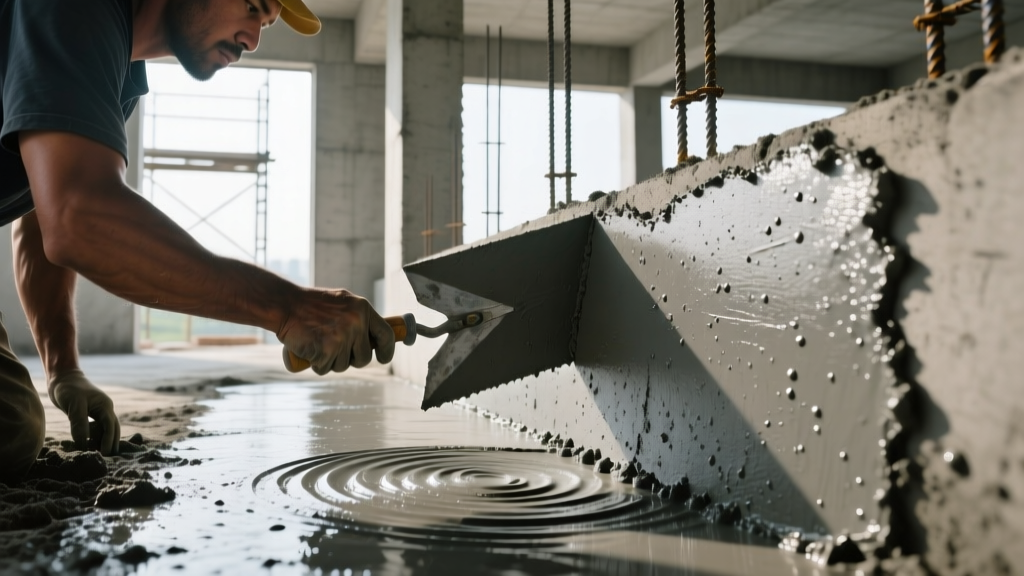
Troubleshooting Common Application Failures
Even with premium materials, environmental and procedural errors can compromise the system. According to technical resources from the Concrete Network, recognizing early failure signs is critical for remediation.
| Failure Mode | Root Cause | Corrective Action |
|---|---|---|
| Delamination / Hollow Sound | Substrate was bone dry; flash-absorption of mix water. | Remove affected area, re-profile, achieve SSD, and reapply. |
| Pinholes and Blistering | Mixing drill speed too high (entrained air); outgassing from concrete. | Grind out pinholes, fill with concentrated slurry paste, and recoat. |
| Craze Cracking | Applied too thick in a single pass; inadequate mist curing. | Apply in multiple thin coats (max 1/16' per coat); implement strict misting. |
2026 Cost and Coverage Metrics
When estimating projects for the current year, contractors must account for both material yield and specialized labor. Bag waterproof material coverage is typically calculated based on a two-coat system.
- Material Yield: A standard 50 lb bag of crystalline waterproofing covers approximately 100 to 125 square feet per coat (200-250 sq ft per two-coat system).
- Material Cost: $1.50 to $3.20 per square foot, depending on whether standard crystalline or high-flex polymer-modified formulations are specified.
- Labor Cost: $2.50 to $4.50 per square foot. Hand troweling complex foundations pushes labor to the higher end, while hopper spraying open plaza decks reduces it.
- Total Installed Cost: Expect to budget between $4.00 and $7.70 per square foot for a fully warranted, professionally applied bag waterproof material system in 2026.
By adhering strictly to CSP profiling, SSD moisture management, and low-shear mixing protocols, contractors can ensure that bag waterproof materials perform to their engineered specifications, providing a permanent defense against hydrostatic pressure and chloride ingress.
Written by
Elena RodriguezElena Rodriguez is a civil engineer and technical writer specializing in concrete technology, masonry systems, and ASTM/ACI compliance. She earned her B.S. in Civil Engineering from Texas A&M University and spent a decade at a materials testing laboratory, performing over 2,000 concrete compressive strength tests and masonry prism evaluations. Elena is an ACI-certified Field Testing Technician (Grade I) and a member of ASTM Committee C12 on Natural Building Stone. She currently consults on forensic engineering cases involving concrete failures and moisture intrusion. Based in San Antonio, TX, Elena is a proud member of the Society of Women Engineers (SWE) and coaches her daughter's FIRST Robotics team.
More from Elena Rodriguez
View all
Walls & Panels
Cost Analysis: Light Gauge Steel Framing Advantages and Disadvantages
Evaluate light gauge steel framing advantages and disadvantages through a strict cost analysis lens, comparing material, labor, and lifecycle expenses.
Aug 4, 2026

Walls & Panels
Gypsum Board Types: Exact Specifications, Thickness & Dimensions
Compare standard, Type X, and moisture-resistant gypsum board types. Get exact specifications, thicknesses, dimensions, and ASTM standards for your project.
Aug 4, 2026

Fire Resistance
Best Fire-Resistant Outdoor Decking Materials: 2026 Buyer Guide
Discover the best fire-resistant outdoor decking materials for 2026. Compare Class A PVC, aluminum, and hardwood options for WUI compliance and safety.
Aug 4, 2026