Ripstop Waterproof Material Guide for Construction Weather Enclosures
Explore ripstop waterproof material specs, PVC vs PE comparisons, and installation protocols for heavy-duty construction weather enclosures.

What Defines a Ripstop Waterproof Material in Construction?
In commercial construction and structural remediation, standard polyethylene sheeting fails under high wind loads and dynamic tension. A true ripstop waterproof material solves this through a specialized weaving technique. During the manufacturing process, high-tenacity reinforcement yarns—typically 500D to 1000D polyester or nylon—are interwoven at regular intervals (usually 5mm to 20mm apart) in a crosshatch pattern. When the base fabric is punctured or torn, the tear propagates only until it hits the thicker reinforcement grid, effectively containing the damage and preserving the enclosure's watertight integrity.
For building envelope protection, scaffolding wraps, and concrete curing, the base fabric is subsequently laminated or coated with waterproof polymers. The two dominant chemical formulations in 2026 are Polyethylene (PE) extrusion coating and Polyvinyl Chloride (PVC) knife coating. Selecting between these two dictates the lifespan, fire rating, and seaming methodology of your weather enclosure.
The tear-stopping capability of ripstop is measured via the tongue tear test (ASTM D5587). A standard 150gsm woven PE might exhibit a tear strength of 30 lbs, whereas a 150gsm ripstop PE with 10x10mm reinforcement grids can exceed 85 lbs of tear resistance, a critical metric for scaffolding wraps subjected to sudden wind gusts.
PE vs. PVC-Coated Polyester Ripstop: Material Matrix
Procurement teams must align the material choice with the project timeline and regulatory environment. Below is a direct comparison of the two primary ripstop waterproof material categories used in modern construction.
| Specification | PE Ripstop (Laminated) | PVC-Coated Polyester Ripstop |
|---|---|---|
| Typical Weight | 120gsm - 250gsm | 450gsm - 900gsm |
| Base Yarn | High-Density Polyethylene (HDPE) | High-Tenacity Polyester |
| Waterproofing Method | Extrusion Lamination (both sides) | Knife-over-roll PVC coating |
| UV Degradation | 6 to 12 months (with UV inhibitors) | 3 to 7 years |
| Fire Retardancy | Rare (CPAI-84 available, costly) | Standard (NFPA 701 / Cal Fire Title 19) |
| Seaming Method | Poly-specific tape or thermal impulse | Hot air welding (450°F - 550°F) |
Critical Applications in Building and Remediation
Ripstop membranes are not general-purpose drop cloths; they are engineered for high-stress, moisture-critical environments.
Scaffolding Enclosures and Wind Load Ratings
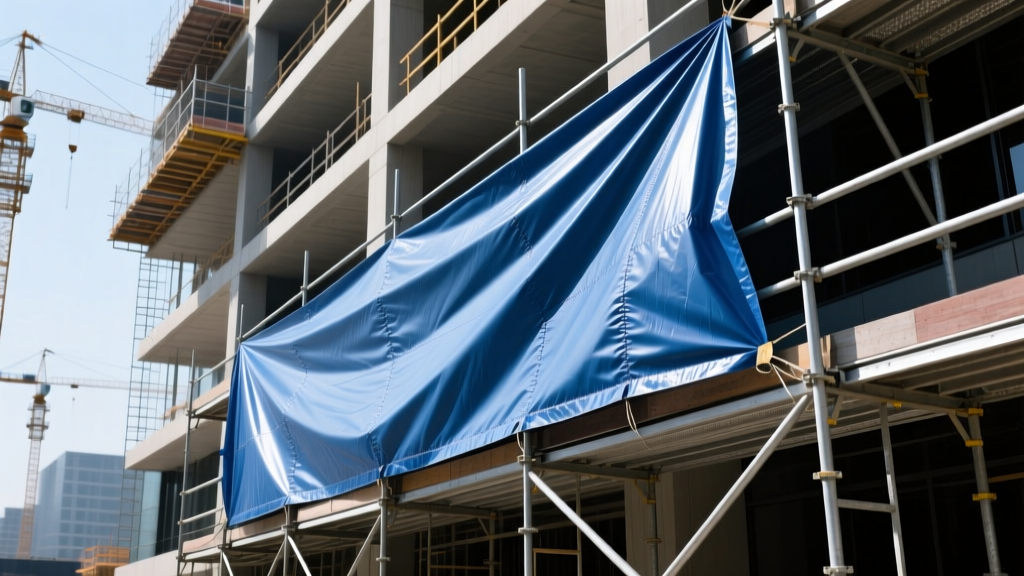
When wrapping scaffolding to protect masonry curing or facade restoration, the enclosure acts as a sail. OSHA scaffolding regulations mandate that weather enclosures must be designed to handle specific wind loads without transferring catastrophic stress to the scaffold ties. PVC-coated ripstop (typically 650gsm) is the industry standard here. The ripstop grid prevents a small grommet tear from unzipping the entire panel during a squall, while the PVC coating ensures driving rain does not penetrate the work zone.
Asbestos and Lead Abatement Containment
Negative air pressure environments require airtight, watertight barriers that will not rupture under vacuum stress. Heavy-duty clear or white PVC ripstop is used to build soft-wall containments. The material's puncture resistance ensures that accidental impacts from scaffolding poles or demolition debris do not compromise the HEPA-filtered negative air seal.
Concrete Curing and Ground Thawing
For flatwork poured in late autumn, retaining moisture and heat is vital for proper hydration. PE ripstop curing blankets trap the exothermic heat of the curing concrete while preventing rain from pooling and diluting the surface paste. The crosshatch weave allows the blanket to be dragged across rough rebar grids without suffering catastrophic tearing.
Installation and Seaming Protocols for Maximum Watertightness
The weakest point in any waterproof enclosure is the seam. Overlapping panels and relying on mechanical fasteners (like zip ties or bungee cords) will result in capillary water ingress. Proper seaming requires chemical or thermal bonding.
Do not use standard duct tape or generic construction tape on PE or PVC ripstop. The plasticizers in PVC will migrate and dissolve standard acrylic adhesives within weeks, while PE's low surface energy repels most glues. Always use material-specific bonding agents.
Step-by-Step PVC Heat Welding
- Preparation: Overlap the PVC ripstop panels by a minimum of 2 inches. Ensure the mating surfaces are completely free of dust, moisture, and silicone release agents.
- Temperature Calibration: Set the hot air wedge welder or handheld heat gun to 480°F (250°C). Ambient temperature and humidity will require slight adjustments; test on a scrap piece first.
- Application: Direct the hot air precisely into the seam overlap. Follow immediately with a silicone pressure roller, applying 40-50 lbs of downward pressure to fuse the plasticized PVC layers.
- Cooling: Allow the seam to cool for 60 seconds before applying tension. The resulting weld will be as strong as the parent material, tested via ASTM D751 hydrostatic pressure standards.
Seaming PE Ripstop
Because PE cannot be easily heat-welded in the field without specialized impulse welders, contractors must use high-tack, poly-specific seam tapes (such as T-Rex Poly Repair Tape or 3M Scotch-Weld polyolefin adhesives). Apply the tape to the interior (dry side) of the enclosure, ensuring a 1.5-inch overlap on both sides of the seam joint.
Cost Analysis and Procurement Specs
Budgeting for temporary enclosures requires looking beyond the initial purchase price to the total cost of ownership, factoring in reuse potential and failure risk. Below is the 2026 procurement baseline for commercial-grade ripstop waterproof materials.
| Material Type | Weight / Spec | Cost per Sq. Ft. (Bulk) | Expected Field Life |
|---|---|---|---|
| Economy PE Ripstop | 120gsm / 8x8 Weave | $0.12 - $0.18 | 1 - 3 Months |
| Heavy-Duty PE Ripstop | 240gsm / 14x14 Weave | $0.25 - $0.35 | 6 - 9 Months |
| Standard PVC Ripstop | 450gsm / 500D Yarn | $0.65 - $0.85 | 2 - 4 Years |
| Architectural PVC Ripstop | 900gsm / 1000D Yarn | $1.10 - $1.60 | 5 - 10 Years |
Maintenance, Tear Repair, and Lifecycle Management
Even with a ripstop weave, extreme mechanical abuse can cause localized damage. Field repairs must be executed immediately to prevent water ingress and maintain negative air pressure in containment zones.
For PVC ripstop, the most reliable field repair method involves cleaning the area with isopropyl alcohol and applying a specialized vinyl cement, such as HH-66. Apply the cement to both the patch and the damaged area, wait 30 seconds for the solvents to flash off, and press firmly. The chemical weld will cure in 24 hours, creating a permanent, waterproof bond that flexes with the material.
For PE ripstop, chemical welding is impossible. Repairs must be mechanical. Use a high-mil, UV-stabilized polyethylene repair tape. For high-tension areas (like grommet pull-outs), apply a patch on both the interior and exterior faces of the fabric, and reinforce the perimeter of the patch with a secondary ring of tape to distribute the load across the ripstop grid.
At the end of the project lifecycle, PVC-coated polyester ripstop cannot be recycled in standard municipal streams due to the mixed polymer and textile composition. However, many specialized textile recyclers accept PVC architectural membranes for downcycling into industrial flooring or truck bed liners, keeping thousands of pounds of synthetic material out of landfills annually.
Written by
Marcus ChenMarcus Chen is a licensed structural engineer (PE) and building materials analyst with over 12 years of experience across residential, commercial, and industrial construction. He holds a Master of Science in Civil Engineering from UC Berkeley and spent six years at Thornton Tomasetti before transitioning to independent consulting and technical writing. Marcus specializes in material selection for seismic-prone regions, concrete reinforcement strategies, and lifecycle cost analysis. His work has been cited by the American Concrete Institute (ACI) and the Structural Engineers Association of California (SEAOC). When he is not on a job site or at his desk, you will find him hiking the Sierra Nevada or restoring a 1920s craftsman bungalow in Oakland, CA.
More from Marcus Chen
View all
Construction Cost
How Much Did the Eiffel Tower Cost to Build?
How much did the Eiffel Tower cost to build in 1889? We adjust for inflation and compare its budget to modern skyscraper construction.
Aug 4, 2026

Fire Resistance
What Is a Fire Resistant Material? Testing & Certification Guide
Discover what is a fire resistant material through ASTM and UL testing. Learn how fire ratings, certifications, and assemblies work in construction.
Aug 4, 2026

Construction Cost
How Much Did the Burj Khalifa Cost to Build?
How much did the Burj Khalifa cost to build? We break down the $1.5B project and extract 5 money-saving strategies for your next build.
Jul 30, 2026