AAC Building Materials Gerber Road Asheville NC: 2026 Supply Review
Compare AAC building materials near Gerber Road, Asheville, NC. Review 2026 supplier options, block vs. panel costs, and Western NC climate performance.

Navigating the South Asheville Supply Corridor
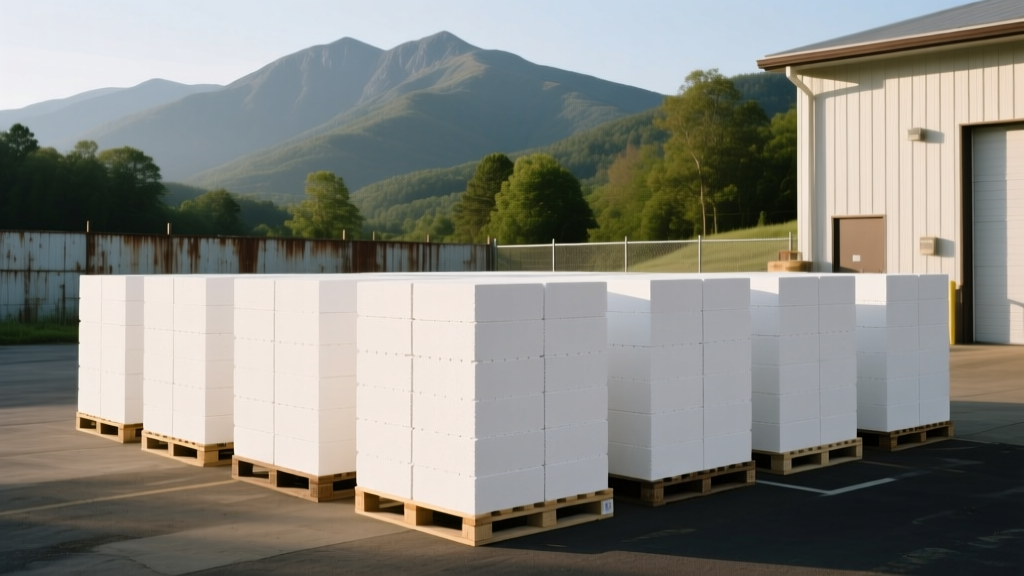
When general contractors and custom home builders search for specialized masonry in Western North Carolina, the query often narrows to a specific industrial hub. Sourcing AAC building materials near Gerber Road in Asheville, NC, requires understanding the localized supply chain for Autoclaved Aerated Concrete. Unlike standard concrete masonry units (CMU) or dimensional lumber, AAC is a specialty product. The Gerber Road corridor and the broader South Asheville / Biltmore Park industrial zones host several key masonry and roofing distributors that serve as the primary logistical nodes for Buncombe County construction projects.
In 2026, the demand for high-performance building envelopes in Asheville has surged, driven by stricter energy codes and a desire for resilient, fire-resistant materials in wildfire-prone foothill zones. However, AAC is not typically stocked on the shelves of big-box retail stores. It requires coordinated freight logistics from regional manufacturing plants in Georgia or Florida. This review breaks down the material comparison, local sourcing realities, and climate-specific installation requirements for Western NC builders.
Material Matrix: AAC Blocks vs. Panels vs. Traditional Alternatives
Choosing the right wall assembly is a critical path decision. Below is a comprehensive comparison of AAC formats against traditional CMU and advanced wood framing, based on 2026 material costs and performance metrics in the Southeast market.
| Material Type | 2026 Material Cost (per sq. ft.) | Nominal R-Value | Thermal Mass Benefit | Installation Speed |
|---|---|---|---|---|
| AAC Blocks (8-inch) | $3.80 - $4.90 | R-10 | High (Delays heat transfer) | Moderate (Requires thin-bed mortar) |
| AAC Panels (8-inch) | $6.50 - $8.80 | R-10 | High | Fast (Crane-set, steel reinforced) |
| Traditional CMU (8-inch) | $2.10 - $2.80 | R-2 (Uninsulated) | Moderate | Slow (Heavy, traditional mortar) |
| 2x6 Wood Framing + OSB | $2.50 - $3.20 | R-21 (with cavity batts) | None | Fast (Standard carpentry) |
Expert Insight: The Effective R-Value Factor
While an 8-inch AAC block tests at a nominal R-10, its true value in Asheville's climate lies in its thermal mass. According to the PNNL Building America Solution Center, the high thermal mass of AAC absorbs heat during the day and releases it at night. In Western NC's mixed-humid climate with high diurnal temperature swings in the shoulder seasons, the effective R-value of AAC can perform equivalently to an R-18 to R-22 lightweight wood-framed wall, significantly reducing HVAC peak loads.
Western NC Climate Zone 4 Performance & Moisture Management
Asheville sits in IECC Climate Zone 4A (Mixed-Humid). This classification dictates strict rules for vapor retarders and exterior cladding. AAC is highly vapor-permeable (roughly 1.0 to 2.0 perms depending on density), which is excellent for allowing interior moisture to dry outward. However, this permeability demands specific exterior finishes.
The Elastomeric Paint Trap
A common failure mode in the Southeast is applying impermeable elastomeric or acrylic stucco coatings directly to AAC. When driving rain (Asheville averages 47 inches annually) penetrates microscopic cladding cracks, the moisture becomes trapped behind the elastomeric barrier, saturating the AAC. Over time, this leads to spalling during winter freeze-thaw cycles.
Never use standard cementitious stucco directly on AAC without a slip plane or uncoupling membrane. The shrinkage rates of traditional stucco and AAC differ, leading to severe cracking. Always specify a polymer-modified base coat with embedded fiberglass mesh, followed by a breathable mineral silicate finish coat.
2026 Sourcing Logistics for Buncombe County
If you are managing a build near the Gerber Road supply district, you will likely be coordinating with regional masonry distributors rather than local retail yards. Here is what you need to know about procurement in 2026:
- Lead Times: Expect 4 to 6 weeks for delivery from Southeast manufacturing hubs (e.g., Hebel or E-Z Block plants in GA/FL). Custom panel lengths can push this to 8 weeks.
- Freight Minimums: Most regional distributors require a minimum order of 1,200 to 1,500 square feet of wall area to justify flatbed freight costs to Buncombe County.
- Crane Access: If utilizing steel-reinforced AAC panels instead of blocks, ensure your Gerber Road or South Asheville site has the overhead clearance and ground stability for a 50-ton boom truck. Mountainous terrain often complicates crane staging.
- Waste Factor: Order an additional 7% for block layouts and up to 10% for complex panel cuts. AAC is easily cut with a standard wood handsaw, but off-cuts are difficult to reintegrate into structural corners.
Installation Nuances: Thin-Bed Mortar vs. Traditional Layup
The structural integrity and thermal performance of an AAC wall rely heavily on the joint system. Traditional CMU uses a 3/8-inch Portland cement mortar joint. AAC requires a proprietary polymer-modified thin-bed mortar applied at exactly 1/16-inch to 1/8-inch thickness.
"Using standard masonry mortar on AAC blocks is a catastrophic error. The traditional mortar is too rigid, too thick, and creates a massive thermal bridge through the wall assembly. Furthermore, standard mortar cures by hydration, but it will dry out too quickly when applied to the highly absorptive AAC surface, resulting in a powdery, failed bond."
— Regional Masonry Foreman, Western NC Custom Builders
Step-by-Step Thin-Bed Application
- Surface Prep: Brush off all AAC dust from the blocks. Do not wet the blocks before laying; AAC thin-bed mortar is designed for dry, porous substrates.
- Mixing: Mix the proprietary thin-bed mortar to a consistency resembling pancake batter. It must flow through the specialized notched trowel without clumping.
- Application: Use a 4mm or 6mm notched trowel specifically designed for AAC. Apply the mortar to the horizontal bed joints and the vertical head joints simultaneously.
- Setting: Tap the block into place with a rubber mallet. The joint should compress to exactly 1/16-inch. Squeeze-out should be minimal and easily scraped off with a putty knife while wet.
Final Verdict for Asheville Builders
For custom residential and light commercial projects in the Asheville area, AAC offers an unmatched combination of fire resistance (4-hour rating for 8-inch blocks), acoustic isolation, and thermal mass. While the upfront material cost is 40% to 60% higher than traditional wood framing or CMU, the elimination of separate exterior sheathing, house wrap, and cavity insulation often balances the total installed cost.
When planning your supply chain, do not rely on standard local lumber yards. Engage directly with specialized masonry distributors servicing the Gerber Road and South Asheville industrial corridors early in the design phase. By aligning your architectural plans with standard AAC panel dimensions and specifying breathable, mineral-based exterior finishes, you can leverage this high-performance material to meet the rigorous demands of Western North Carolina's built environment.
For further reading on wall insulation strategies and thermal mass integration, refer to the U.S. Department of Energy's Guide to Wall Insulation and the EPA Energy Star Climate Zone protocols for Zone 4 compliance.
Written by
Priya KapoorPriya Kapoor is a real estate market analyst and construction economics researcher with expertise in housing affordability, development feasibility, and infrastructure investment. She holds a Master of Regional Planning from Cornell University and previously worked as a senior analyst at CBRE's Investment Properties group, where she modeled returns for $4B in mixed-use development pipelines. Priya now runs an independent research practice advising developers, municipalities, and REITs on construction cost forecasting and market timing. She publishes the quarterly "BuildMat Market Pulse" report tracking material price indices across 12 commodity categories. Based in Austin, TX, Priya serves on the board of Habitat for Humanity Austin and is a marathon runner.
More from Priya Kapoor
View all
Construction Cost
Cost to Build a 1600 Sq Ft Home in 2026: Full Breakdown
Accurate 2026 cost to build a 1600 sq ft home—material, labor, and regional pricing breakdowns included. Plan your budget with real-time estimates.
Aug 11, 2026

Wood & Lumber
Name the Types of Wood for Pressure Treatment and Preservation
Learn how to name the types of wood best suited for pressure treatment. Compare species treatability, chemical retention levels, and 2026 preservation costs.
Aug 4, 2026

Stone & Masonry
Stone Veneer Suppliers Lindenhurst: 2026 Cost Analysis
Analyze 2026 stone veneer costs in Lindenhurst, NY. Compare local supplier pricing, delivery fees, and Suffolk County installation labor rates.
Aug 4, 2026