Building Materials Merchandising Solutions for Pro Dealers in 2026
Explore top building materials merchandising solutions for 2026. Learn how pro dealers use phygital displays and modular showrooms to boost contractor sales.

The Shift from Warehouse to Experiential Showroom
The traditional lumber yard and masonry supply house is undergoing a radical physical transformation. Historically, building material distributors relied on bulk racking and dusty warehouse layouts that prioritized forklift accessibility over product visibility. In 2026, the most profitable pro dealers are deploying advanced building materials merchandising solutions that bridge the gap between high-volume logistics and high-margin experiential retail. According to market analysis from the Home Improvement Research Institute, contractors and serious DIYers are increasingly making material selections based on tactile interaction and visualized performance, driving a 22% increase in average transaction value (ATV) when showrooms integrate interactive merchandising.
Merchandising in this sector is no longer just about endcap planograms for fasteners; it is about creating an environment where a general contractor can confidently upsell a homeowner on premium composite decking or architectural roofing shingles. The integration of heavy-duty display architecture with digital inventory systems defines the current competitive landscape for regional distributors and national chains alike.
Core Merchandising Fixtures Driving Margin Growth
To capture higher margins on finish materials, distributors are moving away from standard gondola shelving and investing in specialized, load-bearing merchandising architecture. The following fixture categories represent the highest ROI for pro dealers this year.
Heavy-Duty Metal Slatwall for Masonry and Veneer
Standard MDF slatwall fails under the weight of stone veneer and brick samples. Modern distributors are installing 16-gauge steel slatwall systems with reinforced aluminum inserts. These systems support up to 85 pounds per linear foot, allowing dealers to mount full-scale, mortar-set display panels of products like Eldorado Stone or Cultured Stone directly in the showroom. By mounting 2-foot by 4-foot sample boards at eye level rather than stacking them on pallets, dealers report a 30% faster conversion rate on premium masonry upsells.
Cascading Roofing and Siding Displays
For exterior cladding, flat sample boards fail to communicate shadow lines and weather resistance. The current industry standard involves cascading, gravity-fed display racks that mimic a 6:12 roof pitch. Brands like GAF and Owens Corning now provide modular cascading merchandisers that allow contractors to pull individual shingle tabs to show the underlying sealant strips and fiberglass matting. These units occupy only 4 square feet of floor space but serve as the primary closing tool for $15,000+ roofing contracts.
Industry Insight: Dealers who transition from pallet-stacked composite decking bundles to elevated, walkable sample decks (minimum 8x8 feet) featuring integrated hidden-fastener cross-sections see a 40% increase in premium tier (e.g., Trex Transcend, TimberTech Landmark) selections over budget-tier PVC options.
Phygital Integration: Bridging the Aisle and the App
The most significant evolution in building materials merchandising solutions is the 'phygital' merge—physical displays augmented by real-time digital inventory and specification data. Pro contractors operating on tight schedules cannot afford to fall in love with a specific window profile or engineered wood siding color only to find it has a 14-week lead time.
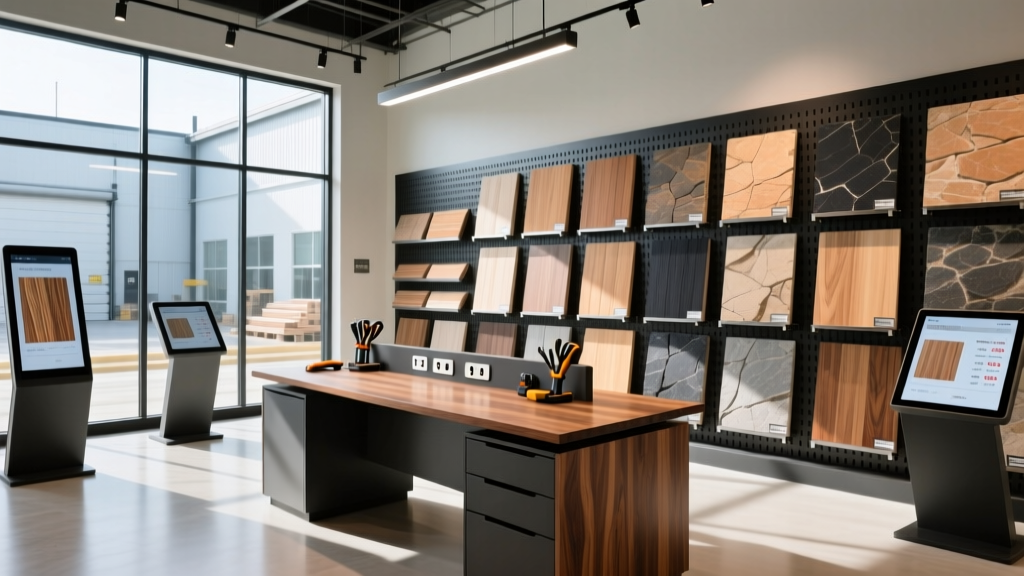
Dealers are installing commercial-grade, ruggedized touch kiosks (such as Elo Touch 24-inch ruggedized displays) directly adjacent to physical sample boards. These kiosks are integrated with the dealer’s ERP system (like Epicor Bison or Prophet 21) to provide live stock levels, yard location maps, and bulk-tier pricing.
| Technology Integration | Average Unit Cost | Primary Application | Estimated ROI Period |
|---|---|---|---|
| Ruggedized Touch Kiosks (24-inch) | $3,200 - $4,500 | Live inventory checks, spec sheet downloads, BOPIS routing | 9 - 12 Months |
| Dynamic QR Code Acrylic Pucks | $12 - $18 per SKU | Linking physical fastener/hardware samples to bulk pallet pricing | Immediate (Under 3 Months) |
| AR Visualization Tablets (Showroom) | $1,100 - $1,500 (iPad Pro + Rugged Case) | Overlaying siding/roofing colors onto uploaded house photos | 6 - 8 Months |
Zoning Strategies: The Pro Desk vs. The Retail Aisle
Effective merchandising requires acknowledging the distinct psychological and operational needs of the 6:00 AM commercial contractor versus the Saturday morning retail remodeler. Top-performing yards utilize strict zoning strategies to prevent workflow collisions.
- The Pro Zone (High-Velocity/Low-Friction): Located immediately adjacent to the drive-through loading bays. Merchandising here focuses on high-turnover consumables: structural fasteners (Simpson Strong-Tie, GRK), adhesives, house wrap, and PEX fittings. Displays are open, pallet-level, and designed for grab-and-go speed. Signage emphasizes bulk-tier pricing and SKU barcodes for rapid scanning.
- The Design Center (High-Margin/High-Touch): Located deeper in the facility, requiring the customer to walk past the Pro Zone. This area features the heavy-duty slatwalls, cascading roof displays, and digital kiosks mentioned above. Lighting is upgraded to 4000K-5000K LED to ensure accurate color rendering for paints, stains, and composite materials. This zone is staffed by specialized sales reps trained in architectural specifications and building code compliance.
Capital Expenditure and Space Optimization
Implementing comprehensive building materials merchandising solutions requires careful capital allocation. A full showroom overhaul for a standard 5,000-square-foot retail footprint attached to a lumber yard typically ranges from $45,000 to $85,000. However, distributors do not need to execute this all at once. Data published by ProSales Magazine indicates that phased rollouts—starting with the highest-margin categories like decking, windows, and masonry—generate the cash flow required to fund subsequent phases.
Space optimization is critical. Utilizing vertical airspace with suspended acoustic ceiling banners that highlight seasonal promotions (e.g., 'Spring Decking Prep' or 'Winterization Insulation') draws the eye upward and maximizes the cubic volume of the showroom. Furthermore, replacing bulky, static wooden display tables with modular, caster-mounted gondola units allows managers to reconfigure the floor plan in under an hour to accommodate seasonal shifts or manufacturer-sponsored training events.
90-Day Implementation Framework for Distributors
For dealers looking to modernize their physical spaces, a structured rollout minimizes operational disruption. The National Lumber and Building Material Dealers Association frequently highlights the necessity of aligning merchandising updates with supplier co-op marketing funds.
Phase 1: Audit and Vendor Alignment (Days 1-30)
Conduct a SKU velocity analysis to identify the top 20% of finish materials generating 80% of your margin. Contact key vendor representatives (e.g., Trex, James Hardie, GAF) to request updated modular display units. Many manufacturers will subsidize or provide these fixtures for free if the dealer commits to a minimum annual purchase volume or grants premium floor space.
Phase 2: Infrastructure and Lighting (Days 31-60)
Upgrade showroom lighting to high-CRI (Color Rendering Index > 90) LED track systems. Poor lighting negates the value of premium sample boards by distorting wood grain and paint undertones. Install the heavy-duty steel slatwall infrastructure on primary focal walls, ensuring studs are reinforced to handle the 85+ lb/ft load requirements of masonry samples.
Phase 3: Digital Integration and Staff Training (Days 61-90)
Deploy the ruggedized ERP-connected kiosks. The hardware is useless without adoption; conduct mandatory training sessions for counter staff on how to use the kiosks to pull up alternative SKUs when a primary product is out of stock. Train staff to use the physical samples as tactile anchors while using the digital screens to close the sale on bulk quantities.
By treating the showroom not as a storage overflow area, but as a highly engineered sales environment, pro dealers can successfully defend their margins against big-box competitors and pure-play e-commerce distributors. The physical weight, texture, and scale of building materials remain their greatest sales advantage, provided the merchandising infrastructure is built to showcase them properly.
Written by
David NakamuraDavid Nakamura is a licensed architect (AIA) and construction technology writer focused on sustainable building methods, mass timber engineering, and high-performance building envelopes. He holds a Master of Architecture from the University of Washington and is a certified Passive House Consultant (CPHC). David spent eight years at the Seattle firm Mithun, where he led the design of three LEED Platinum projects, before founding his own practice specializing in net-zero residential design. He serves on the editorial advisory board of GreenBuilder Magazine and has authored peer-reviewed papers on cross-laminated timber (CLT) connections for the Journal of Structural Engineering. In his spare time, David teaches woodworking at Pratt Fine Arts Center and kayaks the Puget Sound.
More from David Nakamura
View all
Construction Cost
Labor Cost to Build a Deck Per Sq Ft: 2026 Installation Guide
Discover the exact labor cost to build a deck per sq ft in 2026. This installation guide breaks down contractor rates, complexity factors, and hidden fees.
Aug 4, 2026

Construction Cost
How Much Does It Cost to Build a 3 Bedroom House? Financing Guide
Learn exactly how much it costs to build a 3 bedroom house and explore 2026 financing options, construction loan types, and budget frameworks for your build.
Aug 4, 2026

Construction Cost
Cost to Build a Tennis Court: 2026 Guide
How much does it cost to build a tennis court in 2026? Breakdowns for asphalt, concrete, and synthetic surfaces plus fencing and lighting.
Jul 30, 2026