Comprehensive List of Building Materials: 2026 Comparison
Compare our detailed list of building materials for 2026. Analyze costs, R-values, and lifespans for framing, cladding, and insulation.
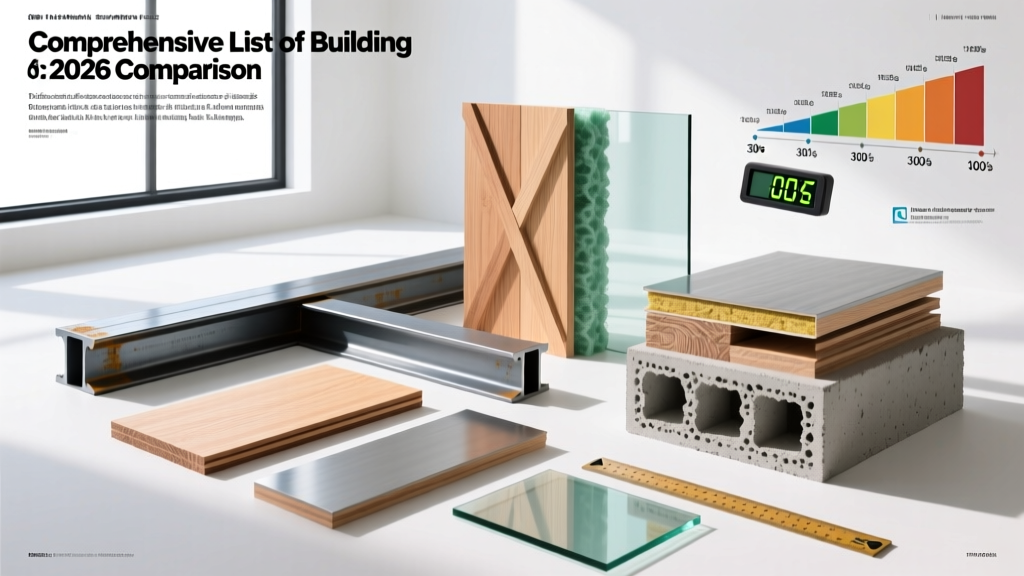
The 2026 Material Selection Matrix: Beyond the Basics
When architects and general contractors compile a definitive list of building materials for high-performance commercial and residential envelopes in 2026, the evaluation criteria have fundamentally shifted. Capital cost per square foot is no longer the sole deciding factor. Today's specification process requires a tri-axial evaluation: initial capital expenditure, embodied carbon (Lifecycle stages A1-A3), and 50-year maintenance liabilities.
The 2026 Specification Framework
Before selecting materials from any list of building materials, run your project parameters through this decision matrix:
- Zone 1 (High Moisture/Seismic): Prioritize cold-formed steel (CFS) and sintered stone cladding.
- Zone 2 (Carbon-Constrained/Urban): Prioritize mass timber (CLT) and bio-based insulations.
- Zone 3 (Budget-Optimized/Suburban): Prioritize engineered wood framing and fiber cement exteriors.
Structural Framing: Engineered Wood vs. Cold-Formed Steel
The backbone of any construction project dictates the speed of the dry-in phase and the long-term structural resilience. In 2026, the battle for mid-rise and advanced residential framing is primarily between Laminated Veneer Lumber (LVL) and Cold-Formed Steel (CFS).
| Material Type | Specific Product | 2026 Avg. Cost (per LF) | Max Span / Limit | Fire Rating (Unprotected) |
|---|---|---|---|---|
| LVL Joist (1-3/4" x 11-7/8") | LP SolidStart | $4.15 - $4.60 | 24 ft (Residential) | 20-minute (Heavy Char) |
| CFS Stud (20-ga, 3-5/8") | ClarkDietrich ProSTUD | $2.10 - $2.45 | 14 ft (Axial Load) | Non-combustible |
| CLT Panel (5-ply, 6-7/8") | SmartLam CLT | $18.50 - $22.00 / sq ft | 30 ft (Floor/Ceiling) | 2-hour (Inherent) |
According to APA - The Engineered Wood Association, LVL continues to dominate floor systems due to its superior acoustic dampening and stiffness (EI values exceeding 2.2E). However, for exterior shear walls in hurricane-prone regions, 20-gauge CFS provides a non-combustible, termite-proof alternative that eliminates the risk of moisture-induced rot during extended construction delays.
Exterior Cladding: Sintered Stone vs. Fiber Cement vs. Engineered Wood
The exterior envelope represents the highest visual impact and the greatest exposure to weathering. The modern list of building materials for cladding has moved beyond basic vinyl and traditional stucco, focusing on high-density, low-porosity options.
Sintered Stone (e.g., Dekton, Neolith)
Manufactured via TSP (Sinterized Particle Technology), sintered stone mimics metamorphic changes in stone but compresses the timeline into hours. For 2026 ventilated facade applications, 6mm to 12mm panels are anchored to aluminum subframes.
- Installed Cost: $48.00 - $65.00 per sq. ft.
- Water Absorption: < 0.05% (Virtually impermeable)
- Gotcha: Requires specialized diamond-tipped CNC tooling for field cuts; standard masonry saws will chip the edges and void the warranty.
Fiber Cement (e.g., James Hardie Artisan Collection)
Fiber cement remains the workhorse for premium residential builds. The Artisan collection offers a 15/16-inch thickness, allowing for deep, shadow-line profiles that mimic old-growth cedar.
- Installed Cost: $13.50 - $16.00 per sq. ft.
- Maintenance: Requires repainting every 12-15 years in high-UV zones.
- Gotcha: Blind-nailing is strictly prohibited for the Artisan line; installers must use color-matched stainless steel face screws and maintain a strict 1/8-inch gap at all end joints for thermal expansion.
Engineered Wood (e.g., LP SmartSide ExpertFinish)
Treated with zinc borate to resist termites and fungal decay, engineered wood strand technology offers the warmest aesthetic at the lowest price point.
- Installed Cost: $8.50 - $11.00 per sq. ft.
- Warranty: 50-year limited substrate warranty, 15-year finish warranty.
- Gotcha: All field cuts must be immediately sealed with a zinc-borate-compatible primer. Failure to seal end cuts within 48 hours leads to localized delamination within 3 to 5 years in humid climates.
Thermal Envelope: Next-Gen Insulation Materials
With the adoption of stricter energy codes, the list of building materials for thermal control now heavily features advanced aerogels and vacuum technologies alongside traditional foams. The U.S. Department of Energy's Building Technologies Office continues to highlight the necessity of continuous exterior insulation (ci) to eliminate thermal bridging.
Aerogel Blankets (Spaceloft)
R-Value: 10.3 per inch
Cost: $12.50 / board ft
Best Use: Historical masonry retrofits where interior space loss is unacceptable and vapor permeability must be maintained.
Closed-Cell Spray Foam (ProSeal)
R-Value: 6.8 per inch
Cost: $2.85 / board ft
Best Use: Complex roof geometries and cathedral ceilings requiring simultaneous air, vapor, and thermal barriers.
Vacuum Insulation Panels (VIP)
R-Value: 25.0 to 30.0 per inch
Cost: $18.00 / board ft
Best Use: Ultra-thin commercial curtain wall spandrels. Panels cannot be field-cut without destroying the vacuum core.
Lifecycle Cost & Carbon Footprint Breakdown
Selecting materials strictly on day-one costs ignores the financial reality of building ownership. The table below models a 2,500 sq. ft. exterior envelope over a 50-year lifecycle, factoring in maintenance, replacement, and embodied carbon equivalents.
| Cladding Material | Initial Install | 50-Yr Maintenance | Expected Lifespan | Embodied Carbon (kgCO2e/m2) |
|---|---|---|---|---|
| Engineered Wood | $24,375 | $18,500 (Paint/Repair) | 40-50 Years | 18.5 |
| Fiber Cement | $36,875 | $12,000 (Repaint) | 50+ Years | 34.2 |
| Sintered Stone | $142,500 | $2,500 (Cleaning/Sealant) | 75+ Years | 42.8 |
Expert Insight: While sintered stone carries the highest embodied carbon due to the extreme heat required for sinterization, its near-zero maintenance and 75-year lifespan result in the lowest lifecycle carbon intensity per year of service. For projects targeting LEED v5 or Living Building Challenge certifications, the operational energy savings from a perfectly continuous ventilated rain screen often offset the A1-A3 carbon penalty by year 18.
Technical FAQs for Material Specification
How do vapor permeability ratings affect cladding choices?
When pairing cladding with continuous exterior insulation, the vapor permeability (perms) must align with the climate zone. Fiber cement is highly vapor-permeable (approx. 10-15 perms), allowing outward drying. Sintered stone is completely impermeable. If using sintered stone on a ventilated rain screen, the air gap (minimum 3/4 inch) is mandatory to manage bulk water and allow convective drying of the water-resistive barrier (WRB) behind the panels.
What are the acoustic STC differences between LVL and CFS framing?
Cold-formed steel framing naturally transmits more low-frequency sound due to its rigidity and thin profile. A standard 20-gauge CFS wall with 3-inch mineral wool and dual-layer 5/8-inch Type X gypsum achieves an STC of 52. An identical assembly using 2x6 LVL or solid wood studs typically achieves an STC of 46 to 48 because wood's cellular structure transmits impact noise differently. To achieve STC 55+ with CFS, resilient channels and acoustic isolation clips must be specified.
Are there supply chain constraints for Aerogel insulation in 2026?
Aerogel blankets remain a specialty, made-to-order material. Lead times for large commercial orders (Spaceloft or Pyrogel) typically run 8 to 12 weeks. It is rarely stocked at standard commercial lumberyards. Contractors must integrate these lead times into the critical path schedule, ensuring the aerogel is on-site before the exterior sheathing inspection phase to prevent envelope dry-in delays.
For further data on construction economics and material pricing trends, refer to the National Association of Home Builders (NAHB) Economics division, which tracks quarterly fluctuations in commodity indexes for lumber, steel, and cementitious products.
Written by
James ThorntonJames Thornton is a construction industry veteran with 25 years of hands-on experience in wood framing, lumber grading, and residential building codes. He started as a framing carpenter in rural Oregon, earned his ICC Residential Building Inspector certification, and eventually became a senior plan reviewer for the City of Portland Bureau of Development Services. James holds a B.S. in Wood Science & Technology from Oregon State University and is a certified lumber grader through the West Coast Lumber Inspection Bureau (WCLIB). He has inspected over 3,000 residential construction sites and authored the city's internal guide on advanced framing techniques (2x6 at 24" O.C.). James lives in Bend, OR, where he builds custom timber-frame cabins and competes in lumberjack sports.
More from James Thornton
View all
Insulation
Best Home Insulation Materials: Complete 2026 Guide
Compare top home insulation materials for 2026. Find R-values, installed costs per square foot, and best uses for fiberglass, spray foam, and mineral wool.
Aug 4, 2026

Sustainable Building
Certify Your Green Building Material for LEED and WELL
Step-by-step guide to certifying a green building material for LEED v5 and WELL v2. Master EPDs, HPDs, and VOC limits for 2026 project specifications.
Aug 4, 2026

Stone & Masonry
Veneer Stacked Stone Panels: Interior Design & Style Showcase
Discover how veneer stacked stone panels transform interiors. Explore modern design profiles, material pairings, and technical installation specs.
Aug 4, 2026